

Ever needed a few math games to have at the ready for your students who finish a (what you thought was challenging) task quickly, or are ready for a greater challenge? Below are some of my favorite web based math games that middle school students are able to play in my classroom. Each of them is linked on a page I include on my classroom management web site (Canvas) and students know that if they finish all of the agenda items for the day that they are free to access them on their Chromebooks.
Note: You may need to get these approved through your district’s web filter to make sure students have access to them.
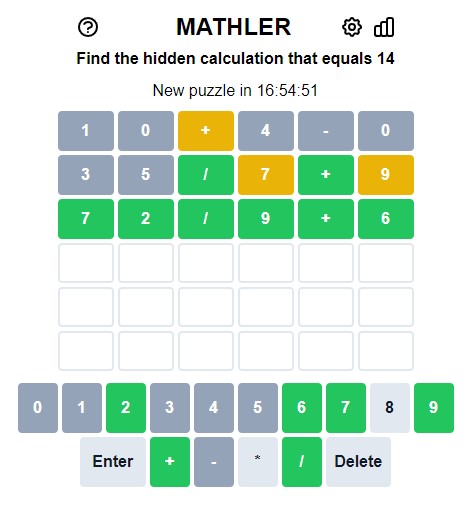
It’s basically math Wordle. Using the same yellow/green block structure as the highly popular Wordle, students have 6 attempts to create a mathematical expression that equals the target number.
Pros
- Encourages flexible thinking about numbers and order of operations.
- Low entry floor using only 4 basic operators and single digit values.
- 4 levels of difficulty ranging from Easy to Killer.
Cons
- Each level of difficulty gives only one puzzle per day.
- Like Wordle, the daily puzzle is the same for all players, so if one students solves it, they can share the answer to everyone, stealing the fun.
This game is all about addition. All you have to do is get each row to add up to the number on the far right and each column to add up to the number at the bottom. You achieve this by removing certain numbers from the square grid. That’s it.
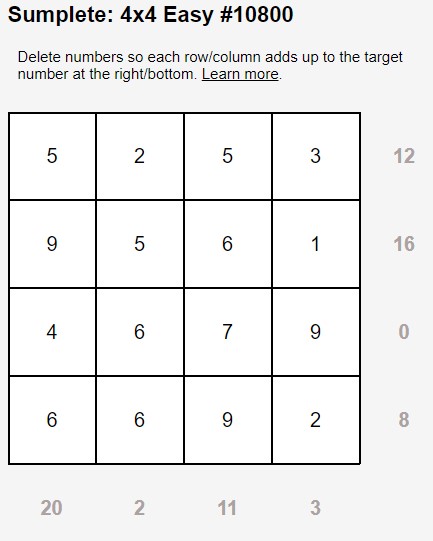
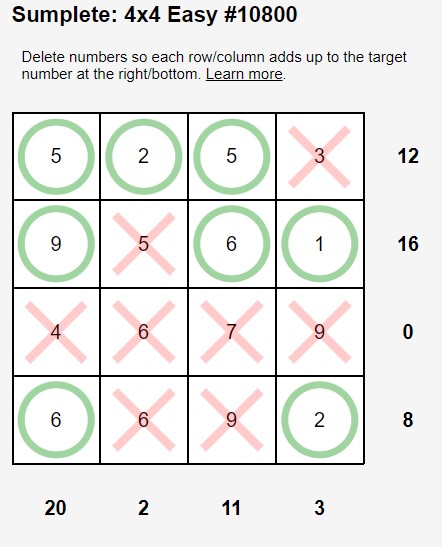
Once you have made all of the rows add up to their target number and all of the columns add up, you win. Pretty simple, right?
Pros
- Grid sizes range from 3×3 to 9×9 and sizes above 6×6 have different levels of difficulty.
- There is no daily limit, so you can play as many times as you want.
- 3×3 grids have a very low entry floor, so even the most math fragile students have a solid place to start and feel success.
Cons
- I honestly can’t think of any. It’s a simple game to learn with a lot of differentiation.
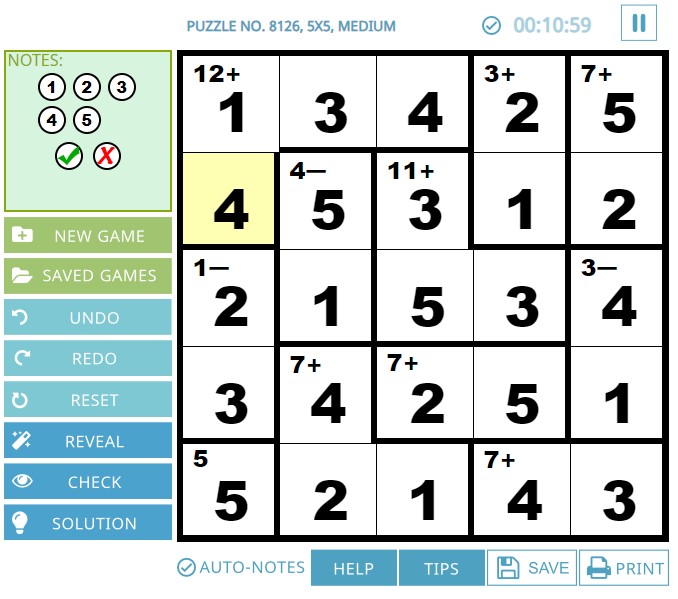
It’s like sudoku, but with more math. Players are given a grid (3×3 all the way up to 9×9) that contains bold line sections that have an operation and a target number. Just like Sudoku, the integers 1 through ? (depends on the grid size you are playing on) must be in each row and in each column.
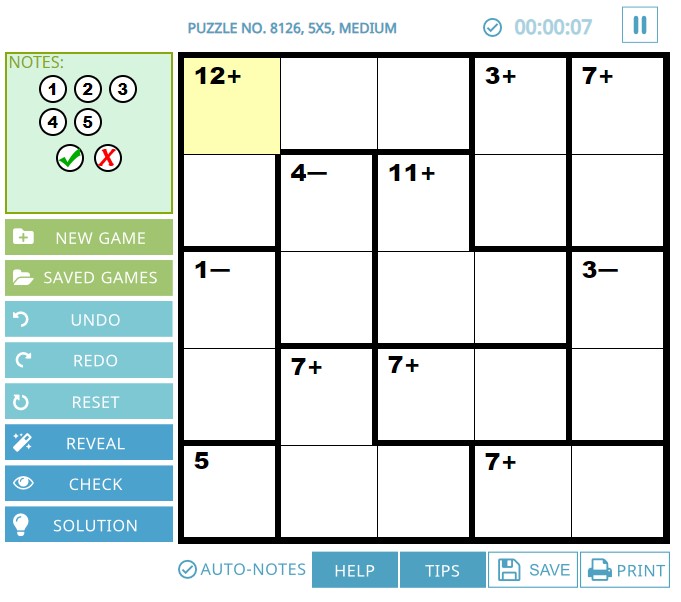
In the example above, the bold rectangle in the upper right labeled “7+” must have two numbers in it that add up to 7. This could be 3 and 4, or it could be 5 and 2. The section below that labeled “3-” must have two numbers that subtract to get 3. This could be 5 and 2 or 4 and 1. Since they are both in the same column, whatever numbers you use for 7+ cannot also be used for 3-. The best space in the given puzzle is the lower left box, since the only thing it can be is a 5.
Let the logic battle commence!
Pros
- More mathematical thinking than a regular Sudoku game.
- Wide range of puzzle size and difficulty levels.
Cons
- The game can be a bit difficult to learn at first, especially if you have never played Sudoku.
- The site has many, many advertisements and animated banners.
- Users must watch an advertisement before seeing the solution.
This game provides you with a target number along with 5 other numbers and the normal 4 operations. All you have to do is use two or more numbers (depending on the difficulty level) and any of the operations to create an expression that equals the target number.
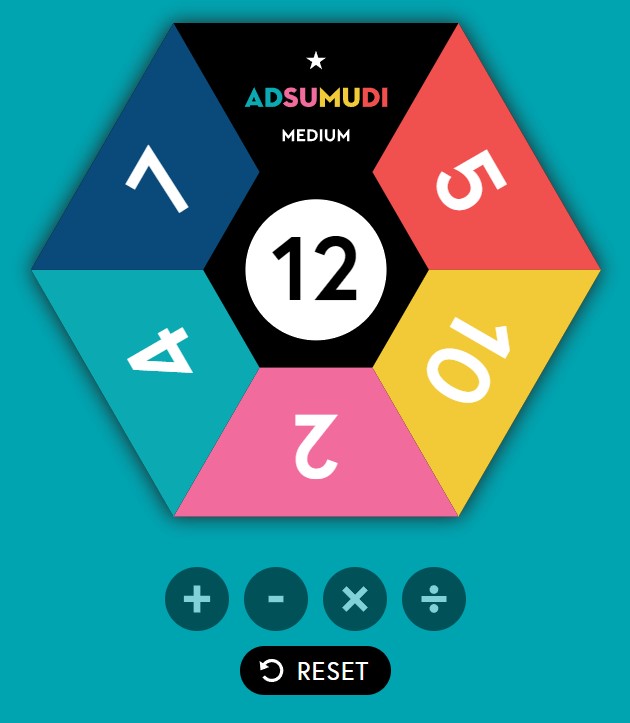
In the example above, the difficulty is set to Medium, so I must use at least three of the given numbers to create an expression that equals 12. In this case I might do the following:
(7+4)+(10/5/2)
Pros
- Varying levels of difficulty.
- Great colorful interface.
- Simple to learn.
Cons
- Web site is created by the people who make the actual board game, so there are a lot of offers for “10% off” and such.
- Not that challenging, even at the highest difficulty
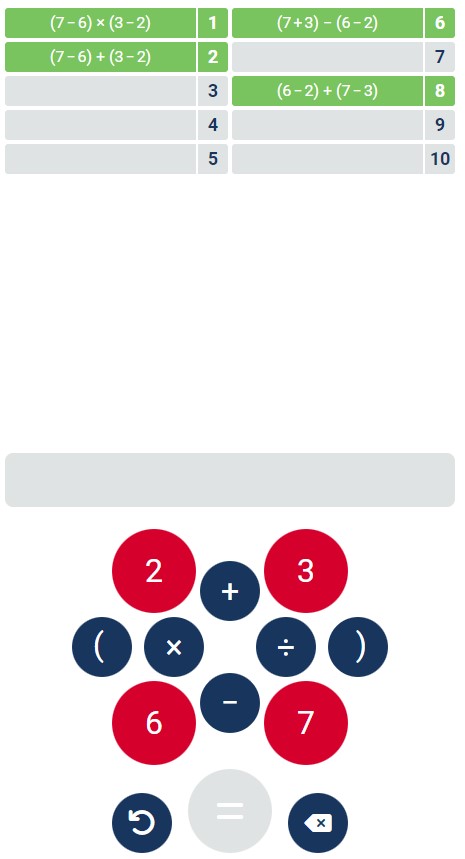
All-Ten is a daily order of operations game in which you are given four numbers, the four operations, and parentheses and you must create ten different expressions to make the digits 1 through 10.
Pros
- Creates opportunities for flexible thinking.
- Simple instructions, but challenging to finish.
Cons
- User interface isn’t the best.
- Only one puzzle given per day, similar to Mathler.
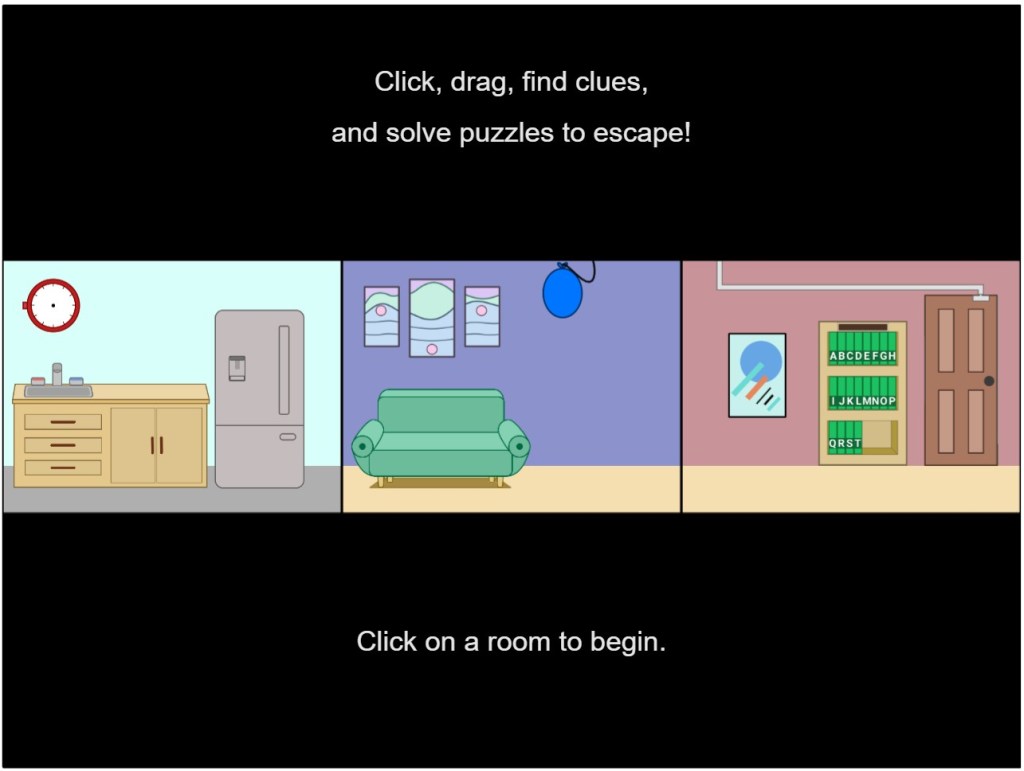
Created by Sean Sweeney, Desmos Escape 1 is a very challenging virtual escape room that gives no instructions and and no help. The room has three screens that you can move between, and interacting with different items in various ways create new things to do. Hard to describe, very hard to complete.
You will need a Desmos teacher account to be able to assign this activity to your students.
Sean created a second escape room, which you can find here.
Pros
- A very challenging task.
Cons
- Easy for students to get frustrated quickly.
- Does not provide any help or hints.
- Not really re-playable.
I’m always looking for more to add to my list. If you have other suggestions, comment below. Ideally, these are games that are free, do not require some kind of account, and are repeatable.
 EZMath Blog