
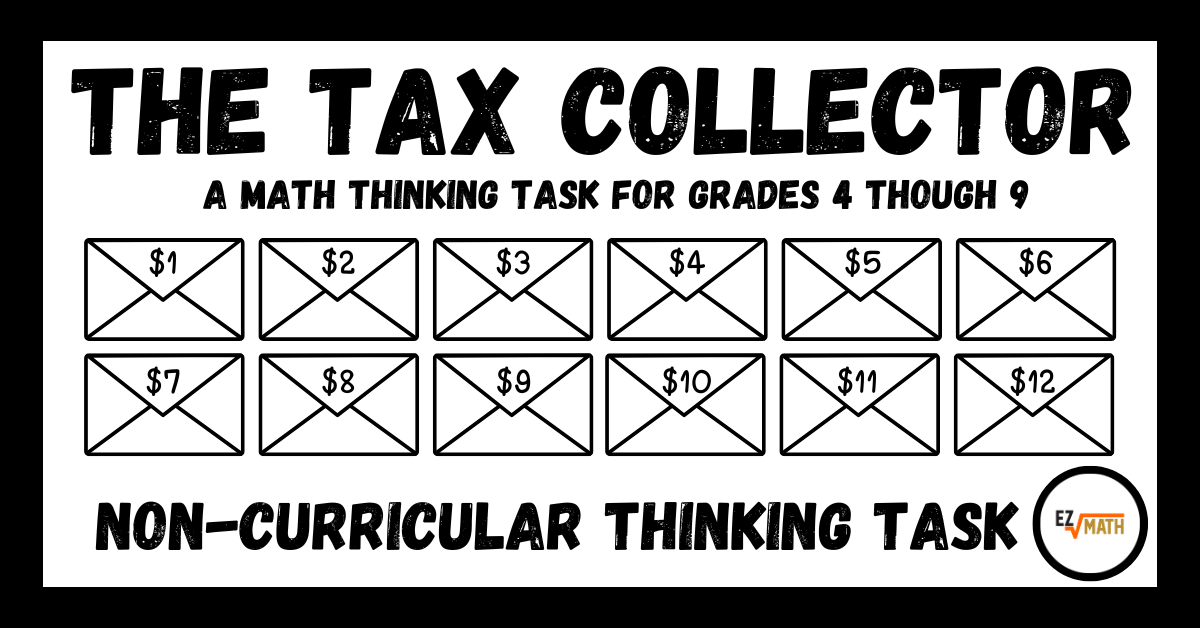
The Tax Collector is a great Non-Curricular Thinking Task that challenges students to get the most amount of money possible, while thinking about composite numbers, prime numbers, and factors.
I first encountered this problem when I attended a summer workshop in my district for teachers interested in implemented Building Thinking Classrooms into their math classes. I had just read the book, and was super excited to join. The leader of the workshop (the amazing Kristy Donovan), had all of us attempt The Tax Collector as a way to model a BTC lesson at the vertical whiteboards.
After using the problem myself in the beginning of the school year the last few years, I can guarantee that your students will dig into this task and be engaged the entire time. I love the math discussion that takes place in each group, and it’s a good way to remind students about some basic math vocabulary.
The Directions
This task first appeared in the New York Times (as far as I know) back in 2015. (here’s the link to the original article I came across). The basic setup is this:
You have 12 envelopes, each with a paycheck in it starting at $1, and going up to $12 (very realistic paycheck sizes, I know). To pay your taxes, you must play the Tax Collector in a game. You begin the game by choosing any paycheck you like, which you get to keep. Once you choose, the Tax Collector automaticcaly takes any paycheck that is a factor of the paycheck that you chose? So, if you start by taking the $12 envelope, then the Tax Collector gets the $1, $2, $3, $4, and $6 envelope, since they are all factors of 12. You then choose again.
The only other main rule is that any time you choose a paycheck, the Tax Collector MUST get to take something. In this example, you would not be able to choose the $11 envelope, since the only factor of 11 is 1, and that envelope is already gone.
The goal of the game is to get more money than the Tax Collector, and also to try and maximize the amount of money you end up with.
The Setup
This task takes almost no lesson prep at all, if you desire. All students really need is a pencil and blank paper, or a whiteboard marker and a surface to write on. You can tell the students all of the rules, and they can work on this individually, in pairs, or random teams of 3.
I like to make it a bit harder though. Instead of explicitly telling them the rules, I like to make up a bit of a story, choosing one of my students to be a fictional business owner in a weird town where taxes are not assessed by percentages, but rather by a battle of wits with the town Tax Collector. I draw 12 envelopes on the board, and tell the class that they can choose any envelope they want, but based on what they pick, the Tax Collector will take something, and it isn’t random. They almost always choose 12, and then I cross out the 6, 4, 3, 2, and 1, without explaining why. They choose again, and usually try to take 11. I say, “Oh sorry, you can’t have that one, because the Tax Collector wouldn’t get anything. Choose again”. They then take 10, because it’s the highest one left, and I cross out the 5. Before they choose again, I explain that with the remaining envelopes there is nothing else they can take, so the Tax Collector gets everything left and they end up with a whopping $22.
At this point many of the students have figured out the rules, but some have not. I challenge them to do better than they did in round 1, and then to try and get the most amount of money possible after that. At this point they are either confused or intrigued, so I tell them to talk with others in the class to see if they can figure out the rules of the game, then start playing.
Possible Extensions
Some students/groups will finish this task quite quickly, which is great! If so, I always have some extension tasks for them. The first one is to change the number of envelopes from 12 to 18. After they explain their strategy for 12 envelopes, I ask them to apply their strategy to the new amount of envelopes to see if it still works. The next extension after that is 24 envelopes. This is usually as far as students get in a 51 minute class period.
Every once in a while I get a team that really blows through this task, so I change the task on them. If they figure out the maximum money for 12, 18, and 24 envelopes, I ask them to try and come up with a pattern or mathematical rule for the maximum amount of money possible given N number of envelopes. An alternate to this is for them to figure out how many envelopes can be obtained depending on the starting number of envelopes (assuming they always start at $1 and increase by consecutive whole number amounts). This is a very different type of problem, and really throws them for a loop. It’s awesome.
Have Fun!
I hope you try this task in your classroom, and that your students have as much fun with it as mine have!
Here’s a link to a simple Google Doc I created with the task on it that you can use, or save in your Drive for later.
Here’s a link to some of my other favorite Thinking Tasks I have done in my own classroom the past few years.
To learn more about Building Thinking Classrooms, go here!
 EZMath Blog