
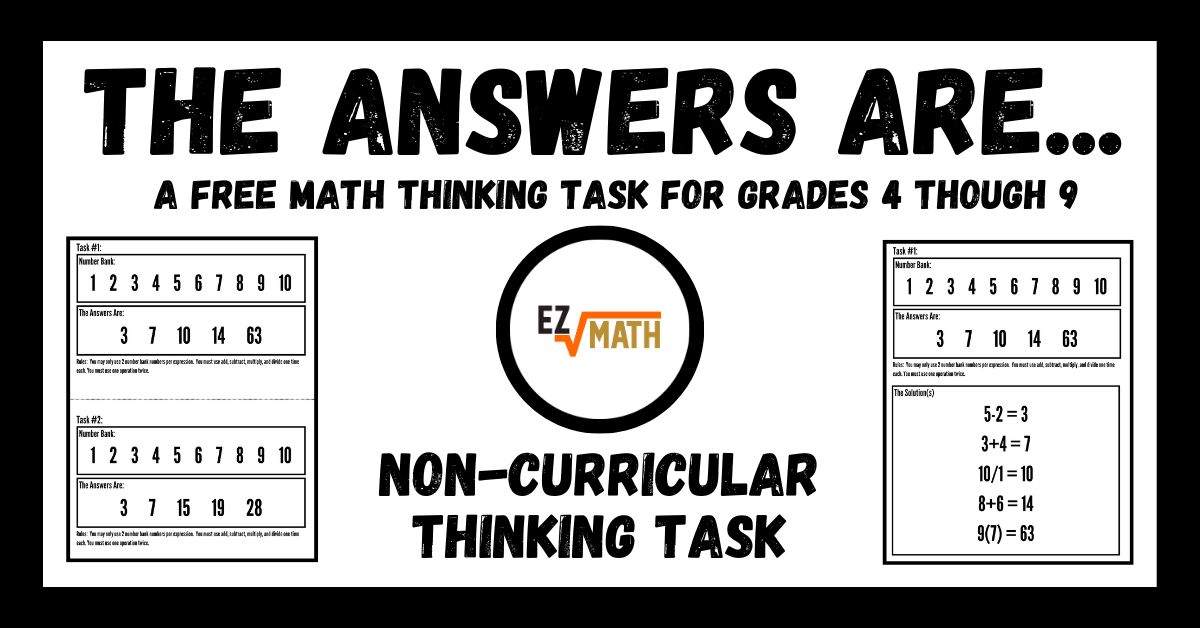
A great first week of school math activity for grades 4 though 9 (or beyond).
Whether you are looking for a good activity to get your mathematicians working together in the first weeks of school, or you need a quick 5-minute filler activity at the end of a class period, The Answers Are… is a great go-to math task for your students.
I first learned about this task in Peter Liljedahl’s book Building Thinking Classrooms a few years back. To be honest, when I first read the task (on page 169) I didn’t fully understand the directions, so I was reluctant to try it out. Once I finally realized what to do, and tried it with my students, it became a class favorite. Here’s how the task works:
The Directions
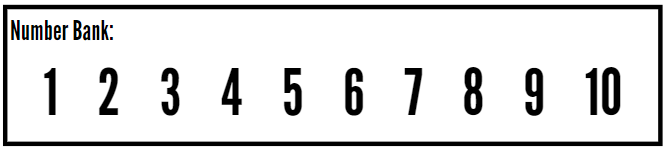
Give the students a pre-selected number bank of 10 numbers to start with. This could be any set of numbers, including integers, rationals, etc. The easiest set to begin with is the whole numbers 1-10, as seen below:
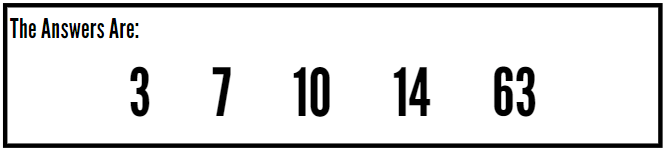
Next, give the students the answers to 5 math problems, or expressions, such as:
Now the students know what numbers they can use from the number bank, and what answers they must get from the answer bank. Here’s where the thinking comes in. The rules of the task are:
- Each answer must be created from two numbers from the number bank and one mathematical operation.
- Once you use a number from the number bank, it cannot be used again.
- You must use each of the four basic operations once (add, subtract, multiply, divide).
- You may use one operation more than once.
- You must use all 10 numbers in the number bank.
For example, to get an answer of 3, they could do 2+1, 3(1), 6/2, or even 10-7. There are a lot of options. They are all equal to 3, but aren’t necessarily what they want to use. The strategy here is that the only way to get an answer of 63 is to multiply 9 and 7, therefore they would not want to use 10-7 to get the answer of 3, since that would use up the 7. Once they use a 7 to get 63, they can’t use 7(2) to get 14, so they probably need to use some kind of addition to get the number 14, and so on. It’s a great mix of logical thinking and math fact strategy.
That’s pretty much it. Use all 10 numbers to create the 5 given answers. Can you solve the example I gave above? Click here if you want the solution!
The Setup
I have done this task multiple ways in class, depending on the needs of the day. I created a set of Task Cards for my students to use in random groups of 3 at the vertical whiteboard Thinking Stations during the first week of school while doing Non-Curricular Thinking Tasks. This is a great way to get students working together and talking about math. The directions are very simple, and if you use whole numbers like I showed above, every student has good access to the task, since the floor is quite low.
I really like creating and printing task cards, cut as half sheets of paper, so the groups can go at their own pace. You can have groups check their answer with you, or have them prove their answer is correct, then erase their board and get the next set of numbers. They can also leave up their answers to help groups that might be stuck. Peter Liljedahl calls this “Knowledge Mobility”. It has it’s pro and cons.
Sometimes I have a few minutes left in class and I just want to keep the kids thinking until the bell rings. I like to have a set ready to go that I can just write down on the board. Since I have whiteboard tables, the students can try to figure it out at their seats, or go to a Thinking Station of their choice and work on it vertically.
In a real pinch I just give them the 1 through 10 number bank and just make up 5 answers on the spot. Not ideal, but it works.
Get Started!
So what do you need in order to do The Answers Are…?
In the most basic sense, pencil and paper. You can write the number bank and answers on the class whiteboard, and students can work on it using just pencil and paper. If you have vertical whiteboards, then dry erase markers and erasers are needed.
If you would like a quick template you can use to create your own Task Cards, here is a link to a simple Canva Template I created.
If you would like the full set of 10 Whole Number Task Cards that I created to use as a Non-Curricular Thinking Task during the first week of school, here is the link to the FREE set that you can print and use in your own classroom.
Have fun with The Answers Are… Get those students thinking!
Go here if you’d like to see all of the Non-Curricular Thinking Tasks I have used in my class.
If you would like to know more about how I am building my own Thinking Classroom, go here.
The see some of the Thin Slicing lessons I have created for my students, go here.
 EZMath Blog