6 Millimeters

While my students always enjoyed trying to use the height chart, and figured that Fabric Corey was there because I loved decorating my classroom with Anaheim Ducks merchandise, he actually served another purpose entirely.

For over a decade the first thing students saw when they walked up to my classroom was Anaheim Ducks forward Corey Perry. Not the real Corey Perry, of course, but a rectangular fabric door decoration that also doubled as a height chart. It was a gift given to me by a former student who found it amongst the various knick-knacks contained in her Wild Wingers Kids Club kit. She thought I would love it, and I did.

+

Students would walk past fabric Corey, giving him a fist bump, poking him in the face, and many times stopping to check to see if they grew an inch from one day to the next. Since Fabric Corey was rarely level with the ground, many students would shout with joy that they were over 6 feet tall, only to be crushed by the sad realization that Fabric Corey was about 10 inches too low to give an accurate measurement. Middle school can be cruel for the vertically challenged.

Fabric Corey became a mascot for the class, and even students who weren’t in my class knew me as “The Hockey Guy” because they could always see fabric Corey when they waited for their ride home outside my room or rode their bike past the front of the school. You see, even though Fabric Corey was installed on the inside of my classroom door, he was always visible to the outside because about 70% of my door is actually made out of glass. 

While my students always enjoyed trying to use the height chart, and figured that Fabric Corey was there because I loved decorating my classroom with Anaheim Ducks merchandise, he actually served another purpose entirely. Since my classroom door was mostly transparent, his main purpose was to shield our classroom from an active shooter on campus.

During safety trainings and active shooter drills teachers are taught to lock all doors and windows, turn off the lights, close all window shades, and keep all students still, quiet, and out of sight. Since my classroom door is mostly glass, I had to improvise to create a shade that would meet the blackout requirements in the event of a violent intruder on campus. I used two large clip on magnets to hang Fabric Corey onto the metal frame of the door so that he would cover the entire glass portion. Often times the magnets would slip or get knocked off when students opened the door, so he would need attention every now and then. But for the most part he was an effective, fun solution to a problem.

Except that last sentence is utterly insane. 

Let’s be brutally honest. If a violent person with any kind of firearm wanted to get into my classroom, there is only 6 millimeters of glass between them and 32 teenagers and one math teacher hiding for their life. Fabric Corey isn’t doing a damn thing to stop it.

I write this knowing that I live and work in one of the safest cities and school districts in pretty much the entire world. The chances of an active shooter on my campus is extremely low, and yet it’s still something I must think about and plan for as part of my job as a public middle school teacher. I attend multiple training sessions each year on active shooters, lockdown drills, and “Stop The Bleed” procedures in case of gunshot wounds. I teach my students about the realities of Fight, Flight, or Freeze, and how to barricade the door with tables and chairs in case an actual shooter is present. We discuss the reality of what happens if someone violent does enter the room. 

All of this takes away from what I actually signed up for when I was earning my teaching credential. 

I signed up for teaching students about logical thinking and problem solving.

I signed up for long unpaid nights and weekends grading tests and making lesson plans.

I signed up for mentoring students through some of the most challenging two years of their lives.

I signed up to coach roller hockey and teach kids the joy of Dungeons and Dragons during lunch club.

I signed up for fire drills and earthquake preparedness.

I signed up for talking kids through difficult friendship transitions.

I signed up for knowing the signs of child abuse and being a mandated reporter.

I volunteered to do all of these things willingly, knowing that the job had many pros and cons. I knew I would never be insanely rich or live a life of luxury, and that was fine. I love my work and cherish every moment a student finally understands how to solve an equation, add two fractions, or grasp the concept of an asymptote.

Not a single teacher in the United States signed up for active shooters, bomb threats, “Stopping The Bleed”,or to watch their students and colleagues get blown apart by weapons of war. We just want to teach our students, take good care of them for 7 hours a day, and send them home to their families smarter and more confident than when they got there in the morning. And we want to make it home to our families as well.

This current reality does not have to be a “fact of life” or “just the price of freedom”.

We can do so much better.


This year I retired Fabric Corey for two reasons. First, he hadn’t played for the Ducks in over 6 years and I figured he was past his time as a Ducks representative. Second, he was somewhat unreliable with his magnets moving quite a lot and shifting during the school day. So I designed a new door design with a more positive math-centric message.

Along with the aesthetic appeal (at least, I think it looks nice), it’s main purpose is to be a permanent window covering that won’t move during the school day.

I still have Fabric Corey waiting in the storage space behind my desk, ready to jump into action should he be needed.

May that day never come.
My 4 Favorite Teaching Podcasts of 2023

After a year of listening, here are my favorite podcasts about teaching.

Anyone who knows me can tell you that I love a good podcast. I listen to them during my morning routine getting ready for work, while I’m exercising, and before I go to sleep. It’s gotten to the point where if I need to walk into another room in my house to get something, I turn on a podcast through my phone speakers during the 5-10 seconds I am traveling to the other room. I’m not sure how much I get out of the few seconds, but it’s a habit of mine now.

Most of the shows I listen to are about politics, financial literacy, science related topics, or actual play RPG shows like Worlds Beyond Number. This past year however I delved into the world of podcasts focused on the teaching profession, mainly because I needed more help and guidance to implement the Building Thinking Classrooms model of instruction into my class. As any podcast fan is probably aware, once you find one good pod, many more tend to find their way into your feed.

After a year of listening, here are my favorite podcasts about teaching.

1. Think Thank Thunk

This podcast’s goal is to help listeners, and the hosts, implement Building Thinking Classrooms the best way possible in their own classrooms. Many of the episodes delve into each chapter of the book, much as I have started to do in my own BTC section of my website, helping break down the most important takeaways and strategies that we could be using. They also interview various experts and classroom teachers to see how it is going for them, and what adjustments they have made along the way. Episode 5 is a highlight, as the hosts interview the author Peter Liljedahl. If you are attempting to teach using this model, I highly recommend listening to every episode.

First Episode: April 18th, 2023

# of Episodes: 28

Average Episode Length: 30-35 minutes

My Favorite Episode: Episode 6 – The Students Have Their Say


2. Making Math Moments That Matter

I’m a math teacher, and I need all the help that I can get. Hosts Kyle Pearce & Jon Orr are passionate educators who truly love teaching math, and want all of their students to succeed and feel the same way that they do about the big world of numbers. Since 2018 they have been interviewing innovators in the math teaching field, as well as experts in brain research and how kids learn math. This was the first teaching podcast that I ever found, and I love when my feed pops up with a new episode because I know for sure that I will learn something new that I can apply with my students almost instantly. If you are a math teacher, you need to listen to this podcast.

First Episode: December 15th, 2018

# of Episodes: 265

Average Episode Length: 1 hour

My Favorite Episode: Episode #260: The Myth of the Math Brain and the Underdiagnosis of Dyscalculia – An interview with Dr. Sandra Elliot


3. The Grading Podcast

Last year the math team at my school switched to using Standards Based Grading over the traditional points/percentage based system we had always used in the past. It was not a very smooth transition, for myself or my students. Over the summer I looked for help in understanding how to better implement the system, and more knowledge about why it was more beneficial so that I could be better prepared for all of the questions I would get from students and parents alike. This podcast has really helped me understand why what I am doing is better for students, and how to implement it more effectively. I really resonated with the first few episodes where the hosts Sharona Krinsky and Robert Bosley talked about their own struggles and failures when putting this into place in the high school and college setting. A must listen for any teacher using Standards Based Grading, or is interested in doing so.

First Episode: July 18th, 2023

# of Episodes: 23

Average Episode Length: 1 hour

My Favorite Episode: Getting Started Part 1: The Problems With Traditional Grading


4. Teacher Quit Talk

So, teaching during the pandemic was really hard. Many teachers decided to leave the profession during that time. Not gonna lie, I thought about it as well. Frazz & Redacted host a show where former teachers talk about why they quit their job, or reasons that make current teachers want to. While the hosts Frazz and Ms. Redacted have TikTok fame, I don’t use that platform, so I only stumbled upon them from an ad from a different podcast. While I never quit teaching (or at least haven’t done so yet) I think my favorite thing about this podcast is the catharsis I feel when listening to other teachers who simply had enough and decided to walk away. If you have taught for more than 5 years I bet you have had that feeling at least once. Probably the best thing I get out of listening is hearing about how poorly teachers are treated in other parts of the country, which really helps me appreciate how amazing my school and school district actually is. A huge dose of perspective when I’m having a bad day.

First Episode: September 9th, 2022

# of Episodes: 66

Average Episode Length: 45 minutes

My Favorite Episode: Episode 10: Queer Librarian


So that’s my list for 2023. What did I miss? Which teaching podcasts do you find value in that I could start listening to? Please let me know in the comments section below, and let’s find more great resources in 2024.

Back To School Night

What does a parent really want from Back To School Night?

Back To School Night is an annual school tradition that usually happens a couple of weeks into the new school year. At my school, the regular school day is shortened and ends at noon, then teachers have about six hours to prepare for the 1.5 hour long event that night. Parents get to experience their child’s class schedule, getting 10 minutes for each class period with a 3-minute passing period in between. The purpose is for parents to meet their child’s teachers, and get a slight inkling of what a regular day of school is like. And it’s…completely terrifying.

Put me in front of a group of 13-year old students and I’m fine. As long as I have a plan, I can pretty much always make it happen. Swap out the kids with adults and I become somewhat useless as a human being. I ramble, repeat myself, and get cotton-mouth about 2 minutes in. I have so much adrenaline in my system that I feel as if I could self-power a unicycle to San Jose in less than an hour.

When the school day ends at noon my anxiety slowly begins to build, I get super itchy all over, and my mind begins to think of every possible negative scenario that could occur. By the time 6PM rolls around I have rehearsed my presentation about 30 times and I still have zero confidence that it will go well. Once the event begins I struggle through my first 10-minute presentation, trying to cover the most important information I think parents need to know, but really all I’m doing is going over the course syllabus with the aid of a mediocre Google slide deck with various Bitmojis of myself in the corner of each slide saying “Welcome Back” and “Thank You!”. If I were to take this 10-minute act on the theater circuit, zero people would buy a ticket (unless they enjoy a healthy dose of schadenfreude). After doing the same performance 4 more times, somehow I get progressively worse each time, and by the end of the night I drive home in shame and lay awake in my bed perseverating over how I must have looked like a crazy person. 

Last year was probably my worst performance ever (although I’m sure Year One version of me would disagree). I had just read the book “Building Thinking Classrooms” by Peter Liljedahl that summer, and I was trying to implement some of the strategies in my class. They were all new to me, so I wasn’t as confident in my teaching methods. I tried to explain how class was going to be different for students that year, and I just wasn’t very good at communicating my vision for the school year. I left school that night feeling pretty defeated.

About a week ago I was beginning to dread Back To School Night again. I knew I needed to work on my presentation, so I sat down at my computer and fired up my usual set of Google slides and began thinking of which creative Bitmojis to insert. Then I paused and thought again about the true purpose of the event.

What does a parent really want from Back To School Night? I was always told by administration and my peers that I needed to cover the core information in the syllabus. One of my mentors early on told me to always keep talking for the whole time and never let the parents ask any questions. If every teacher does that though, the parent goes to six different PowerPoint presentations in a row and gets talked at for an hour. What do they gain? All of the information is already covered in the syllabus or on Canvas, and they know how to read. At best, they get a small sample of each teacher’s personality and get to see what the inside of the classroom looks like. If they are going to make the effort in their busy lives to come to an evening school event, it should have more value that getting talked at about information that is already available. Wouldn’t it be better if they could experience what an actual class period…felt like?

So I had an idea.

How can I both help the parents understand what math class is like, and also explain the new strategies I have been using in the classroom? Why not use the 10 minutes I have to actually teach them a math lesson? So, that’s what I did.

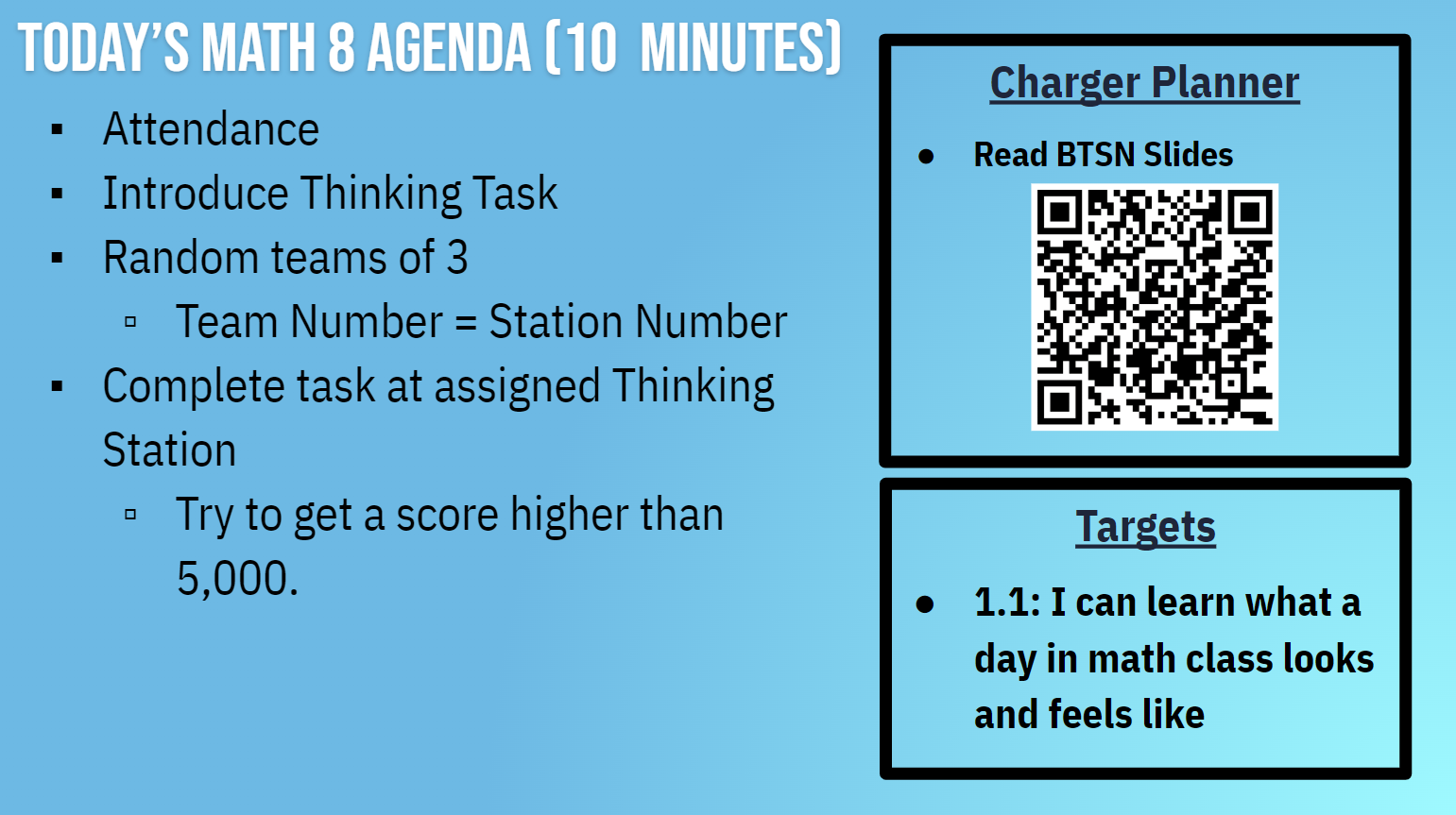
Last night my first period Math 8 parents came to class and the moment the first bell rang I began my lesson. In less than a minute I went over the class agenda for the day:

Yes, the QR Code links to my slide deck filled with Bitmojis.

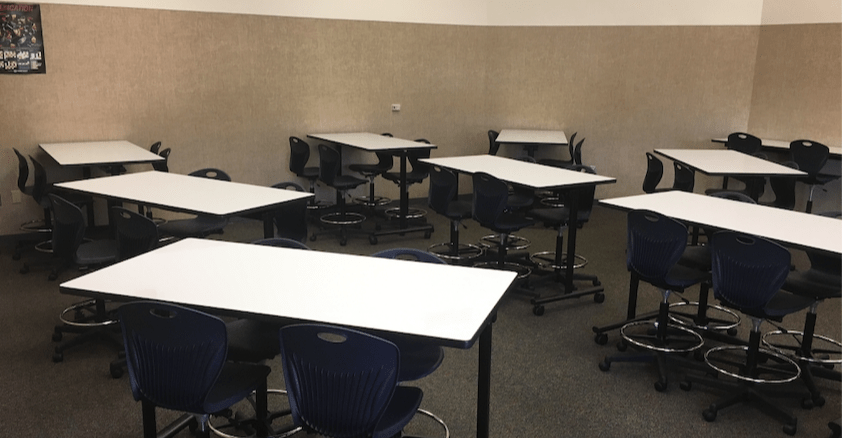
In the next minute I explained the structure of how working at the VNPS Thinking Stations functioned and then randomly grouped the parents using my Random Team Picker pre-loaded with their children’s names, just like I do in class each day. They had 30 seconds to find their Thinking Stations and introduce themselves to their random partners. Next, I explained the Thinking Task for the evening, using the Split 25 task the students did the previous week. I said “Begin!”, and off they went. 

Over the next five minutes I cycled through the room, checked in with each group, listened to their conversations about the task, and talked through their strategies. Parents were thinking, laughing, smiling, asking others for help, and were fully engaged in the activity (well, I had a few off-task parents, to be honest). I saw strategies evolve on the whiteboard, and heard them make connections about what would make the answer get larger and larger. With the last few moments in class I thanked them for their hard work, had them clean up their Thinking Station, and then the bell rang. And off they went to their next class period.

This was, without a doubt, the best Back To School Night I have ever experienced. I felt confident, joyful, and excited to be there. I wasn’t concerned about covering a bunch of redundant information, or thinking about what they all thought of me as a person. There was zero cotton-mouth and the whole night was just plain fun. I taught my lesson in the way I love to teach my students, and I am hopeful that each parent left the classroom feeling how much passion I have for this job.

So much better than a slide deck with Bitmojis.


Thank you to all of the parents who came to Back To School Night last night and allowed me to do what I love most. You embraced the lesson, engaged in the task, and brought joy to my heart. This was a night I will remember for the rest of my life.

The 20th First Day of School

Even though anything is possible, there are still a few things that are almost 100% guaranteed to happen.

The first day of school is always exciting. Even after 20 years in the classroom I get the anxiety flutters about 15 minutes before the first bell rings. I know that I’m ready, have everything planned out, and have done the mental reps to make sure I accomplish everything I want to on the first day. It’s just, well, you never really know how it’s going to go. Gather 34 different humans in a room for 51 minutes at a time and things have the potential to go horribly awry. One time I had a lesson go completely off the rails because a single house fly found its way into my room. Sometimes that’s all it takes. Come to think of it, it’s kind of a miracle that anything actually productive gets done on a daily basis.

Much of my first day excitement comes from knowing that anything is possible on the first day of school. Being a teacher means I am constantly learning and growing. I have learned from my past mistakes, reflected on my past good and bad practices, gained valuable wisdom and experience, and am a better teacher because of it. This year, in theory, should be my best year of teaching ever. Will I make new mistakes or fall back into some of my previous bad habits? Of course I will. Do I know that this year has the potential to be my best one yet? Absolutely. 

It’s the same for my students. They all come to school feeling a sense of hope and optimism for a new year and chance to be their best. I can always feel that on day one. The challenge is to keep them feeling that hope and optimism going for all 180 days. Students don’t start the year expecting to fail. They learn that mindset over time, if you allow them to.


So yesterday was the first full day of school, and it went like many others. Even though anything is possible, there are still a few things that are almost 100% guaranteed to happen. 

  • A student will be in the wrong classroom for period 1 and not realize it until I am finished with attendance. When they realize their name wasn’t called, they will check their schedule again, get hit with a wave of anxiety, then sheepishly exit my room looking for their science class instead.
  • Two best friends will make the strategic error of sitting next to each other when I allow everyone to sit wherever they want, thereby giving me critical human intel. Oh, you are best friends forever? I’ll remember that when I make my seating chart for next week.
  • At least one student from each class period will be way too friendly, way too fast. Slow down sport, I’ll learn your life story over the next 180 days, not the next 3 minutes.
  • After 2 months of being able to use the restroom whenever I desire, my bladder will not understand why it can’t be emptied during the middle of 2nd period. Come on bladder, we’ve been through this before. It’s going to have to wait until exactly 9:45AM. 
  • The lunch line will be a hot disaster as 600 new 7th grade students will learn to navigate the new system. They get it down pretty fast, but day one is always dicey.
  • One of my EXPO markers will be sacrificed to the new school year gods and left without a cap on, or had the ink tip smashed into its body. 
  • At least three pencils will be left on my floor.
  • During period 5 or 6 I will get confused as to whether I’ve covered the agenda for the day, as all the class periods tend to merge in my brain by then. I will have forgotten at least one thing. This year I forgot to take attendance during period 5. Literally the first item on my agenda and I biffed it.
  • By the last class of the day my vocal chords will be absolutely fried from talking more in one day in my “teacher voice” than the past 2 months combined.
  • 30 minutes after school ends will be epic nap time. I have embraced the truth that teaching in my 40’s means many, many naps.

Most of these guaranteed events are trivial (although the student in the wrong period 1 class will most likely relive that moment in their head many times over) and don’t really matter in the long term. What does matter is that on the very first day of school each student and educator has a chance to contribute to the new school culture in a positive way. Every student matters, and every student has an impact. Anything is possible on day one.


I find middle school to be a completely magical place. Over a thousand children from a wide array of cultures and backgrounds are brought to a central location, learn a hugely complex system of routines and practices from many different educators who care for them, navigate an intricate web of personal relationships, and somehow leave with more knowledge and skills than they had the day before. What an amazing place to be.

You Got a Teaching Job! Now What?

So what can you do to prepare for your new job, and what should you do on day one?

You navigated EdJoin for countless hours, submitted countless job applications, filled out the additional online questionnaires at each district, and survived the job interviews. You finally get the call you have been hoping for. You’ve been hired! After the adrenaline wears off, you realize that you are in for a big change, and you wonder what to do next.

In most cases, there isn’t much to do right away. Hiring is usually done in May and June, and you won’t even be able to see your classroom until August. You will probably want to get the contact information for your future colleagues, but that will most likely be unfulfilling. As you might know, most teachers go feral over the summer, so getting in contact with them and having meaningful conversations about work during June and July is not likely. (Unless one of your colleagues reads Building Thinking Classrooms and then ambushes you at your home and talks at you about it for hours and hours. That wasn’t me, I don’t know what you’re talking about). So what can you do to prepare for your new job, and what should you do on day one?

Know Your Content.

It’s summer, you have time (hopefully) to read and process information. Take this time to actually read the entire Common Core Standards Framework for whatever grade you will be teaching. I don’t mean just the standards, but the actual framework document. The standards are just a list of skills to teach with some additional explanation. The framework gives much more guidance about the depth and rigor you should go into for each standard, and gives examples of what that looks like. The document is not perfect, and can be difficult to read sometimes, but it is crucial for you to actually read and process. You have to know what you are actually supposed to teach.

Whether going into a new district, a new school, or just a new department at the same school, you have to not only know the content, but also what content is supposed to be taught. You cannot go wrong if you stick to the framework and the standards. The framework will tell you which standards are essential, and which ones are supporting and less important.

Let the triangles guide you!

For example, the Grade 8 Math Framework is shown above. Notice those little triangles shown after some of the listed standards? Those are the Major Clusters, which are “areas of intensive focus where students need fluent understanding and application of the core concepts.” Let’s say that near the end of the school year one of your colleagues wants to spend the next three weeks on a really cool project on volume, but you haven’t covered Pythagorean Theorem yet. What should you do? Well, I’d go with Pythag, since that is a Major Cluster, and volume is not.

Knowing the standards is critical in planning out your year and knowing where to spend your time. Before the school year starts make sure you have thoroughly read the Framework and know what needs to be taught. 

Make A Calendar

If possible, try to find a digital calendar of events for the upcoming school year. The district most likely already has the master calendar for the next school year posted on their website for parents. You might even be lucky and your individual school site will have all of the major events planned out for the upcoming year. If you can get access to that, great. Before the school year begins I like to fill out my school year calendar with as many events as I can to help with my lesson planning. When are the professional development days, minimum days, holidays, assemblies, weird schedules, and ASB events? The sooner you know when those are happening, the better. 

Rejoice when you see a green box!

Get To Know Essential Staff

It goes without saying that you should treat everyone at your workplace (and life) with kindness and respect. It’s literally the only way society functions. That being said, there are some critical staff members you will rely on that you should meet and get to know on Day One. They are:

The Front Office Staff

Our school has the most amazing front office staff, and yours probably does too. These professionals are crucial for making school function, and all play an important role. At my school we have an attendance clerk, Principal’s assistant, admissions clerk, and office assistant. I interact with them every single day, and they have saved my bacon more times than I can count. Need a last minute supply for a lesson? Office staff. Copier has run out of staples halfway through your job? Office staff. A student left a phone in your classroom? Office staff. Think a student has ditched class? Office staff. Need to find money in the budget for some classroom furniture? Probably the Principal, but maybe the office staff! Just need to vent about how bad the Ducks played last night? Office staff. 

If there is a classroom issue that I cannot handle on my own, it can be solved by the office staff about 90% of the time. Make sure you know them in an authentic way, and that they know you appreciate all of the work that they do. Start on day one, and never stop.

The Custodians

My school has over 1,000 students aged 12 through 14. They are loud, energetic, and messy. The school custodians do an incredible job every day to make the school a safe, clean place to learn. Aside from that, the custodian is usually the keeper of the furniture. Your school site probably does have that one piece of furniture that you need, but only the custodian actually knows where it is. Need one more table for supplies in your classroom? Custodian. Did a chair break and one of your students is sitting on the floor? Custodian. Queasy student didn’t make it out of the room before…ejecting? Custodian. Need a 12-foot ladder for your Barbie Bungee lesson? You guessed it.

Aside from getting to know them, one thing you can also establish on day one with your students is a clean classroom. My students know that at the end of the school day their job is to make sure the custodian can skip cleaning my room. It is my hope that the night custodian opens my classroom door, looks around and says, “I don’t need to clean this one!” Their task is huge. Do your best to make it a bit easier. One of my former colleagues kept a vacuum cleaner in his room and would vacuum his room before leaving school each day. Not because the custodian did a poor job, but so they had one less room to clean.

The IT Staff

For better or worse, classrooms are full of technology now. Most of the time it works. Sometimes it does not. There will always be someone at your school site that knows the technology way better than you. Ideally, you have an on-site IT staff person who can come to your aid quickly if necessary. Sometimes it is a teacher in a stipend position. Sometimes you have to send a Help Desk ticket via email (which can be a struggle when your email is not working).

The best option is to meet with your site’s IT person early in the year and go over the technology currently in your room and make sure you know how it works and what to do when something goes wrong. Spending 30 minutes with them at the beginning of the year trouble shooting problems can prevent or alleviate many issues that happen in the classroom. Be mindful of their time, however, since they are extremely busy at the start of the school year. 

Hang In There

The first day of work at your new school will be a complete information overload. There will be meetings, handouts, schedules, lists, walkthroughs, etc. You might remember 10% of everything when the day is over. Just keep everything you are handed and read it over the next day. 

Forget something? The office staff probably knows the answer. Good thing you already met them and know their names, right? Or it might be on your completed calendar.

Just remember that you are not alone at your school. Even though your classroom can feel like an isolated cave most of the time, you are part of a community of helpful, kind people. There is always someone at your school who can help you out. You just need to ask.

How To Handle A Formal Observation

Just know that no matter how the lesson goes, you will learn something and become a better teacher because of it.

During my daily perusal of the few Facebook groups I belong to I ran across the following post:

I had a few thoughts immediately after reading this.

  1. This person is in a bad place right now. If they are looking for lesson inspiration the night before an observation on a Facebook group, the desperation, or apathy, must be strong.
  2. If your principal hates you, why would you attempt to “WOW” them right before the end of the school year? Is this a “see, I am better than you perceive me to be” kind of thing? A spite lesson, perhaps? I’m intrigued.
  3. If you have already resigned, why are you bothering with this at all?

Despite these initial questions, my main reaction was, “Yeah, I get it”. Being observed can be extremely stressful, even for the most experienced, tenured educator. As a temporary or probationary teacher there are times where your job is quite literally on the line, and you feel as though one small mistake could cost you your teaching position. Depending on student enrollment and future projections, there may be one less spot at your school next year, and you need to prove you are worth keeping. The stress doesn’t leave once you are tenured, as a bad observation could be the first step in being removed (worst case scenario), or the beginning of a lack of trust and support from your administration. 

At least, that’s one way to look at it. A different mindset would be to celebrate with your administration the great work that you are doing, and gain key feedback on strategies and practices you are ( or might not be) using. Obviously, this more positive viewpoint can be more challenging to master, but it’s worth trying.

When I am observed now I try to focus on the good that can come out of it. First off, having other professionals in your room while you are teaching can really only make you better, since they always have a different perspective and can see the things that you are blind to. I still remember in one of my first observations from my mentor teacher in year one she brought a clipboard with the class seating chart on it. During my lesson she made tally marks next to each student who got to speak productively during the lesson. After the lesson, which I thought went pretty well, she showed me the chart and asked what I saw. Out of 32 students, only 6 kids had marks next to their names. I could have sworn more students were verbally active during the lesson, but the stats didn’t lie. She then taught me some more strategies about how to include more voices during a lesson, and other ways students can non-verbally participate but still feel engaged. It was such a simple thing to do that I had not considered. I still think seating chart when planning my lessons today.

In this past school year my principal popped in during my lesson for about 10 minutes and then wrote a note and dropped it on my desk before leaving. He had positive things to say about student engagement, but questioned if there was more I could be doing to support English Learners during the lesson. He was totally right. I hadn’t thought through that portion of my activity, and it made me think more about that for the next time.

Sometimes another educator in the room can really improve your self-esteem. This past year I had a challenging class period that would drain my energy each day and I felt way less effective. One of my colleagues happened to come by during that class period and remarked about how well-behaved and productive they were, noting that one particularly challenging student we both shared was doing really good work. It was a real confidence boost that I certainly needed.

So, what kind of advice did the Facebook group give our fellow colleague from the above comment? Most of the comments were about not worrying about it since she was resigning anyway. Some gave some actual lesson ideas. A few said to do nothing at all. Here’s what I would say to anyone being observed:

  1. Stick with the normal starter routines that you do daily in class. Attendance, warm-up, number talks, SEL openers, etc. Don’t throw a massive curveball at your students the moment they enter the room.
  2. Do a lesson that has a structure you know the students are used to. If you try to “WOW” your administration with something completely out of the ordinary, everyone in the room knows it. It’s not genuine, and everyone knows you are trying too hard. Also, when you try a brand new lesson structure for the first time you always spend more time on directions and logistical things and less time on learning and thinking. This is not the time for that.
  3. Make sure you plan out your strategies for student engagement. How are you going to make sure every student is involved in the lesson? How are you calling on students? Is it equitable?
  4. Make sure the work is rigorous and differentiated. The students should have the opportunity to think deeply, and also have the chance to extend their thinking or step back a bit if needed. Your evaluator should know that you are able to reach all of the students in your class where they are at, rather than just one-size-fits-alling them.
  5. Be yourself and roll with the failures. I have never taught a perfect lesson, and something always goes wrong. Your ability to change directions in a lesson when the formative assessment tells you to is critical in telling your evaluator that you are responsive and can adapt when needed. This is easier said than done, but is also easier when you have more experience doing the job. The longer you teach, the better you can anticipate student errors and different conceptions of the math.

Now, the savvy teacher will read this list and say “Hey, isn’t that what I should be doing on a regular basis for most of my lessons?”. Yeah, pretty much. It’s not like I said anything groundbreaking in the five points listed above. I wish there was a secret tip I could give, but certainly can’t think of one. I’m sure I missed something important, but those were the main five I could think of.

Just know that no matter how the lesson goes, you will learn something and become a better teacher because of it. And to our mystery commenter from above, I hope you find happiness in your next teaching position, and that you learned something from whatever lesson you chose to do.

It’s Time to Retire These Cliches of the Teaching Profession

“They only have to work 9 or 10 months of the year”.

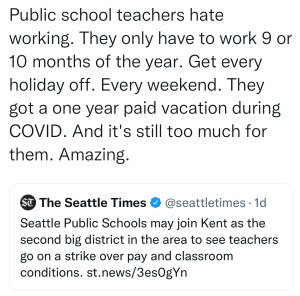
A few weeks back I was mindlessly scrolling through my Twitter feed after a long Monday at work. Most of the accounts I follow are hockey related (go Ducks!), or Critical Role focused. I sprinkle in a few reliable news outlets and some accounts whose opinion I value or find intriguing. A five minute scroll catches me up on news of the day, the latest developments of the Ducks roster moves, and some fantastic fan art of Orym, Fearne, and Fresh Cut Grass. I try to avoid controversial accounts, or people who post every five seconds looking for “engagement”. Every once in a while, however, the Twitter algorithm throws me for a loop with a random “suggestion”. For some reason it felt that I might “enjoy” the following Tweet from a highly followed account :

I have…many thoughts. 

“Public school teachers hate working”.

Um, no. 

Most of my adult life has been devoted to working this job. 

I work hard. I work extremely hard every single day. My family, friends, and colleagues can all attest to this. I am exhausted when I get home from my work day. I wake up at 4:30am every morning and get to work by 7:00am. From the minute I arrive to the minute I leave, usually around 4:30pm, I am working. I create lesson plans, respond to parent emails, meet with colleagues, create and revise assessments, research lesson ideas, grade assessments, etc. Oh, and I teach 5 classes a day. My brain is actively working for 9 -10 hours straight. I work through my 35 minute lunch period, and try to get a few exams graded during the 10 minute snack break after 2nd period.

I don’t hate working. I love the work that I do. My work gives me purpose. The work I do is valuable and important. I know that every single day I show up to work is a day that I can help a student achieve their dreams. I help children understand how to apply critical thinking and logic to the problems in their life.

How dare you claim that I hate working. Shame on you.

“They only have to work 9 or 10 months of the year”.

This is technically true. My teaching contract is from the middle of August to the first week of June. This is a factual statement. 

What this statement leaves out is that I only get paid for 10 months of work as well. I do not receive a paycheck for the months of July or August. I must budget wisely throughout the year to make sure my 10 paychecks last 12 months. If they don’t, I must find other means of earning money to get by. Things can get pretty dicey by the middle of September.

The more degrading implication though, as I understand it, is that teachers don’t really work a full job, or somehow have it easier because of this. I cannot disagree more. During a normal school year I am paid for about 185 days of work, 180 with students and 5 for beginning of the year planning and professional development. I work an average of 9.5 hours each day, but only get paid for 8 of those hours. I also work almost every Sunday for 5-6 hours creating lessons and grading assessments. I don’t get paid for any of that time. This equates to about 1,938 hours of work in a school year, or 242.25 8-hour work days. A normal calendar year has about 260 weekdays in it. I work almost the equivalent of a normal corporate 9 to 5 job, and I do it all in 2 less months. 

Don’t tell me that I “only work 10 months a year”. Let’s end that tired cliche right now.

(If you want my receipts on how much I actually work in a year, I logged every single hour of work for an entire school year here back in 2012/13, just for funsies.)

“Get every holiday off”.

Yep, I do. It’s pretty great. 

I also earn the hell out of those days off.

See above.

“Every weekend”.

Now, I must admit that teaching is the only career I’ve ever had, so my knowledge is limited here. But, don’t most careers get the weekend off? Aren’t there labor laws in place that require employees to only be scheduled so many days in a row, or so many hours in a week? My only other job before teaching had me work Monday-Friday. I’m assuming that hourly workers can choose to work overtime or take on extra shifts, but they get compensated more for their time, right? 

Perhaps I am naive and need to do more research, but I thought there were rules and laws about that kind of thing.

I don’t think weekends are a luxury that only teachers enjoy.

“They got a one year paid vacation during COVID”.

You can absolutely go %@&$ yourself.

That’s all I have to say about that.

“And it’s still too much for them.”

One beneficial thing about the pandemic was that it opened many eyes to what was truly essential in our society. 

Grocery store workers. Essential.

Docks workers and long-haul truckers. Essential.

Doctors, nurses, and hospital staff. Essential

Workers in food production facilities. Essential.

Twitter pundits? Not essential.

Teachers and child care providers. Essential.

The result of this revelation? People know what they are truly worth, and they start demanding it. 

Teachers don’t have too much. They are demanding what they deserve for the essential work they do. If they don’t get it, they harness the power of their union and demand it for themselves, and their students.

I think Shonda Rimes summed it up pretty well back in March of 2020 when schools were forced to close:

“Amazing”.

Congratulations. You finally got something in your Tweet completely correct.

Teachers are pretty amazing, aren’t we?

The Not-So-Obvious Things You Should Have in Your Classroom on Day One.

Sometimes that fly in your room just needs to die.

The lesson is going great. Students are engaged, working together on a high-cognition task. Conversations are on target, whiteboard markers are squeaking, math is in the air. Students are totally in the flow.

An inquisitive student approaches. You are ready to field their question (most likely with a question of your own, or a smile and a move on since they just want an answer and you are not an answer key, my friend).

“Mr. Zuercher?”

“Yes, my brilliant, hard-working, persevering student of mine?”

“There’s a spider on my desk”

“Not what I was expecting, but ok.”

Flow interrupted. Assorted students freak out. One of them bolts from the room. Math is no longer in the air. What a shame.

It’s a fact of life in teaching that situations will arise that you are not expecting, usually at the most inopportune time. I will gloss over the “Can I go to the bathroom?” question during the middle of a discussion trope. I’m thinking more along the lines of “It’s the last 10 minutes of school and right outside your classroom window a school groundskeeper is wrestling to the pavement a completely nude man high on some kind of substance while the nearby elementary school kids are being let out of school for the day and witnessing….everything”.

Whether it is day one of year one, or the second to last day of your teaching career, you will undoubtedly run into a situation where you don’t have what you need. It’s going to happen, but if you have the following items in your teaching toolbox, you might be prepared for them more often.

Bandages

Get all the sizes. You will need them.

Yes, the classroom is mandated to have a first aid kit. We have a nifty backpack right next to the door that has all sorts of items in case of an emergency. There’s even a glow stick for…reasons? In 18 years I think I have used the first aid kit maybe five times. However, I shell out bandages on the regular, at least once a week. Probably the most sought after item in my teacher desk is the big box of assorted bandages that I always buy at the beginning of the year. I don’t know what these kids are doing, but man do they need bandages. Most often it is the student who comes in from lunch or break with a skinned knee. There’s also the random hangnail or cut finger. I don’t need an explanation, just grab a bandage and don’t leave the trash on my floor! As an added bonus, get some extra antiseptic wipes from the nurse’s office. The first aid kit never has enough.

The Fly Swatter

Insect death comes in a variety of colors.

I would love to report that I respect all life on the planet equally, and that every creature should be cherished. I cannot report that. It would be disingenuous of me, and that’s not what I’m here for. Sometimes that fly in your room just needs to die. Having a quality fly swatter at your disposal is critical. Bees, spiders, roaches and the like will all eventually find their way into your classroom, and they must go. My fly swatter has a happy face on it, because I value irony.

If a bird flies into your room, the fly swatter will not be effective. Just turn off all the lights and open the door. It usually works.

In case of a deer…run.

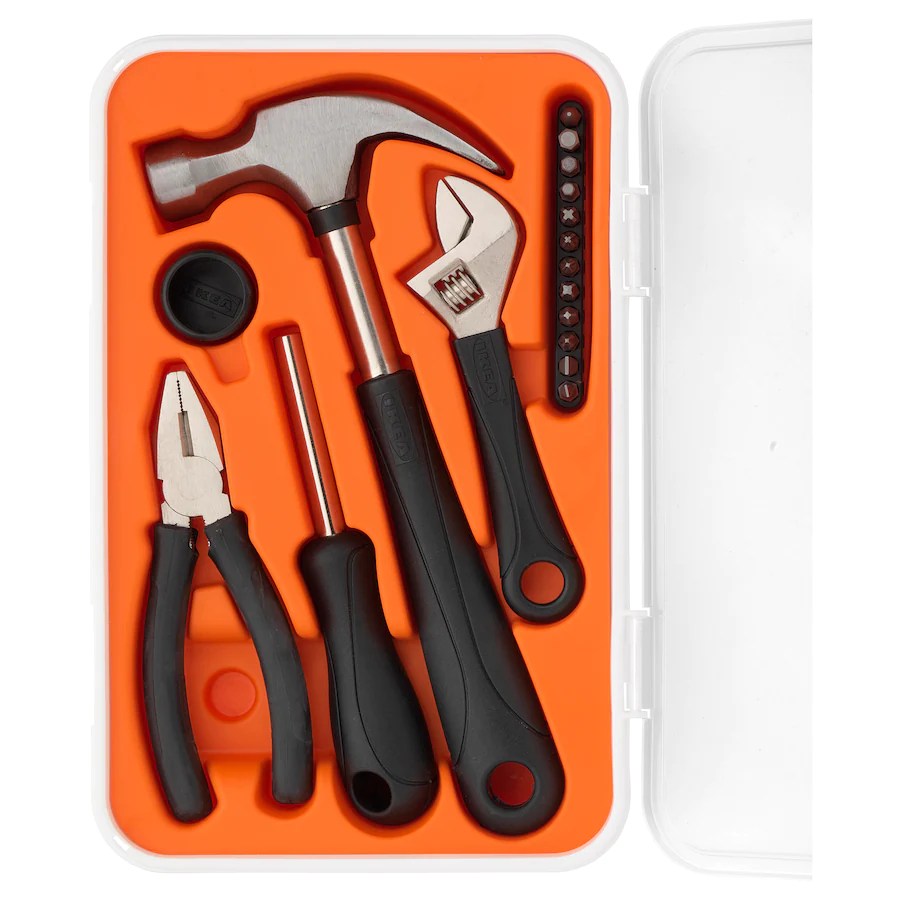
The Basic IKEA Tool Kit

Simple. Cheap. Highly effective.

When I first moved into my condo back in the mid 2000’s I was shopping for furniture at IKEA and I spotted this toolkit at the checkout aisle. I think it was $5.99. Best money I have ever spent. Things in your room are going to break. You will need to hang difficult items on your wall or from the ceiling. Desks and chairs need tightening. I have used every piece of this toolkit multiple times, and I am always glad I have it.

The hammer is also effective against deer.

The Door/Window Shade

My classroom door happens to be 90% window, which is not ideal in a lockdown situation. The ability to quickly cover your windows and doors is essential, unfortunately. Having a quick rolling or pull-down shade is a must for every classroom. Some teachers I know use a large piece of rolled up chart paper taped to the top of their door, which can be implemented quickly in case of emergency. A long time ago a student gifted me a life-size Corey Perry hanging fabric height chart. Mr. Perry hangs in my doorway, protecting us from dangerous situations, such as naked strangers on amphetamines.

Tells you your height, and protects you from danger?

Mr. Perry is somewhat effective against deer.

The Glade Plug-In

Plug it in, plug it in.

My students come to realize pretty quickly that I like to sing in my class. My Canadian National Anthem is pretty solid. I have a pretty decent “Let It Go” chorus as well. My all-time classic though is the Glade Plug-In commercial jingle. Comes in really handy when you are teaching evaluating algebraic expressions. Do you know the value of a variable? Plug it in, plug it in!

Aside from being a fun teaching tool, the Glade plug-in is also a real nose saver.

It’s late August. 92 degrees. P.E. is getting their first benchmark times for the mile run. Students are…pungent. The bell rings and they have 3 minutes to get to your class. You are going to be very thankful for that vanilla scent that permeates the air in your room. Doesn’t solve everything, but you’re gonna be glad you have it over nothing at all.

The Hygiene Box

Please, take as many as you need.

Hit that Target bargain bin aisle every once in a while and try to stock up on travel-size deodorant, mouth wash, and feminine hygiene products. Organize them in a box and put them underneath wherever you have the bathroom pass. The standing rule in my class is that I trust my students to use the restroom when necessary. It’s nice to have certain items available to them when they go. No judgement, just take what you need and handle your business.


What are your favorite items that you have in your classroom for those unexpected situations? What have I forgotten? Leave a comment below.

A Charger Card for Community College

Heck, the textbooks cost more than the actual courses!

Responsibility. Respect. Integrity. These are the core values that our school staff embraced some years back when asked to re-imagine our school discipline policies. A big emphasis of the PBIS (Positive Behavioral Interventions Support) system is to basically catch kids doing good. When students are exemplifying the core values, we are to recognize them for it, and tell them why. One of the ways we do this is to give out Charger Cards, which act as a sort of currency that students can exchange for items at the school store, or privileges such as getting to the front of the lunch line. It’s a positive way to encourage and reward students doing right.

Inspired by this, one of the things I aim to do with this blog is to give out Charger Cards to people, programs, and institutions that I see doing well and making the world a better place. It can be really easy to complain about all the problems in the world of education. Those who know me well can attest to that, as I’ve had many frustrating venting sessions with my friends and family, especially during Covid. Instead of focusing on what’s wrong, I’d like to shine a light on what I see as going right (or at least, the right direction).

Therefore, I hereby give my first Charger Card to…community college!

COMMUNITY — “Herstory of Dance” Episode 407 — Pictured: (l-r) Donald Glover as Troy, Danny Pudi as Abed — (Photo by: Colleen Hayes/NBC/NBCU Photo Bank via Getty Images)

I love community college. Specifically, Orange Coast College in Costa Mesa, California. I absolutely struggled and clawed my way through middle and high school in my youth. Dealing with ADD and chronic depression during my teen years did not empower me to succeed in my academics, and I barely graduated with nary a superfluous credit on my transcript. While most of my friends were going off to four-year universities, I was just glad to be leaving high school with a real diploma. I distinctly remember my friend group stressing about SAT tests, while I couldn’t care less, since I knew I would never need them. You only need those if you plan on applying to university (activate galaxy brain meme here). Enter O.C.C.

Attending Orange Coast College was one of the best decisions I have ever made. It allowed me to further my education, stay at home and save money (there was no chance that I was mature enough to live on my own at that point in my life), and pay for it all with a part-time job. Back then a single credit cost $11 (yes, you read that correctly), which meant I could take 12 credits of classes for the low low price of $132. Heck, the textbooks cost more than the actual courses! I could go to classes in the morning, stop at Wahoo’s Fish Tacos for lunch, then work my part-time job from 1-5pm. Life was pretty great.

In addition to the low cost, O.C.C. gave me the opportunity to explore different subjects and careers. I wish I had the classic origin story of always knowing that I wanted to be a teacher, and that it called to me from an early age. Truth is, I had no clue what I wanted to do with my life. After completing much of my general ed courses, I stumbled into an elective called “Introduction to the Teaching Profession”. “Teacher” always came up as a possible career whenever I took those aptitude tests, so I figured I would give it a try. As part of the course I had to log observation hours in a school setting. I managed to do my hours at my old elementary school with my previous 4th grade teacher. I was hooked. It was just so much fun. I went home after that first day and realized that teaching was for me. This epiphany was delivered by a $33 elective course I could take on a whim because of its low cost.

Now, this was back in the mid-90’s. Today, at least at O.C.C., two years of community college tuition are actually free using the Pirate’s Promise program. I can’t imagine a better start to your higher education journey than free. Compare that with two years at Cal State Fullerton (about $14,000 for two years), UC Irvine (about $33,000 for two years), or Chapman University (about $165,000 for two years). I just can’t fathom graduating from college after four years with up to $330,000 in student loan debt (go Panthers!). I tried to figure out how long it would take to pay that off, and the online payoff calculator app just produced a sad face emoji.

Obviously, community college makes way more financial sense than most other options. The problem is, most of my students today laugh at the idea of attending schools like O.C.C. I bring these examples up in class all the time, especially when teaching about compound interest, and even when presented with the facts, they dismiss the idea. Keep in mind, these are middle school students. Long term planning is not exactly a strong attribute in a 13-year old. For whatever reason, community college still has a reputation as “not a real school” or “school for losers and dropouts” (real quotes from my students). Whether it’s societal, cultural, or familiar, these attitudes and misconceptions about higher education persist, and it drives me crazy.

Community college provides a low-cost, high value education to anyone who desires it. It features a flexible system that can work with many types of schedules, offering all who seek it ways to gain more education, skills, and opportunities. It is an amazing place to explore at low risk and perhaps find a career you never even considered. Because of this, community college receives my first Charger Card for being awesome.

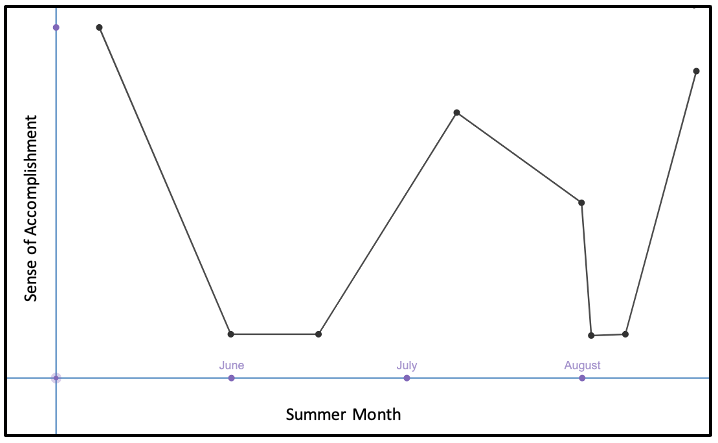
My Seasons of Summer

One summer it was the entire first season of Critical Role.

The day after the last day of school is pretty great. I won’t say otherwise. Ten months of stress, endless decision making, and exhaustion seem to just melt away. Waking up on that Saturday morning knowing that I have zero work responsibilities brings a calm and serenity that is difficult to describe. What should I do today? Well, anything I want! It has become my tradition on that first Saturday to make and devour a huge stack of pancakes drowned in syrup, topped with two eggs. That’s the whole list for the day. It’s pretty much the first to-do list of the year that I actually complete. After that, the seasons of summer begin.

The Blah season begins on day two. This season lasts for about two weeks. I do pretty much nothing. Yes, chores happen, workouts are completed, meals are cooked, but these days are mostly uneventful and not worth remembering. I feel as though my brain needs these two weeks of nothing to recover from the ten months of EVERYTHING. I try to make as few decisions as possible, spend as little money as I can, and just kind of…exist. The “few decisions” aspect is really the key here. I don’t know how most professions work, as I have only ever been an educator, but the sheer amount of decisions I make in a day of teaching is… a lot. According to the few studies that have been done on this, it is estimated that teachers make about 1,500 decisions in a single teaching day. In recent years I have noticed feeling completely exhausted after the school day, crashing around 4pm. My brain is just so tired. The added stress of teaching in the Covid classroom has not improved the situation. I need the Blah season. It recharges me and gives me energy for the next season.

By the end of week two, the epiphany hits that I haven’t done anything with my summer vacation. So begins the Hopeful List season. Lists are made, goals are written down, life questions are asked. What are my fitness goals? Which books should I read? Which places should I go? Who are the people most important to me that I need to spend time with? It’s all very exciting! Hopeful List season is full of optimistic purpose. This will be the year that I accomplish everything! It is joyful. It is full of wonder.

It lasts about three weeks.

Hopeful List season morphs into Realistic List season. Plans are scaled back. Lists are edited down. Was I going to travel to Iceland? Well, maybe just go to Chicago instead. That epic surf trip to Fiji? Maybe just a weekend of surfing at Trestles. Was I going to work out seven days each week with a specific plan for each day? Hmmm, four days seems much more manageable. That six novel science fiction saga I was going to read? Book one sounds good. I still accomplish things, but by the end of the season I always feel like I could have done more.

These three seasons usually take up about a month and a half of summer. By late July there is almost always an event that triggers the next season; The Back To School Shopping Ad. The main culprit is almost always Target. At some point in late July, like a lightning bolt from out of nowhere, Target hits me with an advertisement for backpacks and glue sticks. I’m never ready for it, and it always punches me in the soul. Everything was going fine! I was getting things done. Goals were being (somewhat) accomplished. Now I know that my days of carefree living are coming to an end. Melancholy season has begun.

Melancholy season does not exist because I do not enjoy my profession. I absolutely love watching my students grow and learn. It’s just that I know how much work it takes to make that happen, and the thought of that work during a time in which I’m currently doing very little is extremely overwhelming.

Melancholy season can last anywhere from 3 days to 2 weeks. Sometimes I call this “Netflix Season”, as the power of the Target soul punch is so strong that I am unable to do much more than consume streaming content. This year it was Stranger Things, Ozark, and Picard. One summer it was the entire first season of Critical Role. No matter what content I am slovenly consuming, at some point the final season begins to emerge.

Purpose season is maybe my favorite one of the whole cycle. It starts to tickle my brain in late July or early August. No matter the duration or severity of Melancholy season, at some point I start to feel the pull of Purpose season. The idea that I am meant to do something, and my life requires a purpose. Lazily watching TV is nice, but nothing is really accomplished. There is no intellectual payoff, no challenge, no achievement. I am pulled back into the world of education. I start thinking about new lesson ideas and creating plans. I furiously search Math Twitter seeking out new ways to do things that other math teachers are excited about. I scour my Google Drive, weeding out lessons I know I need to delete or revise. I have a purpose again.

Every school year I have doubts about whether this profession is really what I want to do. The last few years especially. Every summer I wonder if Purpose season will emerge. Will I still have the passion to do this work? So far, it has never failed to arrive. As of writing this post I have started to feel it tug at the back of my mind (the Target ad hit me a few days ago). It actually came a little early this year.