Advice For A Beginning Teacher

Get out of your cave and see what the other bears are doing.

I ran across the following tweet today and had some fun reading the replies:

What did Michelle do?

I thought most of the replies would be related to teaching, but they were more life-centered. Some of my favorite replies were:

“Never go into teaching, find something else to do”

“Go to law school” 

“Invest in Bitcoin”

“Don’t date Michelle”

We have all wished for a time machine at least once or twice, right? I’m sure everyone has some giant mistakes they wish they could erase (yes, I know, bad experiences build character and make you stronger, blah blah blah, cliche, platitude). Honestly, I would rather go back and do-over some of the dumb things I’ve said or the awkward social interactions I have caused in my life. About once a week I will be silently lying in bed trying to fall asleep and my brain will recall a time of supreme awkwardness from 30 years ago and I will audibly say “Jesus” and get a shiver of shame down my spine.

Since time machines don’t exist (right?), the next best thing I could do was try to think of what advice I would tell a teacher at the beginning of their career. What do I wish I knew back then, or maybe what did I actually know, but never internalized it and put it into action? I tried to boil it down to the 3 most important things I could tell myself that could make the next 20 years more enjoyable. Here’s what I came up with:

1) Max out your salary as soon as possible.

Teachers are not paid what they are worth, but they have ways of making more money and being guaranteed a raise (almost) every single year. In most districts teachers are paid based on a salary schedule negotiated by your union and the school district. Here is the current salary schedule for my district:


When you are hired as a first year teacher you start at Step 1 (year one of teaching) and are most likely in the “BA + Cred” column, meaning you have earned a Bachelor’s Degree and have your teaching credential. This guarantees you a 10-month salary of $66,547 before taxes in my district. If you never do any continuing education or professional development during your career, you will stay in this income column for your entire career. This means that over 20 years you will earn a total of $1,639,898 (not including raises negotiated by the union, which in my district is usually about 1.5-3% per year), which sounds great, but you will spend most of that on basic living expenses.

So, how do you move over to the higher columns? Well, to get one column over you must complete 45 graduate credits of continuing education, or about 15 college level courses at 3 units each. This takes time, and many teachers do this work over the summer while they are not in the classroom. In order to get all the way over to the highest column you need to complete 75 units of graduate credits, or 25 3-unit courses. Obviously, this takes a significant amount of time and effort. Is it worth it?

Let’s go aggressive and assume you take your first three years to earn 45 units, then another year to get to 60, then another year to get to 75. This means you will be at max salary starting year 6. You are now making $88,409 per year instead of $76,949, or an additional $11,460 per year! Granted, you need to pay for the college courses that you are taking (which cost anywhere from $65-$200 per unit), but the return on that investment only gets better over time. Take a look at the BA + Cred column again. Notice how your salary stays flat in certain places? For example, your salary does not change at all from year 8 to year 15. Now look at the 75 column. That rarely happens. You get a yearly raise every year until year 13, and then it’s only flat for 3 years instead of 8. This is where the time, effort, and money you invested in years 1 through 5 really start to pay off. By year 20 you are making $20,556 more than you BA + Credential peers.

Assuming you max out your salary in year 6, over the next 15 years you will make an additional $293,348. Let’s say you spend $150 per unit to get there. You will spend about $11,250 to earn almost 300k more money. I know it’s hard. I know it’s expensive. But it’s so worth it. 

Throw away all of the teaching cliches about being heroes, teaching for the love of the job, and being paid in watching your students learn. We live in a world where we need money to survive. Money isn’t everything in life, but it sure makes the basics of day-to-day living a whole lot easier. Do what you can to maximize your compensation. Your future self will thank you, especially if you save that extra income into a Roth IRA, but that’s a whole other blog post!

2) Observe as many teachers as you can.

During my credential program and student teaching I did many observation hours and learned valuable lessons about what works well in a classroom, and what does not. I had the added benefit of working as an instructional assistant in middle school and worked with six different teachers during the school day. I saw so many teaching styles from educators at different points in their careers and learned tons of classroom management strategies.

When I was hired for my first teaching job and started teaching in my own classroom, however, I rarely observed other educators, unless it was part of my induction program during my first year. The job seemed overwhelming most of the time, and I seemingly lived in my classroom cave, rarely seeing the light of day. That survival mode morphed into a practice of habit and I rarely left my room to see my colleagues in action. Looking back, I was missing out on the greatest resource available at my school: my fellow educators.

No matter where you teach I can guarantee you there are incredible people working at your school. One of my favorite things to do at my site is to use my prep period every once in a while to go observe other teachers in action. Some of them are good friends by now and they don’t mind me popping in unannounced. Other times I will ask ahead of time and set up a day that I can come observe. I don’t care what subject or grade level they teach, every time I observe someone I learn how to do something better. Most of the time I pick up a strategy on classroom management or a better way to talk with students. Other times I get a lesson idea or a better more efficient way to take attendance. 

Prep periods in middle school are a precious commodity, and it is hard to use them for things other than grading or lesson planning. If you can manage to use that time every once in a while (maybe once or twice a month?) to observe and learn from others, it can benefit you in the long run.

Get out of your cave and see what the other bears are doing.

3) Grade less, interact more.

I’ve spent countless hours in my life grading things that I didn’t need to. In my early days I used to assign homework each night and collect it the next day. I would assign 3 points for each completed and corrected assignment and enter it in the gradebook for all 180 of my students. This would take 1-2 hours every day. Did anyone actually benefit from me grading it? I would argue no. Formative assessment should be meaningful, not mechanical. (Read this previous post if you want to know more about my current stance on homework).

Take a hard look at your grading practices and ask yourself “Is anyone actually getting anything positive from me grading this?”. If the answer is no or maybe, stop grading it. Not everything needs to go into the gradebook, and no, you don’t actually have to read every single thing each one of your students produces. I did at least four projects in my different math classes this past year that I didn’t grade at all (I did read them, I just didn’t grade them). None of the students cared that I didn’t grade them. They simply enjoyed doing the projects and learned some important skills along the way. 

When you spend less time grading things, you open up more time for planning better lessons and interacting with your students more. In Math 8 this year I assigned a project in which they needed to decide which of three cars to purchase and justify it with research and math (here is a link to that project, if you are interested). The students had multiple days to work on it in groups, and I spent the entire time talking with students about cars, gas mileage, how car payments work, how to find electricity rates, where the best gas stations are, how sales tax works, etc.  I guarantee they learned more from those 5 days working on the project than they ever would have from me grading a nightly homework assignment. Also, not one single student asked if that project would be graded or not. They just enjoyed doing the work.

Grade only what you absolutely must.

Bonus) Be kind to yourself.

As a new teacher you will mess up. You will mess up a lot. I’ve been in the game a long time and I literally screw something up every single day. The only way to survive in this job is to be kind to yourself and try to learn from your mistakes and try to do better the next day. One of the greatest things I ever learned how to do was to apologize to my students when I messed up and tell them I will try to do better next time. 

What would you tell a new teacher? What did I miss? Comment below on the best advice you would give someone starting in this profession.

How To Handle A Formal Observation

Just know that no matter how the lesson goes, you will learn something and become a better teacher because of it.

During my daily perusal of the few Facebook groups I belong to I ran across the following post:

I had a few thoughts immediately after reading this.

  1. This person is in a bad place right now. If they are looking for lesson inspiration the night before an observation on a Facebook group, the desperation, or apathy, must be strong.
  2. If your principal hates you, why would you attempt to “WOW” them right before the end of the school year? Is this a “see, I am better than you perceive me to be” kind of thing? A spite lesson, perhaps? I’m intrigued.
  3. If you have already resigned, why are you bothering with this at all?

Despite these initial questions, my main reaction was, “Yeah, I get it”. Being observed can be extremely stressful, even for the most experienced, tenured educator. As a temporary or probationary teacher there are times where your job is quite literally on the line, and you feel as though one small mistake could cost you your teaching position. Depending on student enrollment and future projections, there may be one less spot at your school next year, and you need to prove you are worth keeping. The stress doesn’t leave once you are tenured, as a bad observation could be the first step in being removed (worst case scenario), or the beginning of a lack of trust and support from your administration. 

At least, that’s one way to look at it. A different mindset would be to celebrate with your administration the great work that you are doing, and gain key feedback on strategies and practices you are ( or might not be) using. Obviously, this more positive viewpoint can be more challenging to master, but it’s worth trying.

When I am observed now I try to focus on the good that can come out of it. First off, having other professionals in your room while you are teaching can really only make you better, since they always have a different perspective and can see the things that you are blind to. I still remember in one of my first observations from my mentor teacher in year one she brought a clipboard with the class seating chart on it. During my lesson she made tally marks next to each student who got to speak productively during the lesson. After the lesson, which I thought went pretty well, she showed me the chart and asked what I saw. Out of 32 students, only 6 kids had marks next to their names. I could have sworn more students were verbally active during the lesson, but the stats didn’t lie. She then taught me some more strategies about how to include more voices during a lesson, and other ways students can non-verbally participate but still feel engaged. It was such a simple thing to do that I had not considered. I still think seating chart when planning my lessons today.

In this past school year my principal popped in during my lesson for about 10 minutes and then wrote a note and dropped it on my desk before leaving. He had positive things to say about student engagement, but questioned if there was more I could be doing to support English Learners during the lesson. He was totally right. I hadn’t thought through that portion of my activity, and it made me think more about that for the next time.

Sometimes another educator in the room can really improve your self-esteem. This past year I had a challenging class period that would drain my energy each day and I felt way less effective. One of my colleagues happened to come by during that class period and remarked about how well-behaved and productive they were, noting that one particularly challenging student we both shared was doing really good work. It was a real confidence boost that I certainly needed.

So, what kind of advice did the Facebook group give our fellow colleague from the above comment? Most of the comments were about not worrying about it since she was resigning anyway. Some gave some actual lesson ideas. A few said to do nothing at all. Here’s what I would say to anyone being observed:

  1. Stick with the normal starter routines that you do daily in class. Attendance, warm-up, number talks, SEL openers, etc. Don’t throw a massive curveball at your students the moment they enter the room.
  2. Do a lesson that has a structure you know the students are used to. If you try to “WOW” your administration with something completely out of the ordinary, everyone in the room knows it. It’s not genuine, and everyone knows you are trying too hard. Also, when you try a brand new lesson structure for the first time you always spend more time on directions and logistical things and less time on learning and thinking. This is not the time for that.
  3. Make sure you plan out your strategies for student engagement. How are you going to make sure every student is involved in the lesson? How are you calling on students? Is it equitable?
  4. Make sure the work is rigorous and differentiated. The students should have the opportunity to think deeply, and also have the chance to extend their thinking or step back a bit if needed. Your evaluator should know that you are able to reach all of the students in your class where they are at, rather than just one-size-fits-alling them.
  5. Be yourself and roll with the failures. I have never taught a perfect lesson, and something always goes wrong. Your ability to change directions in a lesson when the formative assessment tells you to is critical in telling your evaluator that you are responsive and can adapt when needed. This is easier said than done, but is also easier when you have more experience doing the job. The longer you teach, the better you can anticipate student errors and different conceptions of the math.

Now, the savvy teacher will read this list and say “Hey, isn’t that what I should be doing on a regular basis for most of my lessons?”. Yeah, pretty much. It’s not like I said anything groundbreaking in the five points listed above. I wish there was a secret tip I could give, but certainly can’t think of one. I’m sure I missed something important, but those were the main five I could think of.

Just know that no matter how the lesson goes, you will learn something and become a better teacher because of it. And to our mystery commenter from above, I hope you find happiness in your next teaching position, and that you learned something from whatever lesson you chose to do.

Closing Out The School Year

…the last few weeks of May reveal how good your classroom culture really is…

POV: It’s the middle of May. State testing has mercifully concluded. 8th grade students have their initial high school course placement. Grades are pretty much solidified, especially if you use a year-long gradebook like I do. How do you spend those last few weeks with your students?

Many teachers like to do projects during this time. Some teachers try to cram in the last few Learning Targets in order to be able to say that the students were “exposed” to all of the state standards that year. A select few (tenured) teachers fire up the old Disney+ account and watch a large amount of “educational streaming content” (not recommended). No matter what your goal is (content coverage, student exploration, survival), the last few weeks of May reveal how good your classroom culture really is, and whether the time you spent on rules, procedures, and expectations in the first third of the year really made a lasting impact.


My strategy for the end of this year was pretty simple: I’m going to teach all the stuff! I have very rarely finished a school year where I actually taught all of the standards. It’s surprisingly hard to do. In the courses I teach, it’s usually the statistics standards that draw the short stick. That’s a shame, since you can do some really interesting work with statistics. They aren’t critical standards though, so the unit always gets pushed back for other more “essential” standards.

This year I went the project route, hoping to give my students the opportunity to apply what they learned in a novel way. I created a small project called Digging Into The Data in which students took a survey on the things they liked and then looked for trends or strange correlations using two-way tables. They then had one minute to present their most interesting finding to the rest of the class. 

In Math 8 we closed out the year with the classic NCTM activity “Barbie Bungee”, in which students use scatter plots and linear association to figure out how many rubber bands they should give their bungee jumping doll in order to have a fun bungee jump, but not hit the ground, from the top of a 12-foot ladder. See the winning team below:

I promise, First Responder Barbie lived!

No matter what activities, projects, or assignments you choose, none of it matters unless the students are in the right mindset to do them. By the middle of May students are tired and lack a lot of the normal motivation to do well. Summer is oh so close, and your 8th graders know they most likely will never see you or the school ever again. This creates the conditions for some very bad decisions to be made.

This is where all of the hard work you do in August, September, and October pays off. Did you spend the needed time to establish and enforce behavior expectations? Did you make meaningful connections with your students to help foster a sense of belonging and purpose in the classroom. Do your students know that when they enter your room, no matter what is happening outside, it’s now time to get to work on the inside? You might think you established all of those things, but you really find out now.

So, how did my year close out? Well, other than missing the last two days of school because of a pretty nasty cold (I actually took sick days, following my own advice!),things went pretty well. Barbie Bungee can go very wrong, very quickly. Students are using meter sticks and rubber bands to gather data, which lends itself to light saber fights and airborne rubber projectiles. None of that happened this year (as far as I know), and the students were highly engaged and motivated. My Enhanced Math 1 students found some really weird correlations in Digging Into the Data, and we got through all of the presentations in one 51-minute class period. Here is a pretty fun student sample that we had a good laugh about.


Ideally, the end of a school year is a celebration of progress and learning. Students should feel good about the work they did during the year, and have tangible skills to show for it. If you put in the work in the first third of the year building a classroom where all students are expected to achieve at high levels, you have a good chance of celebrating at the end, rather than counting down the minutes until it is mercifully over. 

I wish I could say every school year has ended successfully for me. They certainly all haven’t. The key is to learn from the bad endings, and remember them clearly when approaching the next school year. Having one bad school year is usually an unfortunate stroke of bad luck. Having a string of them in a row means you need to really examine what you are doing in the classroom. I sure have had a few bad ones, but I always try to learn from them and make changes the next year.

The Joy(?) of Homework!

When I graded homework, integrity died.

One of the biggest challenges I face as an educator is how to handle homework in the middle school classroom. Ask ten different people about the topic, and you will likely get ten different opinions. Ideas about homework range from banning homework completely to assigning work every single night. There’s a general rule suggested by the National Education Association that says students should have 10 minutes of total homework multiplied by the grade level each night. For example, a student in 4th grade should have a total of about 40 minutes of work each day, which includes all subjects. This means my 8th grade students should expect an hour and twenty minutes of work each night. That…feels bad.

Over the years I have evolved on this topic, as I have with pretty much everything else I do in my classroom. My first year, all of the students sat at individual desks, seated in nice neat rows. Now they sit in table groups or roam around the room working at various vertical whiteboard stations (more on that in another post later). Most of my early lessons were direct instruction in the model of “I do, we do, you do” (how thrilling). Now I do mostly problem-based lessons where the students work together and I provide support and keep them on track. I used to assign homework each night from the textbook, based on the lesson we did that day with the answers to the odd problems in the back of the book (remember textbooks?). The only reason I assigned homework that way was because that’s what I experienced as a student myself, and that’s how the math department did it when I got hired. I did what was being done.

As I got more experience, processed thousands of pages of student work, and sat through many, many parent conferences, I started to grow suspicious of the efficacy of this system. Some of the main problems that I recognized were:

  • A standard homework assignment in which a student needed to complete and properly correct 15-20 math problems could take one student 15 minutes and another student 60 minutes or more. The time commitment was not equitable.
  • Some students had a high level of support at home, and others did not. Students having access to family help or paid tutors had a distinct advantage over those who did not.
  • Since the homework was based on the lesson that day, many students did not have the conceptual understanding yet to complete the problems on their own. Learning a brand new skill and practicing it on the same day was not working for most kids.
  • Making the homework worth a percentage of the grade in the class was only detrimental. This was an advantage to the students who had the time and support to complete it, and a disadvantage to students who did not. I can only imagine the number of students I had over the years whose overall grade was negatively affected by forces outside of their control.
  • Grading homework rewarded “completion” and dishonesty. I quickly lost count of the students who copied answer keys, had tutors (or parents) do work for them, or copied work from a friend. When I graded homework, integrity died. Work assigned outside of class could not be assumed to have been done by the student.
  • Processing 180 pages of homework each day was time consuming and not beneficial. The only thing I learned from looking at homework the next day was who was cheating on it. I would spend 1-2 hours every day checking homework, and all it got me was more parent conferences focused on integrity.
Photo by Andrea Piacquadio on Pexels.com

Changes needed to happen, but what were the right ones? Honestly, I don’t think there is a perfect system. Some students need to practice a math skill many times over many days to get the concept down. Some kids understand the skill quickly and lock it down after only a few attempts. Every student is different, so the system needs to be flexible. Assigning every student the same amount of work each night is not equitable, or even necessary. I’ve taught many students who have done little to none of the work I have assigned outside of class, yet they still showed consistent mastery on their in-class assessments. Clearly, they just didn’t need to do that much work. After much thought, multiple professional development sessions, and some new guidance from the district, my homework system has turned into:

  • All assignments are a collection of spiral review. Newly taught math concepts do not show up on homework until the topic has been thoroughly covered in class over multiple days. This gives students a better chance at doing the practice independently.
  • The homework assignment is posted on Monday morning, and “due” by Friday afternoon (students can finish it later if needed). Students have a week to work on it, using the time they have in their own family schedules, free time we have in class, or during the tutorial periods we have at school.
  • Homework is not part of the overall grade in the class.
  • All assignments are on DeltaMath, which provides access to worked out solutions and help videos if students get stuck on a topic. This provides equal access for help to all students, assuming they have an internet connection for the school-provided Chromebook. Not a perfect system, but far more equitable than before.
  • I’m still checking homework completion, but only put it in a gradebook category worth 0% to provide feedback to parents. This takes me about 1 hour per Friday, rather than 5-10 hours per week. I can’t begin to tell you how beneficial this has been for my own mental health.
Photo by Keira Burton on Pexels.com

I evolved into this system over many years, and it’s not without its flaws. Since the work is not worth a grade, some students don’t see the point in doing it. They are so focused on what will raise their grade in the class that they don’t see the value in doing the practice. It’s a tough sell for the highly extrinsically motivated. I try to emphasize the value of practice, but that is not effective for some students. Since I refuse to grade homework anymore, I’m not sure what the answer is to that…yet (I will gladly take suggestions).

One thing I would like to try next year is to abandon the whole “weekly assignment” model altogether. I’m envisioning creating a new assignment on DeltaMath every time we finish a Learning Target, and having the assignment active the entire school year. With no specific due date, students could access the assignment at any time and practice the skills when they need to. If I offer formative assessment opportunities in class with feedback, students can make informed decisions on what they need to practice. This could help students make better choices on how they spend their time, and teach important study habits. Instead of me telling them what to practice, they choose what to practice and when. 

The ideal scenario is that homework is only viewed as a positive experience that allows students to check whether they understand a topic or not. In my dream scenario, every single one of my students would be able to say to themselves, “yes, I totally understand this and don’t need to practice it” or “looks like I need to work on this some more”, then know how to move forward. This is what highly functional adults do every day, right? Is that too much agency for a 13 year old? Maybe? But I’d like to find out.

The Day The Classroom Stood Still

First I heard the buzzing of one phone. Then another. Then three.

One of the strangest days of my life was March 13th, 2020. It began as a somewhat normal Friday, except for the looming spectre of Covid-19. I had been paying attention to the news, doing my obligatory morning doom-scroll of Twitter before heading into work. I knew that many school districts were considering a shut-down and that it seemed inevitable for my district. Cases were getting concerning, but it still seemed so far away. 

Being a Friday, I had even block periods of 2, 4, and 6. Even days were more difficult since I didn’t have a prep period on those days, so I came to school ready for a more tiring day. I remember that I had planned a day of review and practice for my 7th grade math classes. It was an easy lesson plan, meeting with small groups and sitting at the back table helping students one on one. During snack break after period 2 I visited my colleague next door and she said that LAUSD had announced they were closing down. As she refreshed her phone she saw that San Diego was shutting down as well. I figured there was no way my district would stay open after that. The bell rang, and in came my period 4 7th graders.

I tried my best to teach as normal as possible. I could feel the stress in the air. It was one of the few times in my life that I could actually feel the electricity in the classroom. It was so unnerving. The students knew. I cycled around the class, helped students, and waited. 

The chime on my computer sounded, indicating that I had received a new email. I headed over to my computer and opened up the message from the superintendent:


I tried to keep teaching as normal, but I knew things were going to change. There was a knock on my door, and I got a surprise visit from one of my colleagues who decided to bring me In n Out for lunch. I will never forget that lunch. A small act of kindness in a sea of uncertainty. I sat at the back table, helping students, waiting.

Then it began. First I heard the buzzing of one phone. Then another. Then three. Parents had received the school district email and were beginning to reach out to their kids. The students were not allowed to use cell phones on campus, but they still had them powered on. 

More phones went off. Students began to grow nervous. One of my kids started crying, and my wonderful colleague took him outside to go for a walk and calm his nerves. Finally the lunch bell rang, and the kids shuffled out to go eat. I stayed in my room, eating In n Out, frantically searching the internet for more news. The lunch period went by so very fast.

By the time period 6 started, word had spread like wildfire. All the students knew we were closing and I did my best to be up front with them. I remember saying that I had no idea when the next time was that I would see them, so let’s make the most out of our time together. They did surprisingly well. The final bell rang, I wished them well, and I never saw any of them again.

The next day I realized that I needed groceries, so I walked to the local Trader Joe’s. The shelves were completely empty. It finally hit me that this was going to be very, very bad. 


School was canceled for Monday and Tuesday, but we met as a staff to figure out a plan on how to teach remotely. The meeting was in the large multi-purpose room with folding chairs set six feet apart. That’s really all I remember about that. The rest of the day was spent in PLC teams trying to figure out how to convert all of our curriculum to an online/digital format. We learned about different apps we were allowed to use, reviewed online policies like FERPA, and tried to cobble together a lesson plan for the rest of the week. The idea was that we would teach online for the next two weeks, then hopefully come back to school after Spring Break.

Covid had other plans.

It was at this point that my 20% rule died a horrible death. 

Pretty much every lesson I had ever created was completely obsolete. Since I couldn’t ensure my students had the ability to print lessons at home, every lesson had to be recreated in a digital format. I created Google Docs, Slide decks, Loom videos, Nearpods, FlipGrids, and Desmos activities. Thankfully I had an amazing PLC team who divided up the work evenly for each course, so the workload was not mine alone to shoulder. I quickly became pretty decent at making a Google Slide Deck. One teaching partner became the Queen of Loom, creating excellent direct instruction videos that I could embed in my Canvas course. Another colleague figured out how to create activities on Desmos. We did what we could to give our students the best of a bad situation.

It was completely exhausting. As the two weeks before Spring Break passed, the news got worse and worse, and I knew we would not be coming back to school. I was isolated, depressed, and my mental health was deteriorating at a pretty fast pace. I would stay up until 2am creating lessons, then trudge to bed. This monotonous pattern continued for days, then weeks. By mid-March I didn’t really feel like getting out of bed each day. I had almost no interaction with my students, except for the occasional Canvas message or email. I knew that my students were feeling the same way I was. Less and less assignments were turned in. They were disengaged and losing hope. Some of my kids did not log on to my online classroom for 2 straight months, and there was nothing I could do.

One of my favorite things about teaching is taking my last day of school photos with each class. Before 2020 I had a photo of every class I taught since 2004. At the beginning of each new school year I open the photos and smile, remembering fun stories and wondering what my they are up to now. My streak was broken in 2020. All I have is a few screenshots of a Zoom conference call I did the last week of school in which about 10 students logged on.

I can’t help but wonder what was lost due to the actions we took as a society. Did we make the right decision? Did we do too much?  Did we not do enough? It’s impossible to know. 

What I do know is that we will feel its impact for years.

How I Use the 20% Rule to Improve My Teaching

No matter how good the batter is, you are always going to mess up the first pancake.

My first year of teaching was…a blur. I look back fondly on it, but I honestly don’t remember much. I recall the colleagues in my department, some memorable students, and… that’s about it. I’m pretty sure we had a heated labor dispute in which the teacher’s union threatened to go on strike. I was encouraged to wear black on certain days to show solidarity, but I was too focused on just figuring out what the heck I was teaching the next day to worry too much about that. My colleagues were fired up about COLA percentages, and there I was just trying to survive and keep my job for the next year. 

The thing about your first year that can be so challenging is that you have nothing to fall back on. Every lesson is brand new, you have no idea how it will go, and it really is just a crap shoot every single day. Hopefully you have a strong PLC (Professional Learning Community) at your school site who can support you with lesson plans and teaching strategies. Even so, doing a new lesson for the first time is like making a batch of pancakes. No matter how good the batter is, you are always going to mess up the first pancake. Even after 19 years I still feel bad for the first class I give a new lesson to, since they never get the best pancake of the batch (shout out to my period 1!).

When I think back to my first year lessons, I was just following the lesson plan format that Chapman University taught me. I dutifully typed up my plans each night using their lesson template on Word. All I can remember about them now is that they had to include an “anticipatory set”, which was some sort of attention grabber at the beginning of the lesson. These were critical, apparently. Every lesson basically ended up with me doing direct instruction and the students taking notes in their trusty math journal. Exciting.

If you stick with it and get a few years under your belt, you end up compiling a modest library of lessons and activities that you can use. Your content knowledge grows, and you can anticipate most of the conceptual errors students might make. Knowing this makes lesson planning way easier. It took me about 5 years to create/borrow/find a decent library of lessons and not have to work every single day to create something new or heavily revise something from the past. This is the point in which I created the 20% rule for myself.

It is not sustainable to re-create every single lesson each year. When you teach multiple sections of different courses, you just don’t have the time to remake everything. After a while you should have a reliable battery of “good” lessons, a few “great” lessons, and a full pantry of “please leave me alone and work on this worksheet” handouts. It’s at this point you need to be strategic and consider your own mental wellness. No lesson will ever be perfect, and you won’t have enough time to do everything. This is where the 20% rule comes into play.

Each year my goal is to revise, create, throw out, or upgrade 20% of my lessons in each course I teach. When I plan out my year, I begin by laying the foundation of the lessons I already have. Once I have my road map, I focus on one lesson per course each week that needs some attention. Is it good, but could be great? Can I change the whole structure so that it is more student-centered? Can I add an extension to challenge students, or lower the entry floor so that more students find early success? Is the lesson just pure crap and I need to start over completely? Each week I focus on the weakest lesson of the bunch, and I do my best to make it at least “good”.

The optimistic teacher in me wants to make every lesson “great”, and create an amazing experience for all of my students every single time I see them. The pragmatic teacher in me knows that this is not really feasible, and that I will have zero energy for my students if I spend all of my waking hours trying to create the “perfect lesson” every day. There has to be a balance, and this was the best system I devised. I figured that by doing this, I would improve 100% of my curriculum every 5 years, which seemed pretty good if you ask me. By year twenty I would have revamped my entire lesson library at least three times.

I religiously followed my 20% rule for about 10 years. Then the world learned about something called Covid-19.

To be continued…

The Hardest Part of the Job

The simple truth is that if you teach long enough, you will outlive some of your students.

January 9th started as any normal Monday morning. I arrived at my classroom, got the supplies ready for the day, made sure the bell schedule was correct and the targets were written for the week. I roused the computer from its weekend slumber and quickly checked my email for any important announcements. My eyes were instantly drawn to the third message in the queue, and a wave of adrenaline and anxiety hit me like a ton of bricks.

“Tragic News”.

No. Not again. Damnit, not again.

There isn’t a single teacher credential program that exists that is able to prepare you for everything you will encounter in your teaching career. They provide you with the latest research on pedagogy and childhood development. You learn strategies for how to get students talking to each other, how to write a basic lesson plan, and ways to manage classroom behavior. 

What they don’t teach you is how to deal with the death of a student.

Nothing can prepare you for the moment you learn that one of your kids is gone. The sadness is deep, and it persists. The logical part of my brain knows they are not my biological children, and that I only see them for about an hour a day. My heart does not care. It’s as if an unseen force reaches into your heart and tears off a portion that you will never get back. The piece may be small, but you still feel its absence.


I learned of four former students dying in the past year. Let me tell you about them.

Max was a gregarious fellow, full of energy and fun. On the hockey rink he skated with abandon, crashing into the boards and other players frequently, always with a smile on his face. He was the goofiest of his siblings, and he never failed to make me laugh.

Christian was a complete rascal with a sly smile that showed he understood more than he let on. His long bleach blond hair gave the impression that he was just a simple surfer and water polo player, but his mind was sharp and full of wit.

Dylan loved to crack jokes and make the class laugh. You always had to be on the lookout for his next opportunity for humor. Behind the comedian was an intelligent young man who never tried his hardest in my class, but I knew that he could do it.

Alex was just a wonderfully empathetic boy. A rarity in middle school. Alex made sure everyone was included and he stood up for what was right. He didn’t get the highest grade in the class, but he didn’t seem to care because he knew he tried his best. Alex would help anyone, no questions asked.


Alex was the subject of the “Tragic News” email. Only a senior in high school. I was looking forward to seeing him graduate in June. Now there will be an empty seat at commencement.

The simple truth is that if you teach long enough, you will outlive some of your students.

Most often the news will be shocking and unexpected. Young people are not supposed to die. 

The news of one will make your memories cascade, reminding you of all the kids you have lost over the years. What you thought you had healed from, or buried, rises to the surface to remind you of how absolutely random and cruel the world can be. In the case of Alex, I learned of his death 30 minutes before school started. The first period bell rang whether I was done crying or not. 


Some of the most important research on effective teaching shows that the stronger your connections are with your students, the higher they will achieve. My principal is well versed in this research, and consistently reminds us how important these connections are in our regular staff meetings. I know that what he says is true. The problem is, the stronger your connections are with your students, the more it hurts when they are gone.

That’s the toughest part of the job. When you truly care about your kids and build those bonds, you open yourself up to the hurt and despair when you lose one of them. If you choose to guard yourself and only know them on a surface level, they can always tell, and they don’t learn as much. Sometimes, you will put everything you have into a group of students and you will never see the result. It will feel as though your efforts were wasted.

Do you lean in and expose yourself to possible grief? Do you close off and merely “do the job”, protected from the pain?

I honestly don’t know the right answer. I just know that my heart is heavy, and I’m tired of losing my kids.

To Sick Day, or Not To Sick Day?

The amount of trash on the floor tells you everything you need to know.

The bell for lunch rings and students hurry off to jockey for position in the serpentine cafeteria line, leaving various items in their wake. My stomach is also grumbling, but my teacher brain tells me to sweep the classroom and look for left behind water bottles, lunch bags, and pencil cases before heading to the lounge to grab my sandwich. I find two erasers, one Hydroflask, and a wooden pencil so small it’s only suitable for Bilbo Baggins. After placing the items in the lost & found box, I head to the front office. Halfway to my destination it hits me.

Uh oh. I think I’m getting sick.

Damnit.

I still have two classes to go before the end of the school day. A quick check of my symptoms tells me I can make it just fine to the end of the school day. It’s the next day I immediately begin worrying about. If things get worse, I won’t be in much of any shape to deliver any kind of decent lesson to my students. 

I grab a rapid Covid test from the office, snag my sandwich from the overstuffed communal fridge, and retreat to my classroom for some cost/benefit analysis. After shoving a cotton swab up my nose and punching in the needed info into the companion iPhone app, I wait 15 minutes and begin planning.


I have no idea how sick days work in other professions. All I know is that taking a sick day as a teacher is extremely inconvenient, and sometimes more costly than just battling through it the next day. Allow me to explain.

The lesson pacing for a school year is extremely delicate, requiring careful planning as a team and consistent revision. We are expected to teach, assess, and reteach a long list of standards over the course of 180 days. In some cases an accelerated math course requires covering 1.5 years worth of material in the same 180 days. This is almost impossible to do. Taking a sick day almost guarantees that I cannot do the lesson I had planned to do, and requires completely revamping my lesson for the next day, and shifting the entire pacing guide back a day. Every once in a while I get extremely lucky and a sick day falls on the same day I would have normally done seat work or review. I believe this has happened maybe twice in my entire career.

Along with the disruption to lesson pacing, taking a sick day also requires making a detailed lesson plan for the substitute. Over the years I have been able to create a template that works pretty well, trying to incorporate everything a sub would need in order to have a successful day. Even with a streamlined approach, creating the plan still takes a few hours, which I’m usually doing after school while progressively feeling worse. I update seating charts, highlight students with special needs, make sure the emergency backpack rosters are accurate, make copies and label them all with clear sticky notes, create Google Slide decks for each class to follow, and organize the entire classroom. All told, the moment I decide to take a sick day I know I have about 2 hours of work to do before I can go home and be sick.

This brings me to the substitute. I must preface this by saying that I have great respect for anyone in this profession, especially over the past 3 years. Being a sub during Covid must be extremely challenging, and I tip my cap to anyone who has stuck with it. I know that our district was absolutely desperate for subs the first two years, and frequently had to send administrators from the district office to cover absences. The job is very challenging, and you never know what you are going to get. 

That being said….

I only ask for two things from a substitute teacher in my room:

  1. Keep the students safe.
  2. Just follow the plan.

I work really hard to make sure everything is ready for you to have a successful day. I’m not asking you to teach a new concept, because I don’t know your level of math expertise and it wouldn’t be fair to you. All I need is for you to arrive on time, read the plan I have left for you, and make sure it gets done. 

I wish I could say this is what happens every time.

I always know how the sub day went the moment I open the classroom door. Just look at the floor. The amount of trash on the floor tells you everything you need to know. High trash volume means the students were not behaving well, or the sub was not in control. It’s an instant indicator of whether I should keep the sub on my preferred list or not. 

After that, look at where the lesson handouts should be. If they are mostly gone, that’s a pretty good sign. One time I came back to a room with every handout still on the table. I asked the students what happened and they informed me the sub spent all 55 minutes telling life stories. He was never asked back to my room. On my most recent sick day, I returned to find many of the handouts stuffed in the supply bins at each table group. When I collected the work from the students the next day, not a single one had completed the work in some of the classes. Apparently they decided to do Karaoke in class instead. Cool.

Most of the time the sub does a great job and manages the day. It’s really all I can ask for. Sometimes they go above and beyond, grading assignments, cleaning the room, and helping students during tutorial. Every now and then it’s a disaster. One year I had a woman who went around telling my most fragile math students in my intervention class that they would never get into college. I made sure she never came back to our school again. 

It’s the unpredictable nature of it all that is the most challenging part. Every day of middle school brings different challenges, and it’s not like I’m always at my best. We all have bad days, teachers and students alike. The hard part is knowing that no matter how well you plan and prepare, you still have no control of what is happening in your classroom.

To sick day, or not to sick day?

Early in my career I would never take a sick day, no matter how bad I felt. I just always figured it would be easier to tough it out. Looking back, this was not a wise decision. A cold that should have lasted 3 days stretched on for weeks at a time. I would go to work when I literally could not speak, and I figured that pantomiming my lesson was still better than not being there. One time I got a concussion on a Sunday night while playing hockey and taught the next day in sunglasses because the overhead projector was so bright I couldn’t think straight. Probably should have stayed home on that one.

Working through Covid-19 these past three years has taught me to value my own health more, as well as the health of my students. Last year I took three sick days, which was half as many as I had taken in the previous 17 years. When I started to feel crummy on the second to last day of school, I listened to my body, made the correct choice and took a sick day the next day. I missed 8th grade promotion and was not able to see my students off to high school. The next morning I tested positive for Covid and was glad I decided to stay home.

Despite my growth in respecting my own health, I still feel the desire to “tough it out” when I’m not feeling well. I’m not really feeling that bad, right? I can make it through one more day.

To sick day, or not to sick day?

Sadly, that is still question. One day I hope it won’t be.


One final thought.

Laurie Unbehand will forever be my most cherished substitute teacher. Smart, witty, confident, and in control. Laurie was always my first choice when trying to get a sub. Laurie knew the math, would always follow the lesson plan, and could be trusted to teach new concepts with skill. Laurie had four children of her own, all of whom attended our school over the years. On days that she was subbing for another teacher we would joke in the lounge that somehow I avoided having all of her children in my class. She knew many of the students because they were friends or teammates with her own children, and she used this expertly to her advantage. If a student she knew was behaving poorly she would bust out her cell phone and ask if she needed to call their parents and let them know how they were behaving. Best of all, Laurie was kind, and truly cared about all of the students in her temporary classroom. 

Cancer stole Laurie from her family way too soon, and I think about her from time to time in my daily work. I still have one of the pencils that was given out at her memorial service encouraging the owner to always keep learning. It’s in my pencil jar on my desk as a small reminder of the good she did in the world.

Thank you Laurie for always keeping my students on task, learning, and cared for.

It’s Time to Retire These Cliches of the Teaching Profession

“They only have to work 9 or 10 months of the year”.

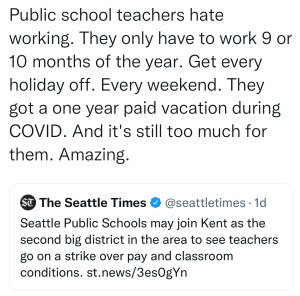
A few weeks back I was mindlessly scrolling through my Twitter feed after a long Monday at work. Most of the accounts I follow are hockey related (go Ducks!), or Critical Role focused. I sprinkle in a few reliable news outlets and some accounts whose opinion I value or find intriguing. A five minute scroll catches me up on news of the day, the latest developments of the Ducks roster moves, and some fantastic fan art of Orym, Fearne, and Fresh Cut Grass. I try to avoid controversial accounts, or people who post every five seconds looking for “engagement”. Every once in a while, however, the Twitter algorithm throws me for a loop with a random “suggestion”. For some reason it felt that I might “enjoy” the following Tweet from a highly followed account :

I have…many thoughts. 

“Public school teachers hate working”.

Um, no. 

Most of my adult life has been devoted to working this job. 

I work hard. I work extremely hard every single day. My family, friends, and colleagues can all attest to this. I am exhausted when I get home from my work day. I wake up at 4:30am every morning and get to work by 7:00am. From the minute I arrive to the minute I leave, usually around 4:30pm, I am working. I create lesson plans, respond to parent emails, meet with colleagues, create and revise assessments, research lesson ideas, grade assessments, etc. Oh, and I teach 5 classes a day. My brain is actively working for 9 -10 hours straight. I work through my 35 minute lunch period, and try to get a few exams graded during the 10 minute snack break after 2nd period.

I don’t hate working. I love the work that I do. My work gives me purpose. The work I do is valuable and important. I know that every single day I show up to work is a day that I can help a student achieve their dreams. I help children understand how to apply critical thinking and logic to the problems in their life.

How dare you claim that I hate working. Shame on you.

“They only have to work 9 or 10 months of the year”.

This is technically true. My teaching contract is from the middle of August to the first week of June. This is a factual statement. 

What this statement leaves out is that I only get paid for 10 months of work as well. I do not receive a paycheck for the months of July or August. I must budget wisely throughout the year to make sure my 10 paychecks last 12 months. If they don’t, I must find other means of earning money to get by. Things can get pretty dicey by the middle of September.

The more degrading implication though, as I understand it, is that teachers don’t really work a full job, or somehow have it easier because of this. I cannot disagree more. During a normal school year I am paid for about 185 days of work, 180 with students and 5 for beginning of the year planning and professional development. I work an average of 9.5 hours each day, but only get paid for 8 of those hours. I also work almost every Sunday for 5-6 hours creating lessons and grading assessments. I don’t get paid for any of that time. This equates to about 1,938 hours of work in a school year, or 242.25 8-hour work days. A normal calendar year has about 260 weekdays in it. I work almost the equivalent of a normal corporate 9 to 5 job, and I do it all in 2 less months. 

Don’t tell me that I “only work 10 months a year”. Let’s end that tired cliche right now.

(If you want my receipts on how much I actually work in a year, I logged every single hour of work for an entire school year here back in 2012/13, just for funsies.)

“Get every holiday off”.

Yep, I do. It’s pretty great. 

I also earn the hell out of those days off.

See above.

“Every weekend”.

Now, I must admit that teaching is the only career I’ve ever had, so my knowledge is limited here. But, don’t most careers get the weekend off? Aren’t there labor laws in place that require employees to only be scheduled so many days in a row, or so many hours in a week? My only other job before teaching had me work Monday-Friday. I’m assuming that hourly workers can choose to work overtime or take on extra shifts, but they get compensated more for their time, right? 

Perhaps I am naive and need to do more research, but I thought there were rules and laws about that kind of thing.

I don’t think weekends are a luxury that only teachers enjoy.

“They got a one year paid vacation during COVID”.

You can absolutely go %@&$ yourself.

That’s all I have to say about that.

“And it’s still too much for them.”

One beneficial thing about the pandemic was that it opened many eyes to what was truly essential in our society. 

Grocery store workers. Essential.

Docks workers and long-haul truckers. Essential.

Doctors, nurses, and hospital staff. Essential

Workers in food production facilities. Essential.

Twitter pundits? Not essential.

Teachers and child care providers. Essential.

The result of this revelation? People know what they are truly worth, and they start demanding it. 

Teachers don’t have too much. They are demanding what they deserve for the essential work they do. If they don’t get it, they harness the power of their union and demand it for themselves, and their students.

I think Shonda Rimes summed it up pretty well back in March of 2020 when schools were forced to close:

“Amazing”.

Congratulations. You finally got something in your Tweet completely correct.

Teachers are pretty amazing, aren’t we?

Saying No: My Path to (better) Work/Life Balance.

When you both arrive at and leave work when it is dark out every single day, it takes its toll.

It began as a small ask from my principal way back in the early days of my teaching career. They needed another teacher to chaperone the first dance after school. Sure. That seems easy. Two hours of witnessing awkward teens be awkward. What could go wrong? (It was fine).

As a first year (temporary) teacher, I felt the need to say yes to every request from the administration. I barely knew what I was doing on a daily basis in the classroom, so anything I could do to further solidify myself as at least a reliable employee seemed absolutely necessary for my future employment. Even if I wasn’t asked back after that first year, they would hopefully be able to say that I was a strong employee with a good work ethic on those future reference check calls. 

Daily lunch supervision, concert supervision each trimester, and the after school homework club were all things I said yes to. Granted, some of those things came with additional pay, which was nice. The problem was that I did all those things, then still stayed until 7-8pm each night trying to lesson plan for the next day. Every work day was at least twelve hours long, and I was only being paid for 7 of them. When you both arrive at and leave work when it is dark out every single day, it takes its toll.

Somehow I made it through that first year (mostly because of the substantial help from my mentor teacher Ann), then also made it to year three, earning tenure. I figured that once my employment status was more permanent I would be able to let some things go. I was wrong. By my fourth year I had said yes to most any adjunct duty that was needed at school. I was also offering help after school to any of my students (and some that weren’t), staying in my classroom for over an hour after the school day. When the kid who hasn’t turned in anything in over a month finally asks for help, you don’t say no.

After a while, small adjunct duties here and there became larger committees and leadership roles. This meant way more meetings, additional planning outside of my regular lessons, and oh so many emails. It felt good that people wanted me to be on certain committees, and I had the chance to advocate for changes I thought our school or district needed to make. When you work really hard for a decade, there is a bit of an ego boost knowing that people value your experience and input. It sure does take up a lot of your time, though.

Around the early 2010’s (if I remember correctly) there was a big shift in our district towards the Professional Learning Community (PLC). This led to much more collaboration with my department colleagues, which was awesome, but also way more meetings and time spent coming to common agreements. Each year our department would set a goal of making one big structural change based on the latest research showing what was best for kids. How could I say no to that? This continued for many years.

Then Covid-19 happened.

School shut down. I had two days to figure out how to turn my home into a classroom and change every lesson I’ve ever created. Two weeks of “Emergency Distance Learning” turned into 2.5 months. 2.5 months turned into another full school year of teaching online. This was not good for my physical and mental health. It did, however, help me gain perspective on what I valued.

Year 18 of my career, back in the classroom full of masked humans, I decided to try an experiment. Say no to everything. How would it feel to just teach my classes and not say yes to any of the extra stuff that can happen at school? I did only my mandatory supervision and adjunct duties. I did almost no additional help after school. I tried my hardest to be as focused as possible during my PLC meetings so that they would last as little time as possible and still be meaningful. I came to work every day at 7:00AM and left by 4:00PM. 

It felt… fine. I wish I could say that I had some monumental epiphany, but I didn’t. I did find that the thing I value most is the daily interactions with my students. I have built positive relationships with so many amazing kids over the course of my career, and watching them grow into incredible adults brings me great joy. 

Year 19 started a few weeks ago. Before the first day with kids we have a few days of meetings and time to prepare our classroom. After that first big staff meeting our principal sends out an email detailing all of the supervision and adjunct duties we can/have to sign up for, as well as additional stipend positions we can take on. When my email chime went off at 2:30pm I rushed to open it and sign up for the bare minimum yet again. It’s a google doc, so duties go fast. Different colored cursors belonging to various staff members are selecting options. Names get deleted by others on “accident”. It’s a frenetic, cut-throat scene. 

I got my preferred 5 weeks of after school supervision duty in the quad. Phew! (Only the rookies take the front of school duty).

I got my coveted “end of year awards committee” adjunct duty. One of the few adjunct duties that is basically just handing out joy to students. That took care of my 6-8 required hours.

I was done. The bare minimum had been achieved.

Then I saw the optional lunch club supervision opportunities. Chaperone a lunch club once a week in your classroom. Pretty easy, could be really fun. 

Then I saw it. The Dungeons & Dragons club.

Sign. Me. Up!

The first meeting of the Dungeons & Dragons (and rubik’s cubing and magic) club was yesterday. My room was full of passionate nerds nerding out to their nerdiest nerd desires. I loved every minute of it. 

This is what I say “yes” to now. 

One lunch per week spent helping kids meet friends who love what they love in a safe place. 

How could I say no to that?