So I shake off the cobwebs, steel myself, and spend the next couple of hours getting tasks done that “Monday morning me” will be very excited about.
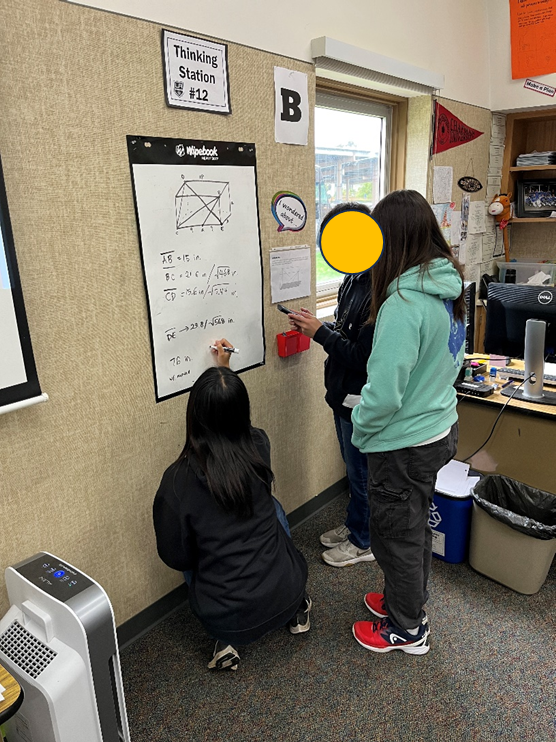
It’s Friday afternoon, around 2pm. My students are working on some word problems at the vertical whiteboards, engaged in the task and happily chatting about math (and who is dating who). I cycle around the room, red expo marker in hand. I check in with groups, circle an interesting strategy that students came up with to discuss during consolidation, and listen in to the math conversations. Class is humming along, brains are thinking. Things are going well.
And I’m completely exhausted.
After a full week of teaching, all I want is for the bell to ring, trudge to my car, drive home, check my mail, snuggle with Puck, then take a 2 hour nap. My Shadowrun gaming group is meeting at my place tonight, and I’ve got to get rest before we are up running the shadows until 1am.
I do my best to stay energized and positive, but my brain is getting fuzzy and I really need that bell to ring.
At long last, the weekend chimes ring out, and students rush out to do a million different things. I’d love to be right there with them, but I know that my Friday afternoon ritual needs to happen, otherwise next week will be much more challenging.
I’ve known many different types of educators in my time. Some can write their lesson plans on a post it note and leave school at 2:36pm. Others create entire manuals for each day, staying until 9pm each night (I do not recommend). A brave/foolish few just simply wing it each day (I do not recommend). On the spectrum of 1 being “winging it” to 10 being “massive over planner”, I’m about a 7. I can’t leave school without my agendas for the next week all set, the supplies organized, and my email inbox all clear. If I don’t check those off my list before leaving, my weekend is laced with stress and uncertainty.
So I shake off the cobwebs, steel myself, and spend the next couple of hours getting tasks done that “Monday morning me” will be very excited about. Copies are made, supplies organized and put away, test retakes are graded and recorded, Canvas is updated. I empty the late work bin and stamp the work, filing each away in its respective class folder. All the tasks that never seem to get done during the week are finally taken care of.
As I’m about to head out, weary but proud of myself, I open up my email one last time. The previous week we had an SST meeting for a student who has not been their best self this year. Math class has been a real struggle for them, and I expressed my frustration at the meeting about how I knew they were capable of so much more, but they kept spending their time and energy trying to be someone they are not. The parent was incredibly supportive of the teachers, administration, and their child. It was a really great meeting, and I was really hopeful to see some positive change.
And you know what? I did.
This week the student was focused, worked really hard, and was much more positive in their words and actions. During our vertical whiteboard time they were a leader in their group, and figured out a new strategy for solving systems of equations by substitution. By Friday they were solving systems like a pro, with a happy smile on their face.
So before I left school, I made myself pause, sit down, and write the student’s parent an email to let them know how well their child did that week in class. It took me about five minutes to write a simple message letting them know the positive things I saw their child do that week.
I sent it off, then phoned a colleague for a few minutes before heading home. In that short span of time I had already received a reply from the parent, thanking me for the email and exclaiming how happy they were to hear the good news. I could almost see the smiling face behind the words.
It’s so easy to be overwhelmed by the everyday tasks of teaching. Grading, lesson planning, organizing, meetings, etc. It becomes a lot. I realize that I can be so focused on getting the “must get done” tasks finished, that I forget about the “should get done” and “this would be nice to do” tasks that can go a long way. A five minute email can really make somebody’s day better.
How many students do I have in my classroom who do the right thing, work hard every day, but don’t get the recognition they deserve because they don’t have a “look at me” type of personality? I bet I’ve had over a thousand students go through my classroom over the years who simply did the things I asked them to without being flashy about it and I took them for granted.
So now I am determined to add one more item to my Friday afternoon ritual list: Send at least two happy emails home to parents, letting them know the awesome things their child did in math class this week.
Instead of celebrating all of the things they knew how to do, they focus only on what they didn’t.
You are back in middle school. Your haircut is phenomenal, your clothing choice is the height of modern fashion, and you just finished eating lunch with your friend group that is heavily skewed towards your own gender. (If you are being honest with yourself, only one of those statements is actually true). You head to math class and hunker down in your assigned seat. The bell rings, attendance is taken, and the teacher begins handing back your test from the previous week.
Close your eyes and imagine what the test looks like. How is it graded? What kind of marks are written on it? Is there a letter grade written at the top like the common Hollywood trope? Maybe a percentage? Perhaps there is a fraction that shows how many points you earned out of how many there were possible?
More important than that, how do you feel? What thoughts and emotions are running through your brain? Are you excited? Proud? Disappointed? Angry?
When you get the test back, do your thoughts immediately head towards beating yourself up for what you did wrong, or do you celebrate over what you knew how to do? I’m willing to bet it’s the former over the latter.
One of my biggest fears as a middle school math teacher is that I have contributed to the feelings of self-loathing and shame for thousands of children over the years because of the way I have graded exams. I have worked so hard over my career to teach with kindness and empathy. I try to be strict but fair with my students, and clear with my expectations. My goal is to make sure that every student knows they are valued, are important, and that they can learn math at a high level. No matter how hard I try, though, I cannot erase the probable trauma that I have caused because of the traditional grading system I used for so many years.
As teachers we want to give feedback to our students they can use to develop their skills; Here is where you are, and here is what you need to work on to reach your goal. Seems simple enough. The problem is that providing this feedback to 150 students on a regular basis for one human being is virtually impossible. How do I find the time to give meaningful feedback to every student for every single Target or learning outcome they are expected to master in a single school year? For example, the Enhanced Math 1 course I teach has 37 different learning targets for the year. It’s…a lot.
I think this is why education developed the letter-grade percentage based system in the first place. It really has that industrialized one-size-fits-all assembly line kind of feel to it, which makes sense since the first record of letter grades comes from the late 1800’s. Got a few hundred students to assess? Give them all the same test, assign points to each question, then assign them a grade based on their percentage. Seems simple, right?
There are so many problems with percentages, but for today I will just focus on one. A percentage doesn’t tell you what you know, and what you don’t know. I mean, it kind of does, but not really. The best example I have for this was presented by Cassandra Erkins at a district training I attended quite a few years ago.
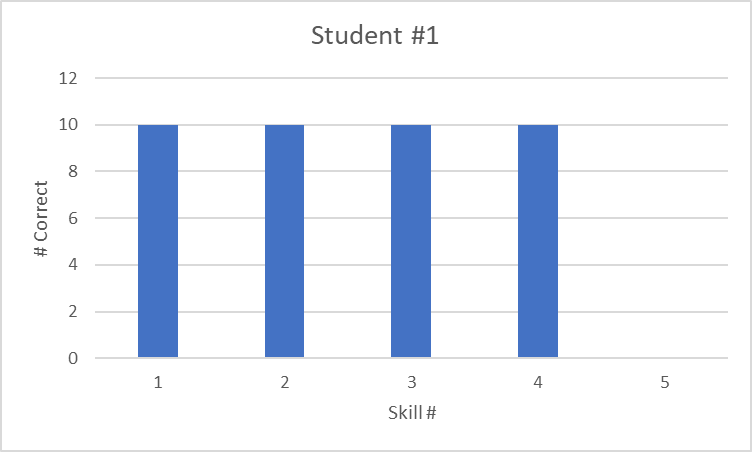
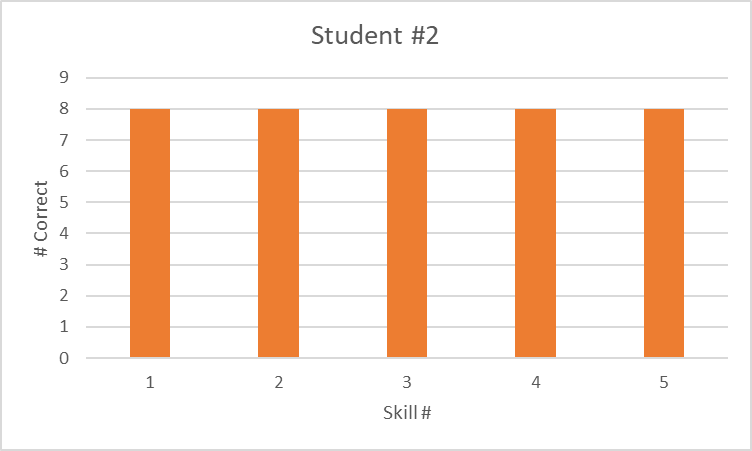
Suppose you have three students take a test that covers 5 different skills. Let’s say there are 10 questions for each skill. Each student gets an 80%. Which student has mastered the content, which student needs a bit of support, and which student needs an intervention?
Impossible to know, right?
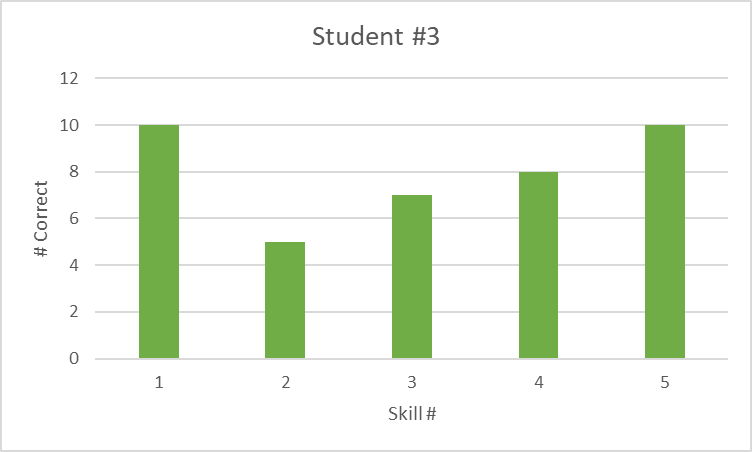
What if you looked at the test and saw how they did on each individual skill? Here’s the results by skill instead:
Which student gets the intervention time? Who has a pretty good grasp of all the concepts? Who needs a little bit more support?
It seems clear to me that Student #1 needs the most support, since they did not know how to do skill #5 at all. Student #2 has a pretty solid grasp on all of the skills, and Student #3 needs some additional support on skills 2 and 3. All of the students got an 80% on the test, but two of the three need more help. Unless you focus on the actual Targets, you might just say “80% is good enough” and 2 out of three students would not get the help they need.
Also, who’s to say that 80% is a good score anyway? I mean, it’s great for a hockey player’s shooting percentage, but it’s pretty terrible if it’s a surgeon’s mortality rate. Percentages are super subjective and don’t really tell you the whole story. So why do teachers use them?
Well, it’s easy, that’s why. It’s really easy to assign points to each question, grade them right or wrong, then give an overall percentage score. If you use an overall score, you never need to do the work of digging into the results and finding the Student #1’s in the class.
While overlooking student misconceptions is one harmful byproduct of using percentages to grade students, I would argue that the more harmful practice is that of students seeing themselves as that percentage. I’ve witnessed it a thousand times. Hand back a test to a student and the first thing they look for is the score. If it isn’t 100%, the next thing they look for is what they got wrong. Then they get mad at themselves for getting those things wrong. The phrases “I’m so stupid” and “Why did I do that” start flying around the room. Then students start arguing with you for more points in a desperate attempt to raise their grade. It’s a disturbingly toxic cycle I have seen happen over and over again. Instead of celebrating all of the things they knew how to do, they focus only on what they didn’t. What should be a moment of joyful learning inevitably becomes an anger and shame spiral.
So now I use Standards Based Grading in my classroom. I don’t give points or percentages. Students are assessed on specific Targets and are given feedback via a 4-point rubric that shows what they know, and what they still need to work on. When using the rubric I focus on the student’s overall understanding of the Target, and I don’t worry about small formatting mistakes. When I give back the assessment I always begin by having them celebrate what they are proud of. I listen closely for any student starting down the shame spiral and I try to intervene by highlighting what they did well.
Is it a perfect system? Of course not. I don’t believe that one of those could ever exist. Is it better than what I used to do? Absolutely. The work is hard and time consuming, but the learning outcomes and mental health of my students is worth the time and effort. No child should ever reduce themselves to a numerical score, and I never want to contribute to that kind of thinking ever again.
I plan on writing in more detail about how our school has implemented Standards Based Grading in the future. If you would like more information on the practice, here are some of the best resources I have used:
What does a parent really want from Back To School Night?
Back To School Night is an annual school tradition that usually happens a couple of weeks into the new school year. At my school, the regular school day is shortened and ends at noon, then teachers have about six hours to prepare for the 1.5 hour long event that night. Parents get to experience their child’s class schedule, getting 10 minutes for each class period with a 3-minute passing period in between. The purpose is for parents to meet their child’s teachers, and get a slight inkling of what a regular day of school is like. And it’s…completely terrifying.
Put me in front of a group of 13-year old students and I’m fine. As long as I have a plan, I can pretty much always make it happen. Swap out the kids with adults and I become somewhat useless as a human being. I ramble, repeat myself, and get cotton-mouth about 2 minutes in. I have so much adrenaline in my system that I feel as if I could self-power a unicycle to San Jose in less than an hour.
When the school day ends at noon my anxiety slowly begins to build, I get super itchy all over, and my mind begins to think of every possible negative scenario that could occur. By the time 6PM rolls around I have rehearsed my presentation about 30 times and I still have zero confidence that it will go well. Once the event begins I struggle through my first 10-minute presentation, trying to cover the most important information I think parents need to know, but really all I’m doing is going over the course syllabus with the aid of a mediocre Google slide deck with various Bitmojis of myself in the corner of each slide saying “Welcome Back” and “Thank You!”. If I were to take this 10-minute act on the theater circuit, zero people would buy a ticket (unless they enjoy a healthy dose of schadenfreude). After doing the same performance 4 more times, somehow I get progressively worse each time, and by the end of the night I drive home in shame and lay awake in my bed perseverating over how I must have looked like a crazy person.
Last year was probably my worst performance ever (although I’m sure Year One version of me would disagree). I had just read the book “Building Thinking Classrooms” by Peter Liljedahl that summer, and I was trying to implement some of the strategies in my class. They were all new to me, so I wasn’t as confident in my teaching methods. I tried to explain how class was going to be different for students that year, and I just wasn’t very good at communicating my vision for the school year. I left school that night feeling pretty defeated.
About a week ago I was beginning to dread Back To School Night again. I knew I needed to work on my presentation, so I sat down at my computer and fired up my usual set of Google slides and began thinking of which creative Bitmojis to insert. Then I paused and thought again about the true purpose of the event.
What does a parent really want from Back To School Night? I was always told by administration and my peers that I needed to cover the core information in the syllabus. One of my mentors early on told me to always keep talking for the whole time and never let the parents ask any questions. If every teacher does that though, the parent goes to six different PowerPoint presentations in a row and gets talked at for an hour. What do they gain? All of the information is already covered in the syllabus or on Canvas, and they know how to read. At best, they get a small sample of each teacher’s personality and get to see what the inside of the classroom looks like. If they are going to make the effort in their busy lives to come to an evening school event, it should have more value that getting talked at about information that is already available. Wouldn’t it be better if they could experience what an actual class period…felt like?
So I had an idea.
How can I both help the parents understand what math class is like, and also explain the new strategies I have been using in the classroom? Why not use the 10 minutes I have to actually teach them a math lesson? So, that’s what I did.
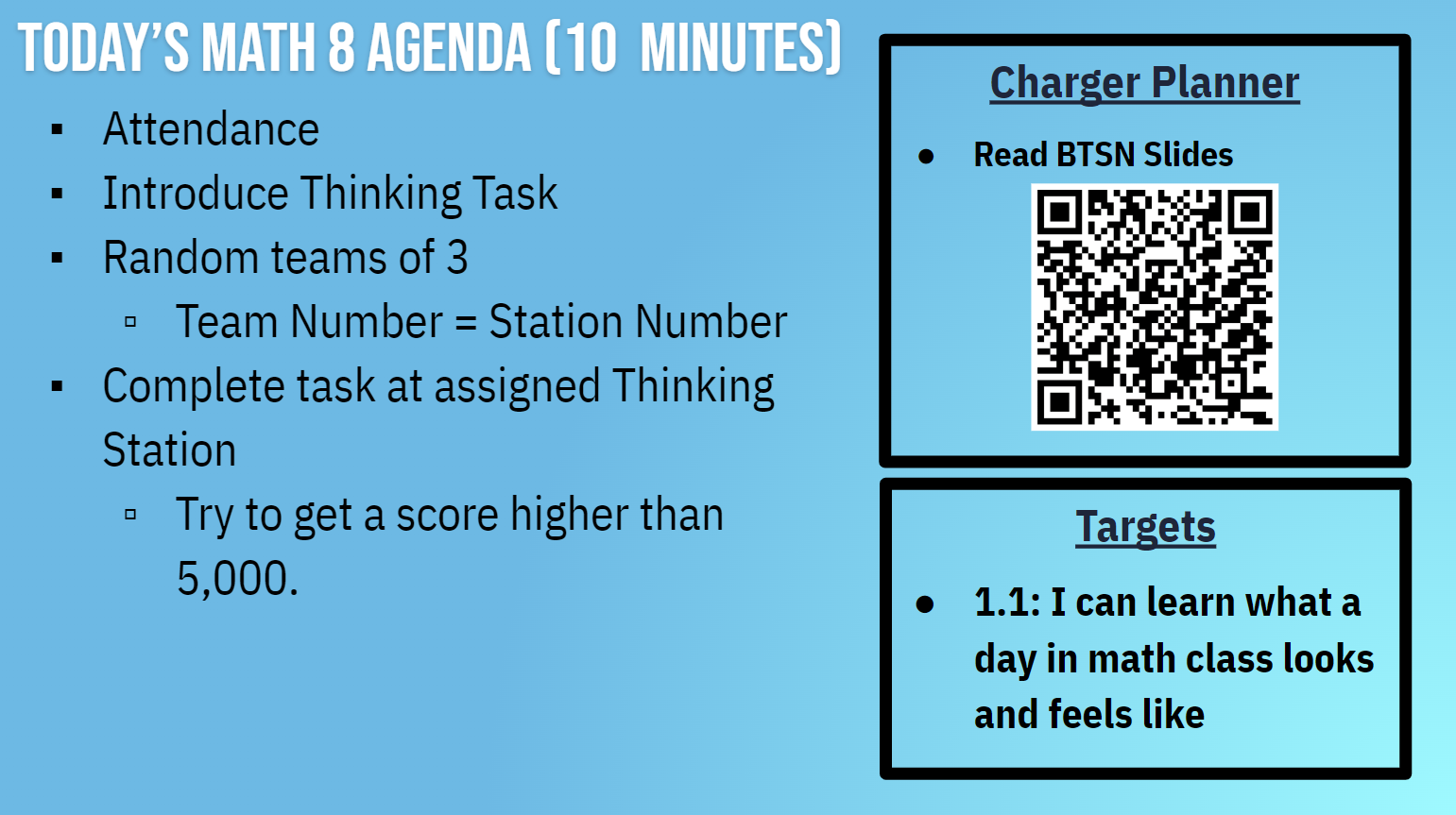
Last night my first period Math 8 parents came to class and the moment the first bell rang I began my lesson. In less than a minute I went over the class agenda for the day:
Yes, the QR Code links to my slide deck filled with Bitmojis.
In the next minute I explained the structure of how working at the VNPS Thinking Stations functioned and then randomly grouped the parents using my Random Team Picker pre-loaded with their children’s names, just like I do in class each day. They had 30 seconds to find their Thinking Stations and introduce themselves to their random partners. Next, I explained the Thinking Task for the evening, using the Split 25 task the students did the previous week. I said “Begin!”, and off they went.
Over the next five minutes I cycled through the room, checked in with each group, listened to their conversations about the task, and talked through their strategies. Parents were thinking, laughing, smiling, asking others for help, and were fully engaged in the activity (well, I had a few off-task parents, to be honest). I saw strategies evolve on the whiteboard, and heard them make connections about what would make the answer get larger and larger. With the last few moments in class I thanked them for their hard work, had them clean up their Thinking Station, and then the bell rang. And off they went to their next class period.
This was, without a doubt, the best Back To School Night I have ever experienced. I felt confident, joyful, and excited to be there. I wasn’t concerned about covering a bunch of redundant information, or thinking about what they all thought of me as a person. There was zero cotton-mouth and the whole night was just plain fun. I taught my lesson in the way I love to teach my students, and I am hopeful that each parent left the classroom feeling how much passion I have for this job.
So much better than a slide deck with Bitmojis.
Thank you to all of the parents who came to Back To School Night last night and allowed me to do what I love most. You embraced the lesson, engaged in the task, and brought joy to my heart. This was a night I will remember for the rest of my life.
Even though anything is possible, there are still a few things that are almost 100% guaranteed to happen.
The first day of school is always exciting. Even after 20 years in the classroom I get the anxiety flutters about 15 minutes before the first bell rings. I know that I’m ready, have everything planned out, and have done the mental reps to make sure I accomplish everything I want to on the first day. It’s just, well, you never really know how it’s going to go. Gather 34 different humans in a room for 51 minutes at a time and things have the potential to go horribly awry. One time I had a lesson go completely off the rails because a single house fly found its way into my room. Sometimes that’s all it takes. Come to think of it, it’s kind of a miracle that anything actually productive gets done on a daily basis.
Much of my first day excitement comes from knowing that anything is possible on the first day of school. Being a teacher means I am constantly learning and growing. I have learned from my past mistakes, reflected on my past good and bad practices, gained valuable wisdom and experience, and am a better teacher because of it. This year, in theory, should be my best year of teaching ever. Will I make new mistakes or fall back into some of my previous bad habits? Of course I will. Do I know that this year has the potential to be my best one yet? Absolutely.
It’s the same for my students. They all come to school feeling a sense of hope and optimism for a new year and chance to be their best. I can always feel that on day one. The challenge is to keep them feeling that hope and optimism going for all 180 days. Students don’t start the year expecting to fail. They learn that mindset over time, if you allow them to.
So yesterday was the first full day of school, and it went like many others. Even though anything is possible, there are still a few things that are almost 100% guaranteed to happen.
A student will be in the wrong classroom for period 1 and not realize it until I am finished with attendance. When they realize their name wasn’t called, they will check their schedule again, get hit with a wave of anxiety, then sheepishly exit my room looking for their science class instead.
Two best friends will make the strategic error of sitting next to each other when I allow everyone to sit wherever they want, thereby giving me critical human intel. Oh, you are best friends forever? I’ll remember that when I make my seating chart for next week.
At least one student from each class period will be way too friendly, way too fast. Slow down sport, I’ll learn your life story over the next 180 days, not the next 3 minutes.
After 2 months of being able to use the restroom whenever I desire, my bladder will not understand why it can’t be emptied during the middle of 2nd period. Come on bladder, we’ve been through this before. It’s going to have to wait until exactly 9:45AM.
The lunch line will be a hot disaster as 600 new 7th grade students will learn to navigate the new system. They get it down pretty fast, but day one is always dicey.
One of my EXPO markers will be sacrificed to the new school year gods and left without a cap on, or had the ink tip smashed into its body.
At least three pencils will be left on my floor.
During period 5 or 6 I will get confused as to whether I’ve covered the agenda for the day, as all the class periods tend to merge in my brain by then. I will have forgotten at least one thing. This year I forgot to take attendance during period 5. Literally the first item on my agenda and I biffed it.
By the last class of the day my vocal chords will be absolutely fried from talking more in one day in my “teacher voice” than the past 2 months combined.
30 minutes after school ends will be epic nap time. I have embraced the truth that teaching in my 40’s means many, many naps.
Most of these guaranteed events are trivial (although the student in the wrong period 1 class will most likely relive that moment in their head many times over) and don’t really matter in the long term. What does matter is that on the very first day of school each student and educator has a chance to contribute to the new school culture in a positive way. Every student matters, and every student has an impact. Anything is possible on day one.
I find middle school to be a completely magical place. Over a thousand children from a wide array of cultures and backgrounds are brought to a central location, learn a hugely complex system of routines and practices from many different educators who care for them, navigate an intricate web of personal relationships, and somehow leave with more knowledge and skills than they had the day before. What an amazing place to be.
You spending hundreds or thousands of your own dollars to bridge the gap does not fix the structural problem, it only hides it.
It’s the week before school begins. In less than 168 hours (which will be gone in what feels like 12 minutes) a large group of children will be in your classroom with varying degrees of motivation and multiple years of school experience informing their current demeanor. You gaze upon your empty learning space, thinking of ways to fill the void. Motivational posters, word walls, anchor charts, a handy rolling cabinet to keep art supplies accessible and organized. The possibilities are endless. You jot down your list of ideas, then head to Learning Trails, Target, or Office Depot to spend, spend, spend. Pretty soon your credit card has $500 more debt on it, but you have everything on your list and can’t wait to make the room look perfect.
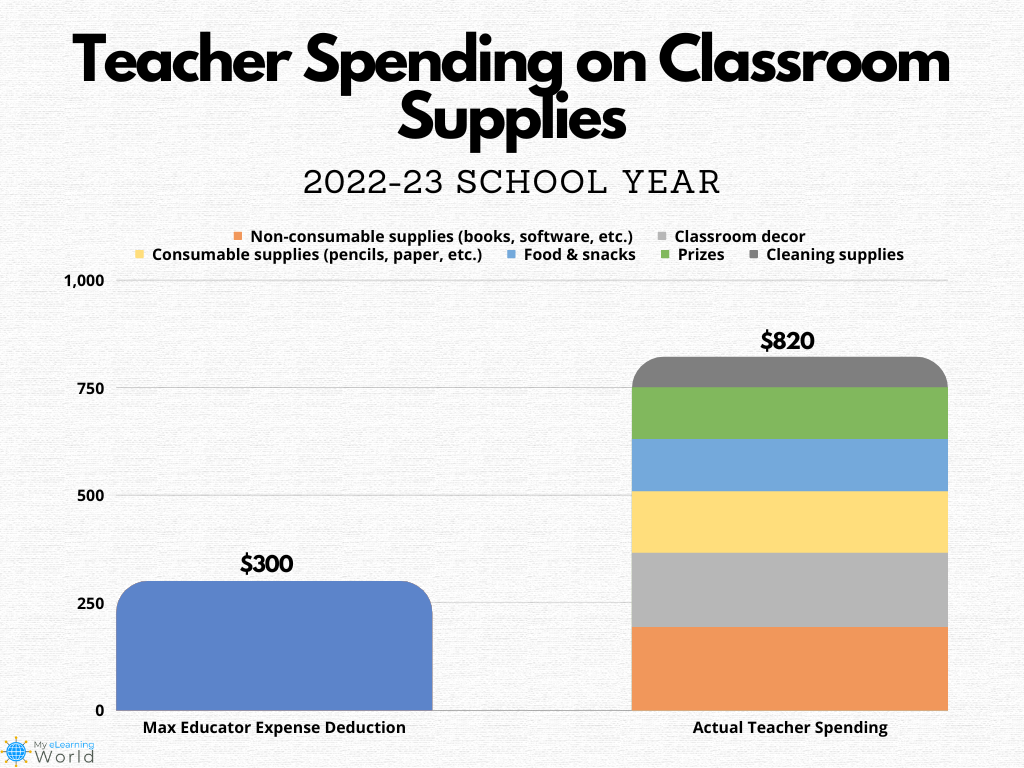
If you have taught for more than a few years, you can probably relate to this scenario. I know I do. This was my behavior for many, many years. If my classroom didn’t have something I thought it absolutely needed, I would go out and buy it. Seems simple enough. It’s all tax deductible if I buy it for my classroom, right? Yes, up to $300. I’ll get reimbursed from the school, won’t I? Maybe. One year I spent over $2,000 on my room and my students. Nobody taught me this mindset, as far as I can recall. For some reason I just felt like I was expected to spend my own money.
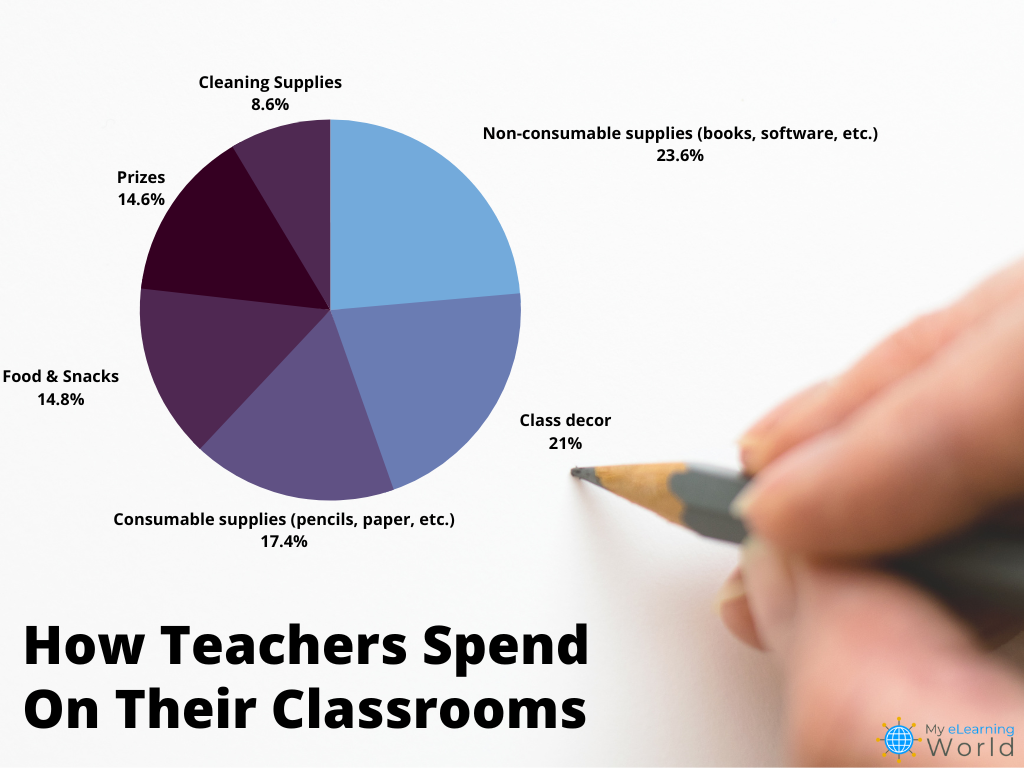
Is your classroom spending higher or lower than the national average?
While this most likely represents less than 2% of their average salary, $820 is a lot of money to many, many educators in this country. Personally, that pays for a full year of electricity bills, or two months of groceries, or almost two full seasons of ice hockey league fees, or 6 different Spartan races that I could enjoy. That rolling cabinet is nice, but I’d rather be playing ice hockey.
So, what are teachers spending their money on? In my early years I would spend about $100 per month at Costco for snacks I gave students who came after school for additional help. Sometimes it was last-minute supplies I needed for lesson ideas I thought up the day before. Excitement would get the best of me and I would rush out to Target to purchase everything I needed because I was not able to plan far enough in advance. This has declined in recent years because I usually try to manifest my idea digitally using Google Apps, which are free. For other educators, the spending varies from cleaning supplies (I bet this skyrocketed in 2020), to incentive prizes for students (or as I call it, learning by bribery), to classroom decorations (this has never been an issue for me).
Which categories do you find yourself spending in?
After almost two decades I finally came to the realization that none of this out-of-pocket spending should be happening. I have a few reasons for this mindset shift, some of which are pragmatic, and a few that are more conceptual.
1. I Probably Don’t Need It
Over the years I’ve purchased so many things for my classroom that I thought would inspire my students or magically unlock their learning. Low-tech, high-tech, no-tech, most of them never made much of a dent. A well-chosen thinking task paired with effective student communication strategies wins 100% of the time. Technology is great, but I haven’t found anything that beats a good class debate in a room where every student feels safe to share their thinking.
2. Classroom Culture Isn’t Found In a Store.
Hear me out. Classroom decorations are nice and pretty, but they don’t actually create the warm environment you are hoping for. You do. Your words, actions, teaching strategies, and classroom management create the safe learning environment you are looking for, not the kitten poster on the wall. You can put a million colorful borders, posters, and inspirational quotes around the room, but it’s all fake if your actions don’t match what’s plastered around the room. Instead of agonizing over what your room looks like, take that time to reflect on your teaching at the end of each day and examine whether your words and actions matched what you value.
3. My School Does Have Money.
The school you work at most likely has more money in the budget than you think it does. At my school each teacher has a few hundred dollars to spend on classroom supplies that is gifted by the PTSA (thank you!). We also have an amazing front office staff that can order just about any office supply from the district warehouse or approved vendors and it can be there in sometimes a day or two. This requires decent planning skills, which I have improved at over the years. I bet if you find the right person at your site to ask, and can plan far enough ahead, you can find money in the budget for what you need.
4. We Shouldn’t Have To.
It is not your job to cash flow the supplies in your classroom. The school district receives funding through taxes and it is their job to supply you with the basic things you and your students need. If a school cannot supply its teachers and students with even the basic supplies they need for learning, there is a larger community issue at play. You spending hundreds or thousands of your own dollars to bridge the gap does not fix the structural problem, it only hides it. If you notice many of your students are hungry during the day, perhaps the schools need to consider more school-funded nutrition breaks rather than you buying food for them.
5. I’m Perpetuating Stereotypes.
When you consistently purchase your own supplies, you further perpetuate the common societal belief that educators should be selfless heroes who constantly make sacrifices for their students because they love the profession and their students. That is an unrealistic, toxic stereotype that does more harm than good. Yes, there are teachers who practice extreme acts of kindness, empathy, and altruism on a regular basis because that’s just who they are and how they are wired. That is not the average person, and an entire profession should not be held to that standard. I don’t expect all baseball players to be Shohei Ohtani. That would be very unfair to the Trey Mancini’s of the world who are having a nice solid career, but not going to the Hall of Fame. It’s ok to be an above-average educator who is passionate about their job, but also has money to spend on their family and personal life.
So as you head into this school year, I implore you to think about why you might be spending your own money on your classroom. Are you not asking the right person? Do you need to work on medium and long term planning? Are you buying brand name items instead of using school provided supplies that work just as well? Are you hoping that your colorful walls will do the classroom management for you? Are you buying things you want rather than focusing on what the students truly need?
I’m guilty of all of these thoughts. When I have them I now I try to remind myself that no matter how much money I might spend on my classroom, it’s my words and actions that have the biggest impact on my students. Acts of kindness and empathy are free.
Shame spirals are never ideal, and avoiding them is preferable.
During my first few years of teaching I would arrive at school about an hour before the first bell would ring and those 60 minutes would fly by as I rushed to make sure everything was ready for the day. Sometimes I was lost in thought, repeatedly going through the mental reps of my lesson plan, trying to anticipate all of the things that could go horribly wrong. Other times it would be self-induced panic due to my brain coming up with a new idea the night before and I would be frantically trying to create my vision using an uncooperative table on Microsoft Word (seriously, why do tables never go where you want them to on that stupid program?). On other occasions I was desperately trying to finish grading an exam that I had held onto for weeks and promised the students I would return that day. As I sat in my classroom facing the school parking lot I would always spy the same couple of veteran teachers arriving at school 10 minutes before the first bell, calmly walking to class seemingly without a care in the world. How was that possible?
What secret did they know? Were they so incredibly organized and competent that they knew exactly how the day would go? Did they have years of lesson plans to fall back on and had the whole school year planned out already? Did they just never do anything new, so planning was a breeze? Did they utilize the classic 80’s grading strategy of “switch your paper with your seat neighbor and grade their work”? Did they grade nothing at all? Had they reached a level of complete apathy that it just didn’t matter what they did each day since they had tenure and only needed to tough it out for two more years in order to max out their pension benefits? Were they wizards? So…many…questions!
The word search is so accurate.
The longer I taught, and the more I got to know those veteran teachers, it really was a mix of all of those things, except maybe the wizardry. The longer you teach, the better you become at it. You make more efficient systems, learn better strategies, and gain valuable experience that allows you to innately anticipate student behavior, questions, and misconceptions. So now that I am entering year 20 of my teaching career, I’m able to arrive at school 10 minutes before the bell, right? Not a chance.
I still arrive an hour before the bell, and those 60 minutes still fly by. While I am more organized, and my grading practices have improved greatly, I still agonize over my lessons and frantically try to create things right before class starts. I change my agenda, come up with a new warm-up puzzle, or change the last question on a quiz because the other one just didn’t elicit the type of thinking I wanted to assess. I don’t think I’ll ever be a 10 minutes before the bell kind of teacher, because that’s just not who I am. Every single day of teaching is filled with large amounts of anticipation and anxiety, and if I didn’t arrive early, my whole day would be even more stressful than it already is.
Doesn’t look a day over 32.
Since I know this about myself, I have tried to be very intentional about reducing my stress and anxiety while at work, and to minimize the amount of work I do while not at work. If you know a teacher, you know they almost always take the job home with them pretty much every single day. They physically take the job home with stacks of papers to grade or lesson plans to make, or they mentally bring home the negative interaction they may have had with a parent, administrator, colleague, or student. The number of times I’ve lost an entire weekend because a negative parent email I read right before leaving work at 4:00pm on a Friday initiated an anxiety induced shame spiral is a non-zero number. Good luck sleeping this weekend, loser!
Shame spirals are never ideal, and avoiding them is preferable. So what strategies and practices have I learned that help reduce how much work I actually take home?
1) Answer all emails before I leave work.
Keeping up with the email inbox can be a challenge, but it only gets exponentially worse if I don’t take care of it consistently. My common practice now is to not leave work until I have cleared out my inbox. This means I have gotten quite good at writing succinct, to-the-point emails that answer the question and nothing more. Most parent emails can realistically be answered in one paragraph or less. The 504 plan update I need to complete really only takes 10 minutes. The Google form my colleague needs filled out is done in under a minute. Just get it done, and get the heck out of there.
2) Establish clear email boundaries with parents and students.
At the beginning of the school year I establish the 4pm rule with my students and parents at Back To School Night. I don’t link my work email to my personal devices, so if they send me an email after 4pm, I won’t see it until the next school day. I make sure to stress that if a student is having a mental health crisis there are much more effective people to communicate with who are available any time of day. I am not a mental health professional, but I provide them with emails and phone numbers they can use in case of emergency.
3) Make all copies before I leave work.
The copy machine is a fickle beast whose services are in high demand in the early morning hours. There may or may not be paper, toner, staples, or time for your job to be completed. After many stressful mornings I have finally learned to make all of my copies before I leave for the day. This has greatly improved my morning anxiety.
4) Only grade what is absolutely necessary.
Authentically grading student work and providing meaningful feedback is one of the most important and time consuming things I do. This practice takes a massive amount of time and energy. Knowing this, I have learned to strategically choose what I actually grade. I no longer grade any homework or much of the work done in class. Most of my classwork assignments are designed to allow students to correct their own work and assess themselves, so they have a clear picture of what they know, and what they still need to work on. When it comes time for an assessment that affects their actual grade I have time to do that because I am not inundated with scoring and recording meaningless busywork or random worksheets. I still take some of this home, but way less than I used to.
5) Keep a yearly paper calendar.
The school year is filled with special schedules, minimum days, early outs, lockdown/earthquake/fire drills, and professional development days. Knowing when all of these are at a glance is extremely helpful when planning a unit. Long term planning also relieves stress when it comes to supplies I might need for certain lessons. If I know I will be doing a lesson that requires students to use a large amount of sticky notes, I can ask ahead of time for those supplies at the front office. Sufficient planning ahead will mitigate the late night Target run the day before. I also like to have the paper calendar on my desk so I can always see it and it doesn’t rely on an internet connection. Paper never goes offline.
6) Sometimes average is good enough.
Not every lesson is amazing, nor will I be at my best every single day. While my goal is always 100% positive student engagement for every lesson, that almost never actually happens. If the lesson ends and I can honestly say that most of the students were highly engaged and felt safe in the room, I call that a win. I take some time after school to reflect and make some notes on what went well, what didn’t, and why. Then I move on.
Do I successfully implement all of these strategies every single day? Nope. Sometimes I break the 4pm email rule or forget to update my calendar. Once in a while I find myself grading a random classwork assignment and thinking to myself “why did I do this?”. On a drive home I’ll realize that I forgot to print some copies or update that IEP form. On average, however, I stick to these practices and I’m able to focus on my non teaching life once I leave my classroom for the day. One of my greatest joys in life is to come home without any work to do or think about and just do whatever I want (which is usually snuggle time with my perfect cat Puck).
Snuggle time > grading papers
What are some of the strategies you have implemented over the years to help reduce your own teaching anxiety and leave work at work? I’d love to know them. Please share!
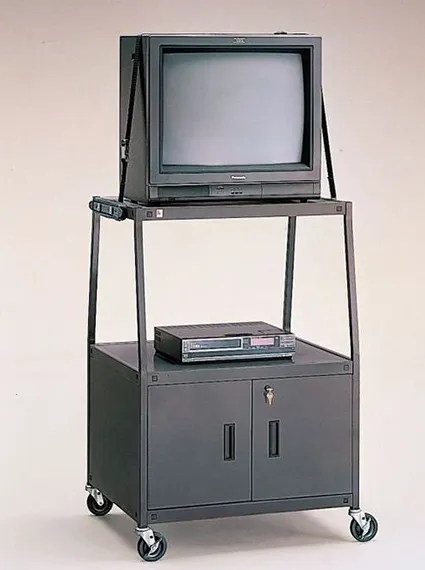
Back in middle school the best day ever was when one of my teachers would wheel out the cathode ray TV and VCR combo on a wheely cart and pop in a sweet VHS tape. Time to turn my brain off and coast for an hour. Unless it was Bill Nye the Science Guy, I was automatically asleep at the wheel, and no learning was taking place. The one exception was when we watched Honey I Shrunk The Kids in elementary school as a “treat” and I was forever traumatized by the heroic ant being viciously stung to death by a scorpion (thanks, Mrs. Heath).
It’s the safety strap that really does it for me.
Perhaps you have a thought or emotion attached to the TV/VCR cart that comes to mind. It might be quaint nostalgia, or perhaps an endearing feeling attached to knowing you didn’t have to work hard for an hour.
Now, what feeling is attached to the teacher who wheeled out that cart? What words come to mind when you think of the educator who used it once in a while. What about every week? How about constantly? I suspect that the more it is used, the more negative those descriptors tend to be.
Whether correct or not, the TV cart usually indicated a teacher who was tired, lazy, or unmotivated. Aside from being the easiest sub plan ever (insert VHS, press play, relax), the TV cart showing up in class constantly was not a strong sign of an effective educator. Not much learning was going on in that classroom, I would surmise.
Even though TV carts are a relic of the past (if your school still has these in circulation, I’m sorry), there are modern equivalents that show up just as often. Obviously, firing up Disney + on your overhead projector is just a new technology form of the same thing, although there are many great documentaries and nature programs available that are of high value. Interactive quiz apps like Kahoot! and Blooket can be used effectively for review of a particular learning target, but often turn into “Name That Corporate Logo” or “Interesting Facts About Halloween” time wasters.
In my classroom my goal is to use every single minute for instruction and mathematical thinking. I don’t always succeed, but I’m always trying to maximize the learning. This means having the agenda and warm-up thinking task ready to go as the students walk in. Attendance is done within 30 seconds of the bell ringing. The main lesson starts no more than 5 minutes after class starts (after completing the warm-up task), and ends within 2 minutes of the bell ringing so students can organize their materials and get ready for the trek to their next class. Students are NEVER meandering around the room or standing by the door for minutes at a time, waiting for the bell to ring so they can sprint to the snack line (this is a huge classroom management pet peeve of mine).
So what do I do when the lesson ends early, or we have a few spare minutes left in class? Why, math games, of course! Over the years I have collected a few reliable math games that are effective in many situations, and require almost no materials or prep work. Here are some of my favorites:
The X Game
Time needed: Less than one minute.
Materials: Overhead Projector or Vertical Whiteboard Surface.
The perfect game for when you have less than a minute of class and you don’t want to waste it.
1. Think of any two integers (or fractions if you are feeling spicy). Draw an X on the board and write the product of the two numbers in the top space and the sum of the two numbers in the bottom space. For example, if I’m thinking of the numbers 3 and 5, I would draw this:
2. Have students silently study the drawing and determine what two numbers go on the left and on the right. For the above example, it could be 3 and 5 or 5 and 3. If they know the answer, they raise their hand. I never call on the first student, as my goal is not speed. I usually call on the 5th or 6th hand. If they get it correct, I make a new one. I can usually do 2-3 per minute once the students understand the game.
Note: I do not tell students how to figure out the blank numbers on the left and right. I just write it on the board and tell them to figure it out. Eventually they conclude that two numbers must multiply to get the number on top and add to get the number on the bottom. In 19 years I have never had to explain this game. I just write the x, the top and bottom numbers, and tell them to figure it out.
This game is great in middle school, as it secretly prepares them for factoring quadratic equations in high school later on.
Mental Pattern
Time needed: About 2-3 minutes.
Materials: Overhead Projector or Vertical Whiteboard Surface.
This game is my go to when I have only a few spare minutes left in class. This is great for developing number sense and function recognition. Here’s how it works:
1. Think of a function, any kind. Linear functions are best to start with before making things more complicated as your students get used to the game. Something like y = x + 7 or y = 3x is a great place to start.
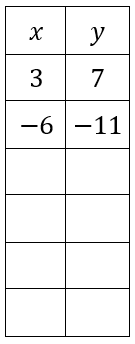
2. Write a T-Chart on the board and complete two rows of the chart using random inputs. I usually do one positive integer and one negative integer to begin with. I never start with zero.
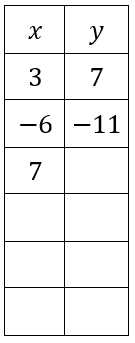
3. Give students some time to consider the pattern. If a student thinks they know the pattern being used, have them raise their hand. After a few hands are up (hopefully), call on one student and give them another x-value in the table and have them mentally compute the correct output. They are not explaining the pattern out loud, but simply giving the numerical output for the given input. If no students raise their hands at all, fill in another row with new values to give them more to think about.
Note: It’s important to stress that this is a mental math game and that students must try to figure out the pattern themselves. They are not sharing answers or telling other students how to do it. It is much more satisfying for a student to suddenly realize the pattern rather than have someone turn to them and tell them what it is. That’s no fun!.
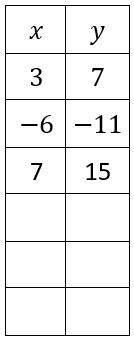
4. If the answer is correct, fill in the table with that answer. If the answer is incorrect, just say that it is incorrect and call on another student. Many times students will be incorrect in the first round since the table does not have much information in it and they are thinking of many possibilities. Wrong answers are great, as they help narrow and focus other students’ thinking.
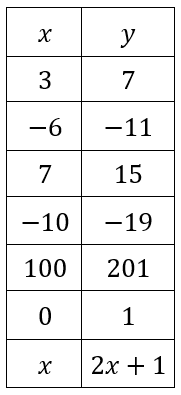
5. Continue this process, always calling on new students as you go, for about 5-6 different rows in the table. You will notice that more hands will go up each time you add numbers to the table. Sometimes students need a bit more time or a few more pieces of evidence for them to finally see the pattern. Once you have 5-6 rows complete, have a new student explain the pattern, or describe the pattern in terms of x.
6. Repeat the game with a new pattern if you have time. I usually just make one up in my head depending on the class I am teaching and the student population. If I know the class has been struggling with linear functions, I might focus on proportional equations or one-step linear functions. If they have mastered linear functions, I might start with linear functions with fractions or integers, then extend into simple quadratics such as y=x^2 + 3 or something with absolute value in it.
I can usually sneak one or two rounds in at the end of class. Some students will be packing up and organizing their belongings while others are playing the game. Nobody is just wandering around the room or waiting at the door.
Warning: This game is exclusionary in nature, and may not be right for your class culture. I don’t play this game with every class. If you have fostered a growth mindset and students are ok with publicly getting math wrong, then it can be really fun. In most cases, students make fun of themselves and have a great time and are ok with messing up in front of others. We laugh a lot, but not at the expense of others.
This game is great to play outside if you have decent weather and just need the kids to move around a bit and be able to be loud. Here’s how it works:
Have all of your students stand in a circle with you in the middle. Explain the rules as follows:
I will call out a factor number, point at a random student, and point either left or right.
Starting at the number 1, each student must say the next number in order out loud.
When you say the number out loud, you must either clap, or not clap, depending on what number you are on.
If the number you yell out is a multiple of the factor number, you DO NOT clap.
If the number you yell out has the factor number as one of its digits, DO NOT clap.
If neither of the above is true, CLAP.
If you clap when you shouldn’t, or don’t clap when you should, you are out and must either sit down or leave the circle.
When a player gets out, the next student starts back at one.
I can change the factor at any time, so pay attention!
For example, suppose you point at a student, yell out 4 as the factor number, and point to the left.
The first student yells out 1 and claps.
The student to their left yells out 2 and claps.
The next student yells out 3 and claps.
The next student yells out 4 and DOES NOT clap.
Student 5 claps.
Student 6 claps.
Student 7 claps.
Student 8 DOES NOT clap, since 8 is a multiple of 4.
Students 9-11 clap.
Student 12 DOES NOT clap, since 12 is a multiple of 4.
Student 13 claps.
Student 14 DOES NOT clap, since 14 has the digit 4 in it.
Keep going until someone messes up.
I usually use the same factor for a few rounds and then change the number and the direction.
The last three students standing are the winners of the game.
A non-exclusionary variant of the game is to work as a class to see how high you can get without making a mistake. You can write down class records for different factor numbers and try to beat them as the year goes on. This way you are working as a team, rather than having individuals trying to win on their own.
D.U.C.K.S.
Time needed: 10-15 minutes
Materials: Overhead Projector or Vertical Whiteboard Surface, two number cubes, 1 quarter sheet of blank paper per student, 1 pencil per student.
I learned this game at a math conference about 17 years ago and cannot remember who taught it to me. Sorry, un-credited math educator. You are forever in my debt. I remember he called this game “SKUNK”, but I re-named it because I love the Anaheim Ducks, and it’s also easier for each round of the game to be represented by a different letter in the alphabet.
Hand out a quarter sheet of blank paper to each student and have them write D U C K S (or whatever word you like) at the top of the paper, like so:
Each letter represents a different round of the game. If you want a shorter or longer game, you can use a shorter or longer word. 4-5 rounds is usually the right amount.
Here are the rules of the game:
At the beginning of each round, all students stand up at their seat (I provide red/green nesting cups for students who are unable to stand up due to physical differences. Green means standing, red means sitting).
At the beginning of the round the game leader rolls two number cubes. I roll under a document camera for transparency.
If neither number cube shows a 1, the values are added together and every student standing gains those points.
For example, if I roll a 5 and 4, every student standing would write under the letter D that they got 9 points.
If either number cube shows a 1, the round is over and anyone standing loses all of the points they collected that round.
Optional rule: If the very first roll in a round has a 1 in it, ignore it and re-roll until you get a non-1 roll.
After each roll, every student standing can choose to stay standing and continue playing, or sit down and be “safe”.
Seated students cannot gain more points or lose any points. This is the only way a student can actually earn any points. If they stay standing, they are always risking their points.
Once a student sits down during a round, that student cannot stand up again until the next round.
A single round is over when one of two things happens
A 1 is rolled on either number cube.
Every student has chosen to sit down before a 1 is rolled (this rarely happens).
At the end of the round, all students stand up again and begin the next round.
Repeat this process until all rounds are complete.
The winning student is the one with the most total points over all 5 rounds.
This requires a level of integrity and trust that students are keeping score correctly.
Verify the student’s score by confirming how many numbers they got for each round and that it all adds up.
Optional Rule: Rolling two ones, or “snake eyes”, causes all students standing to lose all of their accumulated points for every round completed, not just their points for that round.
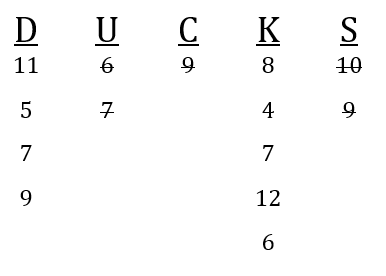
Here’s how a student’s score card might look at the end of a game:
In round D the student stayed standing up for 4 consecutive rolls, then sat down. They earned 32 points.
In round U the student stood up for two rounds, then was still standing during the third roll, which had a one in it, so they crossed out the points they had earned.
Round C was tough, as a one was rolled on the second roll, so the student lost the 9 points they had.
Round K was great, as they stayed standing for 5 straight good rolls and earned 37 points before sitting down.
They got no points for Round S, as they were standing up when a one was rolled on the third roll.
This student would have a total score of 69 points. Nice.
Admittedly, there isn’t a whole bunch of skill involved in this game, but it does elicit good conversations about probability when rolling two dice. I love playing this in 7th grade after doing the Statistics & Probability unit.
Since this game takes longer than most, it’s great for a block day as a break between activities, or a fun way to close out a long class period.
Hopefully you can use one of these free math games in your own class and keep your students thinking until the very end of class.
What are some of your favorite math games to play in class that require little to no prep work or supplies? Let me know in the comments.
I have a pretty strong memory of the first math lesson I ever taught. If I close my eyes I can picture the room, although many of the faces are a bit fuzzy at this point. There are six neat rows of desks, each with five single-student desks. All of the desks face the front, and eager 7th grade students fill each one. I hand out a quarter sheet of blank paper to each student and ask them to write a sentence or two about their experience with math in elementary school. Once they write down their responses I confidently say “Crumple up the paper and throw it in the trash! This is a new year, and you get to write a new math story for yourself. This year will be different!”. The students excitedly ball up their paper metaphor and hurl it towards the large trash bin I borrowed from the custodian. Students are smiling. I’m excited. Attitudes are positive and refreshed.
What a lying liar I was.
Pretty much nothing I did in my first year was “new” or “different”. I was barely making it through each day, and I relied on what I had experienced as a student and what my colleagues told me to do.
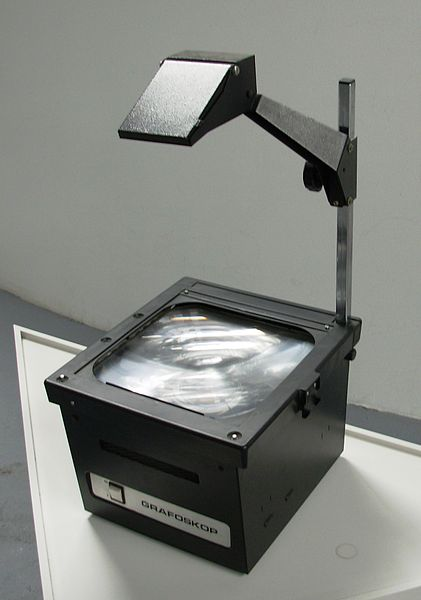
I didn’t innovate. I didn’t trail blaze. I survived. Almost every lesson was the same format, since it was all I knew how to do. I wrote notes on the overhead projector with my set of 4 Vis-a-Vis pens, and the students sat there and copied the notes down in their notebooks. If we finished the lesson early they could start their homework, or we might play a game.
If you see this and think “Math Class”, you grew up in the 90’s.
Thrilling.
Any educator with at least a decade of experience can definitely look back and think of some teaching strategies or “not-so-best practices” they used to use and feel a huge sense of cringe. Here are my top 3.
1) The Cold Call
One job that I thankfully have never had to endure is that of the cold calling salesman. The thought of randomly calling a name on a list and trying to sell them something raises my anxiety level to DEFCON 3. Forget the concept of knocking on a random person’s door and being like, “Do I have a food storage system for you!”. Just… no. I cannot do it. If that’s the case, then why was I fine with randomly calling on students in the middle of my lesson, just hoping they would know the answer and be confident enough to say it out loud?
It is my belief that when you cold call on a “random” student, it’s almost never really random (unless you are using some kind of truly random system, such as a random number generator). Unconscious bias (or maybe even conscious, if we are truly being honest) leads you to choose students you know are not paying attention, or those who are less likely to raise their hand. It works more as a classroom management/punishment strategy than it does a method of eliciting knowledge and vigorous classroom debate. It’s a negative method of keeping students “engaged” and “paying attention”, not because the lesson is so engaging, but because students are fearful that they might be randomly called on and possibly look foolish in front of their peers.
Have I used this in the past? Absolutely. Do I still do it now? Sadly, sometimes. Old habits die hard. Edutopia’s article this past April tackles this topic in more detail, and suggests 8 ways to make this a more positive strategy. It is my hope that I remove this strategy from my daily teaching practice once and for all. I strive for a classroom where students work in teams to tackle challenging, engaging thinking tasks that foster rich discussion that students want to be a part of. If you have to force them to participate or pay attention, the lesson isn’t good.
2) The Hunger Games
Middle school introduces many new social situations to children that are inherently anxiety inducing. The convergence of two or more 6th grade student groups, all with their own ingrained social dynamics, can cause friend groups to splinter and crumble. Many students begin their first forays into dating (mostly via text message over a hormone flooded 24-hour period). For some kids just the act of changing clothes for P.E. can be terrifying. Every day, possibly every hour, can introduce a new stressful social scenario. Knowing this, why did I ever let students choose their own groups?
When I first started assigning group projects I would always begin by trying to hook the students with an engaging introduction to get them excited about the work. One of my favorite projects was when I had my 7th grade students design their own homes. I handed out model home floor plans, discussed the budget they would have, and how many square feet they could use. No matter how hard I tried, however, students would start to do the social mental math and try to figure out who they could work with. Eyes darted across the room, making contact with possible partners. Many groups would be chosen non-verbally before I even presented the rules. Invariably, some students would be left out.
Heterogeneous, homogeneous, teacher chosen, student chosen. It honestly doesn’t matter. All of the traditional methods of choosing groups include bias, either by the teacher or the students. When the teacher chooses heterogeneous groups strategically, students tend to assign themselves roles based on their own self-perception. “James is in this group, and he has an A in the class, so he is meant to be the leader. I’ll just stay quiet then”. Peter Liljedahl discusses this phenomenon at length in his book Building Thinking Classrooms (and I discuss it in more depth here). A homogeneous group frequently lacks diversity of thought. When students choose their own groups all sorts of social factors come into play, which almost certainly disadvantages some individual students (in my experience, students on the Autism spectrum and neurodivergent thinkers often get left out by their peers).
I choose to select groups as randomly as possible. The Picker Wheel app makes all of my groups completely random, and I spin the wheel in front of the whole class. Whether we work at the vertical thinking stations, sit in table groups, or convene for a large project, I let the random number generator decide. This removes much of the social anxiety of students finding their own groups, and absolves me of any bias I might bring. Yes, students still get grouped with others they don’t get along with at times, but part of life is learning how to work with others. Let fate take the wheel!
3) The Ticking Time Bomb
One of the most common Hollywood tropes is that of the ticking time bomb. The hero discovers the nefarious device and must frantically work to figure out how to disarm it. If they are lucky, the hero has a knowledgeable colleague on the other end of an earpiece calmly giving detailed instructions. At the very last moment, the hero cuts the correct wire and the day is saved. Hooray.
The best ticking time bomb scene in cinema history.
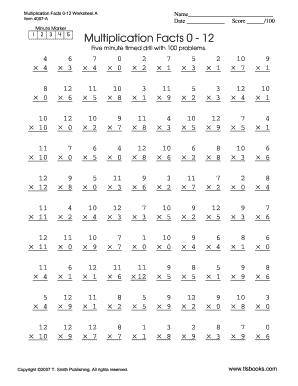
This type of actual bomb scenario pretty much never happens in real life. Yet, educators across the country (including my early teaching self) recreate this same situation on a daily basis with their students when teaching mathematics. How, you ask? Well, it’s our old friend the “Timed Fact Test”.
I honestly can’t think of a worse way to entice kids into loving math.
In an effort to instill math fluency, thousands of educators every day give hundreds of thousands of students little sheets of math fact problems that they must complete in a certain amount of time. Some even have elaborate reward systems for students who reach certain time benchmarks. I even remember doing this as an elementary school student, with my 6th grade teacher adding in the caveat of saying random numbers out loud while we worked to throw us off even more. I honestly can’t think of a worse teaching strategy.
I also can’t believe I used to do this in my own classroom. Now, in my room it wasn’t basic math facts, but rather perfect squares up to 625 and certain formulas such as volume of a cylinder or area of a trapezoid. I printed out half sheets of paper and gave students two minutes to complete them by memory.
Why two minutes? Hell if I know.
Did they really need to memorize those numbers and formulas? Nope. The internet exists.
Why did I do that? I have no clue.
How much anxiety and trauma did I cause students every Friday when I gave those tests? No way to tell, but it’s not zero, that’s for sure.
Jo Boaler’s article in 2012 suggests “timed tests are the direct cause of the early onset of math anxiety” and that “Math anxiety affects about 50 percent of the U.S. population…” If we have known this for more than a decade, why are we still doing it? Searching the phrase “math facts fluency timed tests” on Teachers Pay Teachers gives over 2,700 search results.
Ask yourself this question. When was the last time in your life that you had to do quick mental math under great pressure. I’ll wait. The only time I encounter this in my life is when I play Dungeons & Dragons, and even then I’m not being timed. Yes, I need to do some mental math to add my dice rolls. No, I’m not timed nor is there a dire consequence if I am slow.
Yes, math fluency is important. The better a student’s fluency is, the more time and space their brain has for tougher cognition tasks when they get to subjects like percentages, fractions, algebra, and beyond. Do timed tests develop and assess fluency? No. They only create frustration and anxiety, which makes math even harder for students to learn.
I stopped giving timed memorization tests around 2017 (yes, I was also late to the party). They will never happen in my classroom again. There are no bombs about to go off in the classroom. Let’s stop acting like there are.
Those are my greatest teaching strategy regrets. Care to share yours in the comments? Own your shame, knowing that we are always doing our best, but also always looking to learn and improve.
P.S. – To all of my former students who I gave timed tests to: I’m sorry. Please forgive me.
My list of the All-Time Hero Supplies that I use in my classroom every single day.
It’s a lazy Saturday morning in the middle of July, 1993. I’m 12 years old. I’m barely awake, but alert enough to shamble downstairs to pour a giant bowl of Honey Bunches of Oats and turn on X-Men: The Animated Series. My favorite mutants Wolverine and Rogue are battling the evil Sentinels, as well as their own feelings for each other (it doesn’t work out). I’m in the zone. Life is good. Then my world comes crashing down.
Back-To-School shopping commercials invade my happy place.
Markers, Trapper Keepers, JanSport backpacks, Elmer’s glue sticks. Target is selling it all!
That Unicorn Rainbow Trapper Keeper though.
But summer just started, didn’t it? It’s only July! NOOOOOOOOOOO!
It was always a gut punch when those Back-To-School ads came on TV. The joyful summer utopia was coming to an end, whether I wanted it to or not. If I’m completely honest, it still feels that way now. The bad news is delivered a bit differently now, usually in the form of an Instagram ad, or a quick YouTube ad that I skip after I’m held hostage by capitalism for 4-5 seconds.
I actually got my first back to school ad yesterday (yet another reason to delete Twitter). Once I recovered from the ennui and existential dread, I actually thought about what supplies I rely on heavily as an educator, and how my back-to-school shopping list varies greatly from that of my students.
So here is my list of the All-Time Hero Supplies that I use in my classroom every single day.
Disclaimer: This post contains Amazon affiliate links. As an Amazon Associate I earn from qualifying purchases.
My go-to grading pen for about 14 years was the Pilot G2 0.7mm blue pen. I must have marked tens of thousands of tests with that trusty work horse. It was smooth, had a great grip, and a large ink reservoir that never seemed to run out. We had a good thing going. My only issue was that I could not easily fix my mistakes, relying on White-Out tape to hide my oopsies. Then the Frixon Erasable Pen came into my life.
Words cannot express how much of a game changer these pens have been in my daily teaching life. About 5 years ago I saw a student using one of these, and it blew my mind. My only experience with erasable pens was back in high school when I had the Eraser Mate. It was…not great. Yes, it would “erase” the ink, but would always leave a terrible smear and smudge the page. Good try, Paper Mate, but no. I reject you. Apparently erasable pen technology has improved over the past 30 years.
The Frixon pen erases really well, and I absolutely love it for when I am giving feedback on assignments and assessments. I use it also when writing on the document camera and am able to fix my mistakes quickly without having to use White-Out. While the ink does not apply as smoothly as the G2, I still prefer the ability to erase anything I write. I also love that I have been using the same 3 pens for the last 5 years, since you can purchase replacement ink cartridges for about $2.00 less than the cost of a whole new pen.
My classroom has a lot of whiteboard space. Like, a lot. I am always in the hunt for effective whiteboard erasers that are versatile and washable. These are a great choice, as they have a magnet inside that will stick to any magnetic surface. Many of the whiteboards in my room are also magnetic, so I can stick these all over my vertical whiteboards and students have easy access to them.
I also tried placing these in my supply bins at each table group, but that proved to be folly, as the soft blue material is easily picked at , stabbed, and/or defaced. The moment you have a less-than-engaging lesson in your class, these become a fun canvas for a bored student to…artistically explore?
Final Supply Rating: 7/10
TL,DR: Versatile. Magnetic. Not Durable. Easy to violate artistically.
Probably the most crucial supply in my classroom, I go through about 100-200 expo markers per school year. While I prefer the bullet tip, the chisel tip is much cheaper for some reason. While it’s nice to have a variety of colors, I tend to just buy the black markers. The main reason is that if there is only one color option for the students, they can’t fight over them. Everyone gets a black marker. Deal with it. Now if only I could prevent the students from smashing the tip of the marker into the housing, rendering the perfectly good marker useless.
Sheet protectors are an essential supply in my classroom, as they serve a few purposes in my day-to-day lessons. Before I had whiteboard tables, they were an extremely cheap method of creating personal whiteboards. Slide in a single sheet of white computer paper or cardstock and you have an instant mini whiteboard. Now that I have tons of whiteboard space in my room, I use these for most of the thinking tasks I assign my students. I can print out a set of Open Middle problems and slide them each into a sheet protector and the students can grab one at a time, write all over it while they think about the problem, and erase it when they are done. While using VNPS during a thin slicing lesson (see my BTC Journey page for more on that topic) I put each task card in a sheet protector and each group is able the grab the task they need and hang it on a push pin in the wall that the whole task is visible while they work.
Students doing the Spider Box thinking task.
With the teaching strategies I currently employ I always need a few hundred sheet protectors on hand.
Every year I tell my students that they need only two things when they come to school every day. If they just do these two things, they will be fine.
Wear appropriate clothing.
Have a pencil.
That’s it. Pretty much everything else is taken care of if they just complete those two things each day. Sadly, some students are only able to complete 50% of this list (thankfully, I have never had a student go 0 for 2).
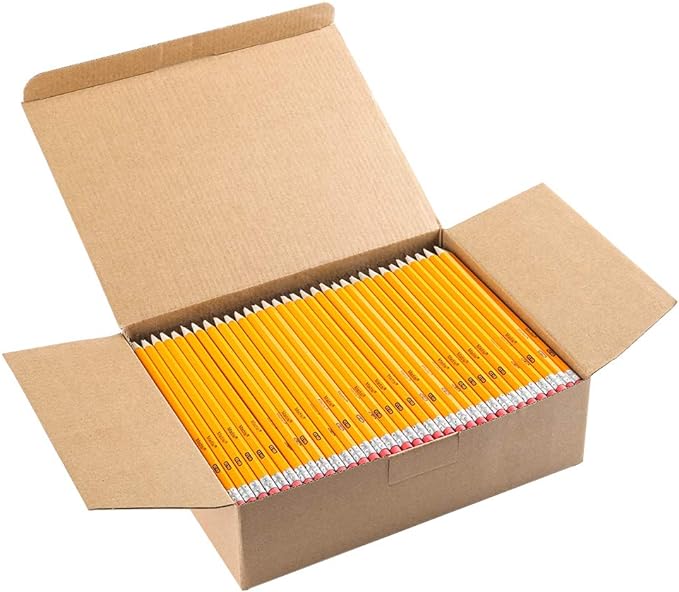
If you’ve ever taught middle school you know that the children seem to eat pencils. They just…devour them. It’s astonishing. I’ve tried many borrowing systems over the years for those forgetful students, but it can be distracting or time consuming when a student approaches you for a pencil in the middle of your lesson. I finally caved and just buy the giant box of bulk pencils. Need a pencil? Don’t bother me, just go get one from the dispenser.
I love this pencil dispenser simply because it reminds me of the straw dispensers that McDonald’s used to have back in the day. The bulk 320 pack of pencils will usually last the whole year. Sometimes yes, sometimes no. It’s not a perfect system for sure, but it is what it is.
Final Supply Rating: 8/10
TL,DR: Fun Dispenser. Time saver. Enables irresponsible behavior. You can never buy enough.
That’s my Top 5 list of things I must have on day one to start school successfully. What did I miss? What supply must you have in order to get through the school day (don’t say coffee)?
So what can you do to prepare for your new job, and what should you do on day one?
You navigated EdJoin for countless hours, submitted countless job applications, filled out the additional online questionnaires at each district, and survived the job interviews. You finally get the call you have been hoping for. You’ve been hired! After the adrenaline wears off, you realize that you are in for a big change, and you wonder what to do next.
In most cases, there isn’t much to do right away. Hiring is usually done in May and June, and you won’t even be able to see your classroom until August. You will probably want to get the contact information for your future colleagues, but that will most likely be unfulfilling. As you might know, most teachers go feral over the summer, so getting in contact with them and having meaningful conversations about work during June and July is not likely. (Unless one of your colleagues reads Building Thinking Classrooms and then ambushes you at your home and talks at you about it for hours and hours. That wasn’t me, I don’t know what you’re talking about). So what can you do to prepare for your new job, and what should you do on day one?
Know Your Content.
It’s summer, you have time (hopefully) to read and process information. Take this time to actually read the entire Common Core Standards Framework for whatever grade you will be teaching. I don’t mean just the standards, but the actual framework document. The standards are just a list of skills to teach with some additional explanation. The framework gives much more guidance about the depth and rigor you should go into for each standard, and gives examples of what that looks like. The document is not perfect, and can be difficult to read sometimes, but it is crucial for you to actually read and process. You have to know what you are actually supposed to teach.
Whether going into a new district, a new school, or just a new department at the same school, you have to not only know the content, but also what content is supposed to be taught. You cannot go wrong if you stick to the framework and the standards. The framework will tell you which standards are essential, and which ones are supporting and less important.
Let the triangles guide you!
For example, the Grade 8 Math Framework is shown above. Notice those little triangles shown after some of the listed standards? Those are the Major Clusters, which are “areas of intensive focus where students need fluent understanding and application of the core concepts.” Let’s say that near the end of the school year one of your colleagues wants to spend the next three weeks on a really cool project on volume, but you haven’t covered Pythagorean Theorem yet. What should you do? Well, I’d go with Pythag, since that is a Major Cluster, and volume is not.
Knowing the standards is critical in planning out your year and knowing where to spend your time. Before the school year starts make sure you have thoroughly read the Framework and know what needs to be taught.
Make A Calendar
If possible, try to find a digital calendar of events for the upcoming school year. The district most likely already has the master calendar for the next school year posted on their website for parents. You might even be lucky and your individual school site will have all of the major events planned out for the upcoming year. If you can get access to that, great. Before the school year begins I like to fill out my school year calendar with as many events as I can to help with my lesson planning. When are the professional development days, minimum days, holidays, assemblies, weird schedules, and ASB events? The sooner you know when those are happening, the better.
Rejoice when you see a green box!
Get To Know Essential Staff
It goes without saying that you should treat everyone at your workplace (and life) with kindness and respect. It’s literally the only way society functions. That being said, there are some critical staff members you will rely on that you should meet and get to know on Day One. They are:
The Front Office Staff
Our school has the most amazing front office staff, and yours probably does too. These professionals are crucial for making school function, and all play an important role. At my school we have an attendance clerk, Principal’s assistant, admissions clerk, and office assistant. I interact with them every single day, and they have saved my bacon more times than I can count. Need a last minute supply for a lesson? Office staff. Copier has run out of staples halfway through your job? Office staff. A student left a phone in your classroom? Office staff. Think a student has ditched class? Office staff. Need to find money in the budget for some classroom furniture? Probably the Principal, but maybe the office staff! Just need to vent about how bad the Ducks played last night? Office staff.
If there is a classroom issue that I cannot handle on my own, it can be solved by the office staff about 90% of the time. Make sure you know them in an authentic way, and that they know you appreciate all of the work that they do. Start on day one, and never stop.
The Custodians
My school has over 1,000 students aged 12 through 14. They are loud, energetic, and messy. The school custodians do an incredible job every day to make the school a safe, clean place to learn. Aside from that, the custodian is usually the keeper of the furniture. Your school site probably does have that one piece of furniture that you need, but only the custodian actually knows where it is. Need one more table for supplies in your classroom? Custodian. Did a chair break and one of your students is sitting on the floor? Custodian. Queasy student didn’t make it out of the room before…ejecting? Custodian. Need a 12-foot ladder for your Barbie Bungee lesson? You guessed it.
Aside from getting to know them, one thing you can also establish on day one with your students is a clean classroom. My students know that at the end of the school day their job is to make sure the custodian can skip cleaning my room. It is my hope that the night custodian opens my classroom door, looks around and says, “I don’t need to clean this one!” Their task is huge. Do your best to make it a bit easier. One of my former colleagues kept a vacuum cleaner in his room and would vacuum his room before leaving school each day. Not because the custodian did a poor job, but so they had one less room to clean.
The IT Staff
For better or worse, classrooms are full of technology now. Most of the time it works. Sometimes it does not. There will always be someone at your school site that knows the technology way better than you. Ideally, you have an on-site IT staff person who can come to your aid quickly if necessary. Sometimes it is a teacher in a stipend position. Sometimes you have to send a Help Desk ticket via email (which can be a struggle when your email is not working).
The best option is to meet with your site’s IT person early in the year and go over the technology currently in your room and make sure you know how it works and what to do when something goes wrong. Spending 30 minutes with them at the beginning of the year trouble shooting problems can prevent or alleviate many issues that happen in the classroom. Be mindful of their time, however, since they are extremely busy at the start of the school year.
Hang In There
The first day of work at your new school will be a complete information overload. There will be meetings, handouts, schedules, lists, walkthroughs, etc. You might remember 10% of everything when the day is over. Just keep everything you are handed and read it over the next day.
Forget something? The office staff probably knows the answer. Good thing you already met them and know their names, right? Or it might be on your completed calendar.
Just remember that you are not alone at your school. Even though your classroom can feel like an isolated cave most of the time, you are part of a community of helpful, kind people. There is always someone at your school who can help you out. You just need to ask.
























 EZMath Blog