It’s game night and you are ready to host your trusty board game geek friends for another spirited marathon session of Settlers of Catan, Codenames, and Ticket To Ride. But wait… the married couple’s baby-sitter has cancelled, your old college roommate has a cat emergency, and your high school pal got surprise with a free Taylor Swift concert ticket. It’s just you and your partner for tonight? You still want to play board games, but what do you do? Well, perhaps it’s time to try out one of these great two-player games!
Here’s a list of my 6 favorite board games that work amazing for two people, with some commentary and critique mixed in.
Disclaimer: This post contains Amazon affiliate links. As an Amazon Associate I earn from qualifying purchases.
When I first sat down to play the revised edition of Arkham Horror: The Card Game, I felt a thrill of anticipation. The Lovecraftian theme is so immersive, and every decision felt like stepping deeper into a dark, eerie world. The streamlined mechanics made the experience smoother than earlier editions, and the narrative drew me in immediately. Building my investigator’s deck felt like crafting a personal story, and every card I played revealed a piece of that tale. As my partner and I faced eldritch horrors together, the cooperative gameplay kept us engaged and on edge.
The game wasn’t without its frustrations, though. The reliance on luck from card draws added some unpredictability that occasionally disrupted our plans. Also, knowing how expansive the game’s content is, it can feeling overwhelming at the prospect of diving into future expansions. Still, for anyone who loves thematic storytelling and strategic challenges, this revised edition is an absolute must-try.
Sky Team feels like stepping into the cockpit of an actual airliner. This cooperative two-player game had my partner and me working together as pilot and co-pilot to land a commercial plane safely. The tension was palpable as we silently communicated through dice placement, balancing speed, altitude, and other critical controls. Each airport presented unique challenges, keeping every session fresh and engaging. The streamlined mechanics and straightforward rules made it easy to jump in, but the depth of strategy kept us coming back.
That said, the game isn’t without its challenges. The lack of direct communication during key moments added an exciting twist but could feel restrictive at times, especially for those who thrive on verbal collaboration. Additionally, while the game is fantastic for short, intense sessions, it might not appeal to players looking for longer, more complex experiences. Still, Sky Team is a masterclass in cooperative design and a must-play for duos looking for a unique and immersive challenge
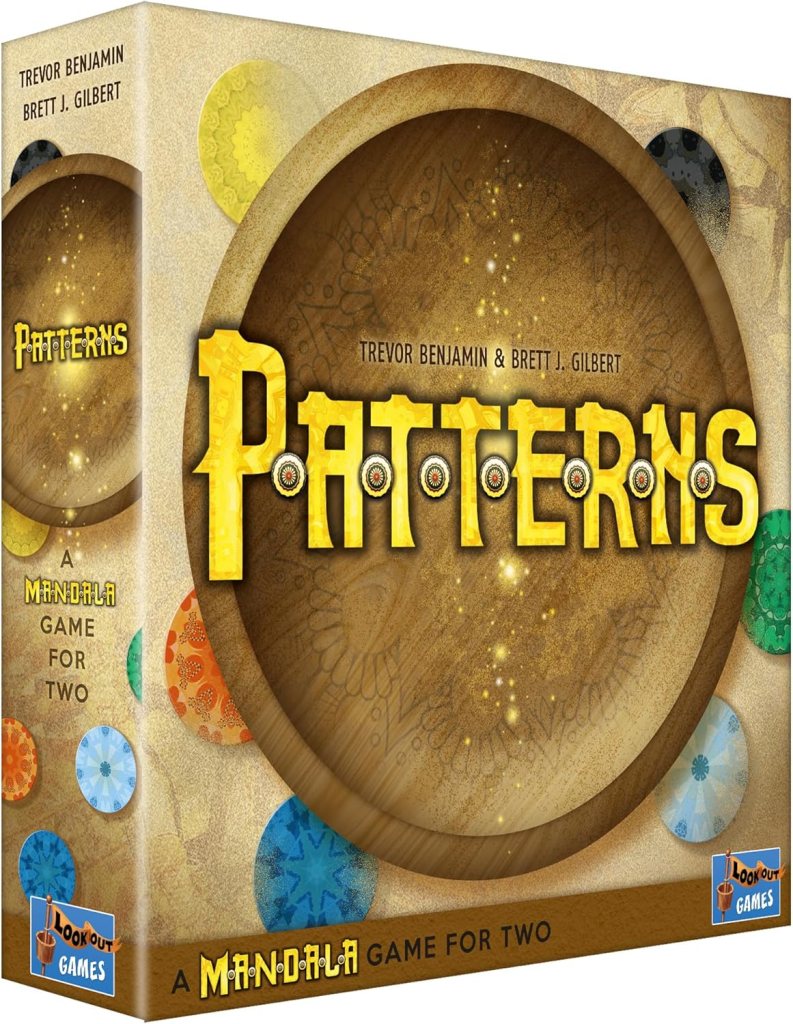
When I first spread out the play mat and started forming the vibrant mandala from the game’s 54 tiles, I was struck by the simplicity yet depth of Patterns: A Mandala Game. In this two-player abstract strategy game, my opponent and I took turns swapping tiles and marking contiguous areas in our colors to claim territory. Every move felt deliberate, as I had to anticipate how to maximize my scoring opportunities while thwarting my opponent’s plans. The gameplay was incredibly smooth, with setup and rules explanation taking no more than five minutes, allowing us to dive right into the competition.
What stood out to me was the tension between careful planning and adaptability. Just when I thought I had a winning move, my opponent disrupted my strategy with a well-placed marker. Despite the straightforward mechanics, the game challenges you to think several moves ahead. It’s also visually stunning, with its colorful design creating a relaxing yet strategic atmosphere. While the gameplay might feel repetitive after several plays, as the objectives remain consistent, the quick rounds and potential for subtle tactical improvements kept it engaging for me each time we reset the board
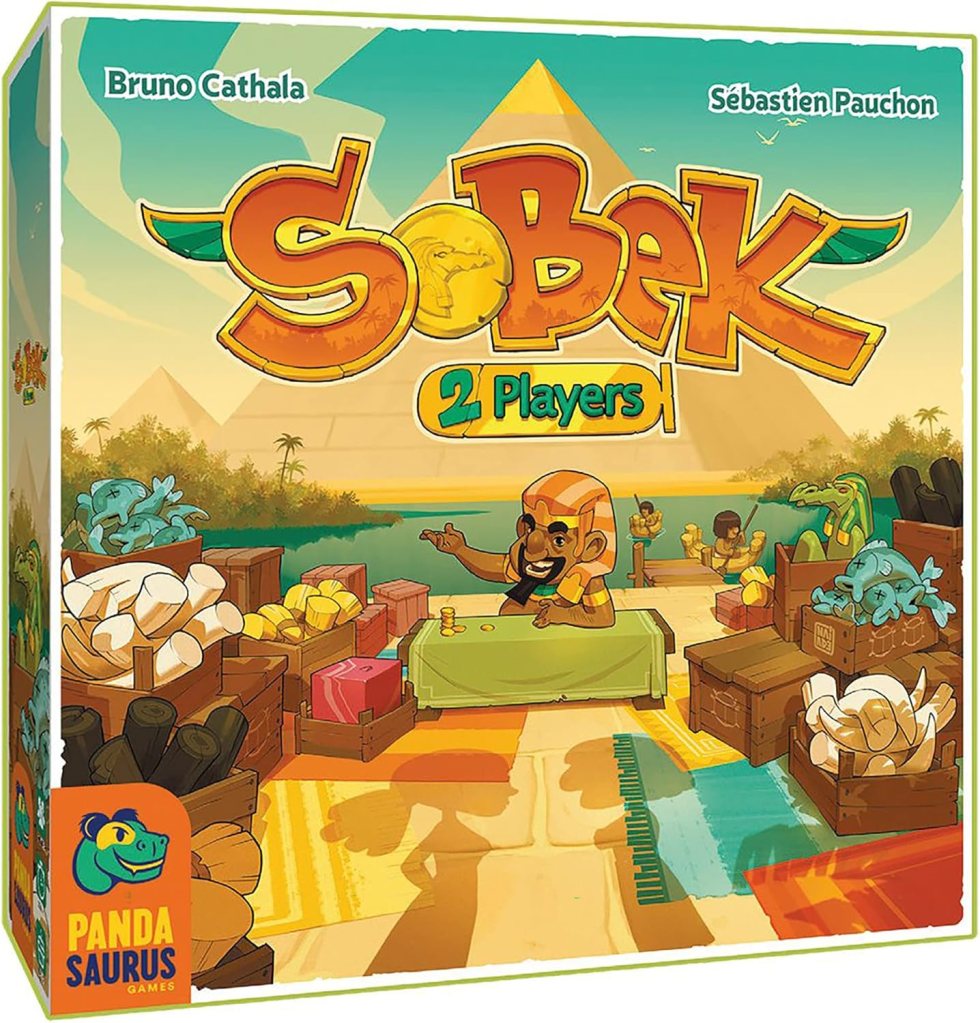
I didn’t expect such a compact game like Sobek: 2 Players to pack as much punch as it did. The strategic decisions kept me on my toes, as I had to balance resource collection with managing corruption. Every move felt like a delicate balance of risk and reward, and the anticipation of my opponent’s next move added a layer of tension. The theme of ancient Egypt was beautifully integrated, making the experience both engaging and aesthetically pleasing.
The only downside was that its small size and simple rules made it feel more like a “filler game” than a centerpiece for a game night. Still, it’s one of the best choices for a quick, strategic battle when time is limited, and I’d gladly recommend it to anyone who enjoys tightly designed two-player games.
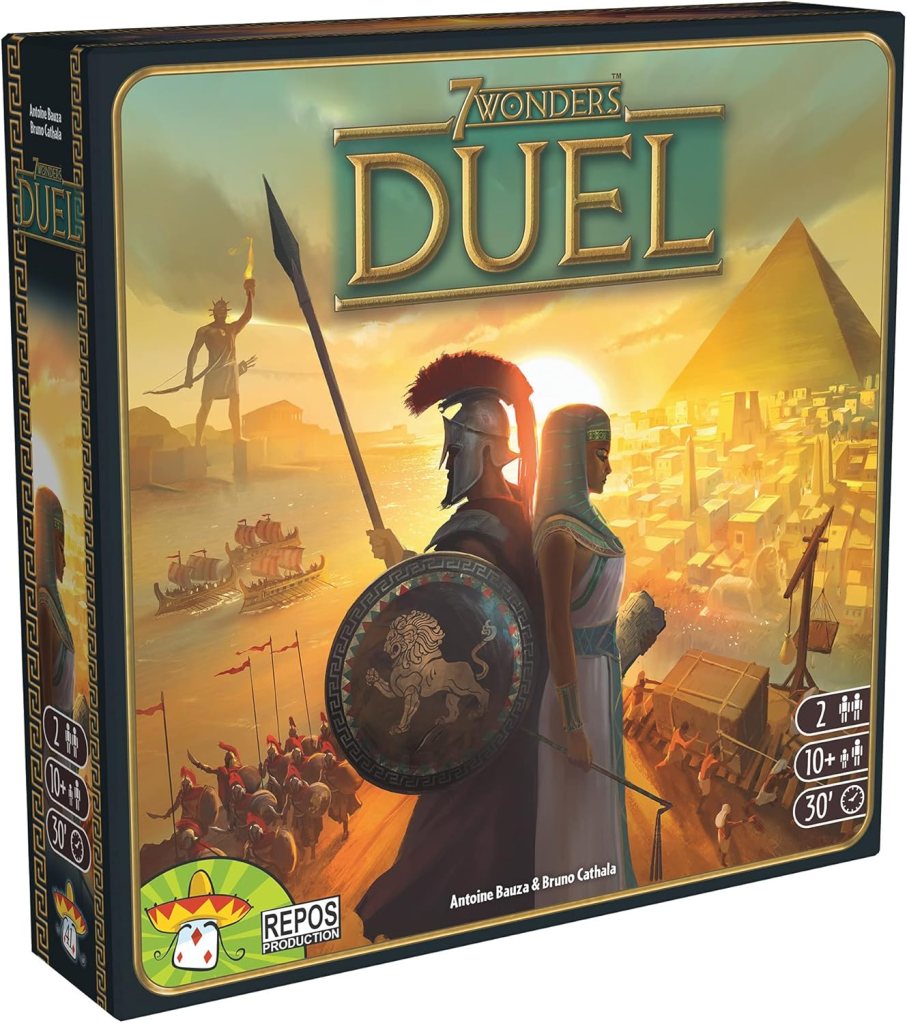
From the moment I played my first round of 7 Wonders Duel, I could see why this game is so highly regarded. It brilliantly condenses the sprawling 7 Wonders experience into an intense, tightly focused duel between two players. Drafting cards from the pyramid-shaped layout added a unique layer of strategy—I wasn’t just thinking about my own moves but also blocking opportunities for my opponent. The game’s three potential victory paths—military, scientific, or civil—kept me constantly reevaluating my strategy. Should I push for a quick military win or invest in culture and science to dominate later rounds? Every decision felt significant.
One of my favorite aspects was the game’s pace. It’s quick and engaging without feeling rushed, and the balance between accessibility and depth meant that I could introduce it to casual gamers or spar with seasoned opponents. My only critique is that some games can feel lopsided if one player pulls ahead in a specific victory condition early on. That said, the constant tension and variety in strategy ensure it remains one of my favorite two-player games.
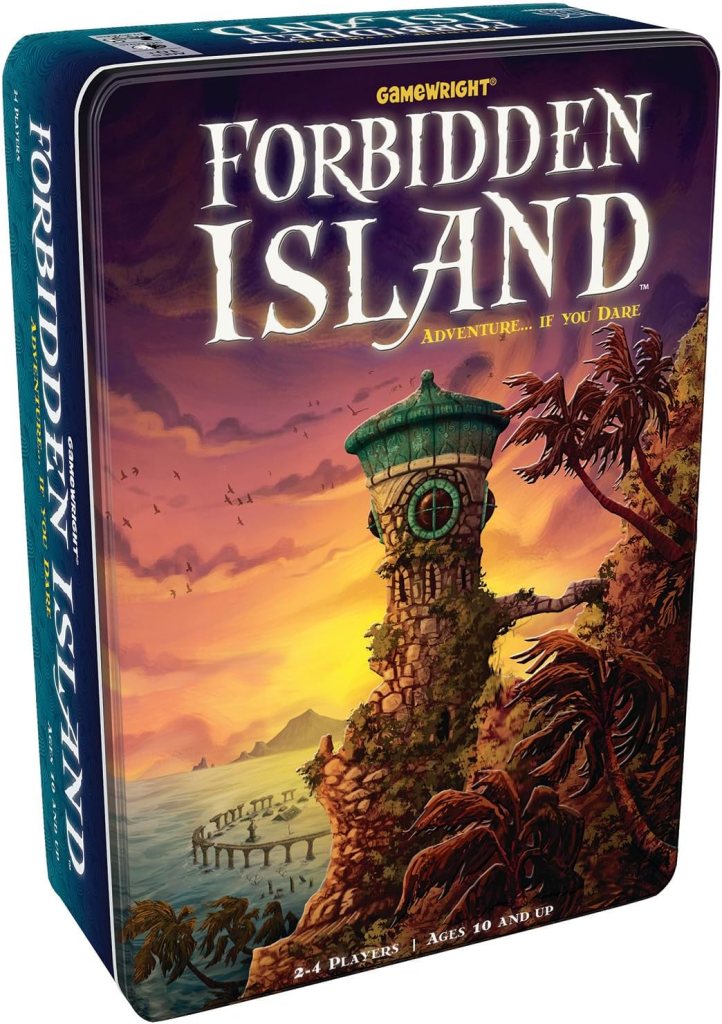
The first time I played Forbidden Island, I was immediately drawn in by its sense of adventure and cooperation. My partner and I assumed the roles of explorers tasked with recovering ancient treasures before the island sank beneath us. The gameplay was straightforward, with each turn offering critical decisions: should I move to shore up sinking areas, collect treasure cards, or position myself to assist my teammate? The steadily rising waters kept the tension high, making every move feel vital. The vibrant artwork and modular tile layout added to the game’s immersive and dynamic nature.
While I loved the cooperative mechanics and the thrill of racing against the clock, I did notice that the game’s replayability is somewhat limited. Once you’ve mastered the strategies for each role, it becomes easier to predict the optimal plays, which can reduce the challenge. That said, increasing the difficulty level breathed new life into our sessions. For its simplicity, portability, and teamwork-focused design, Forbidden Island is one of the best introductory co-op games I’ve played, perfect for two players looking for a light yet engaging challenge.
Thank you to every single student who uses the class materials properly and returns them to the correct storage location. You are the true heroes of the classroom.
Thanksgiving is without a doubt my favorite holiday of the year. I love the food, the time spent with family, the endless televised sporting events, and the food. Did I mention the food?
Over a decade ago I was spending the day with my parents, just the three of us, and my mom went to all the trouble of cooking the entire tradition Thanksgiving meal. She spent about 8 hours (possibly more) creating a meal that we ate in about 20 minutes. Then we cleaned it all up. The meal was amazing as always, but it seemed like so much work for just three people.
The next year I was watching the Food Network and there was a show about famous foods from around the United States, and how you could get them delivered through the mail. One of the featured foods was Lou Malnati’s deep dish Chicago style pizza. Since both of my parents grew up in Illinois, I have a healthy love of Chicago style deep dish and get it any time I am in Chicago visiting my brother. I hadn’t had it in quite a while, and immediately wanted to go to the website and order it.
Before I ordered, however, I had a thought. What if we ordered pizza from Chicago for Thanksgiving instead? Nobody would need to spend countless hours making food that gets demolished in the blink of an eye, and everyone gets to eat something special that they love.
I floated the idea to my mom, and she agreed to try it out. I assured her that I didn’t really care about the huge meal, and that all I really wanted was to spend time with my parents. So now our family tradition is baking a couple of deep dish pies in the oven, whipping up a batch of my mom’s famous broccoli salad, and munching away in front of the TV while the Bears lose.
I like that we started this new tradition and have kept it going for over a decade. Nobody is stressed out, everyone has more time to be together, and the clean-up is a breeze. It’s simple, fun, and keeps what is important at the forefront.
The main reason I love Thanksgiving is that it is a holiday in which you are meant to spend time being grateful for what you currently have in your life. It’s basically the anti-capitalism holiday, as the whole purpose is to just be with your family (biological, found, or otherwise) and be grateful for what you have. The day is essentially a “don’t go buy anything today, except maybe mayonnaise for sandwiches tomorrow” kind of day. Of course, this is immediately ironically destroyed by the “buy everything you can possibly see” Black Friday sales the next day, but that is a topic for another day.
So with the focus of being thankful, instead of being a ravenous consumer, I wanted to make a list of things I am thankful for, with a bit of a teaching slant. So here is my list of Thanksgiving Thankfulness Teacher Thoughts:
1: I am thankful for my wonderful colleagues that I get to work with every single day. Every teacher I know is passionate about the job, gives their best effort every single day, and is always willing to help me out when I need it. I am so lucky to teach at my school.
2: I am grateful for the student who misses multiple days of school and comes back to class knowing what happened when they were gone because they read the weekly agenda online. Instead of “What did we do while I was gone?”, they say “I saw that I missed two lessons and I grabbed the worksheets from the absent work folders”.
3: Thank you to every single student who uses the class materials properly and returns them to the correct storage location. You are the true heroes of the classroom.
4: I am thankful that my principal has supported me with implementing Building Thinking Classrooms in my own classroom, both with financial support and with students and parents. From the moment I presented him with the book and my ideas for change he has supported me.
5: I am thankful for the existence of the Frixion Erasable pen. I just love it so much.
6: I am grateful for my Friday afternoon debrief sessions with my teaching partner Mrs. Balbas. Pretty much every single Friday we are able to talk about how the week went, safely vent our frustrations, and go into the weekend knowing what went well, what needs to be done next week, and how we are going to accomplish it. Having a colleague you truly trust is such a blessing.
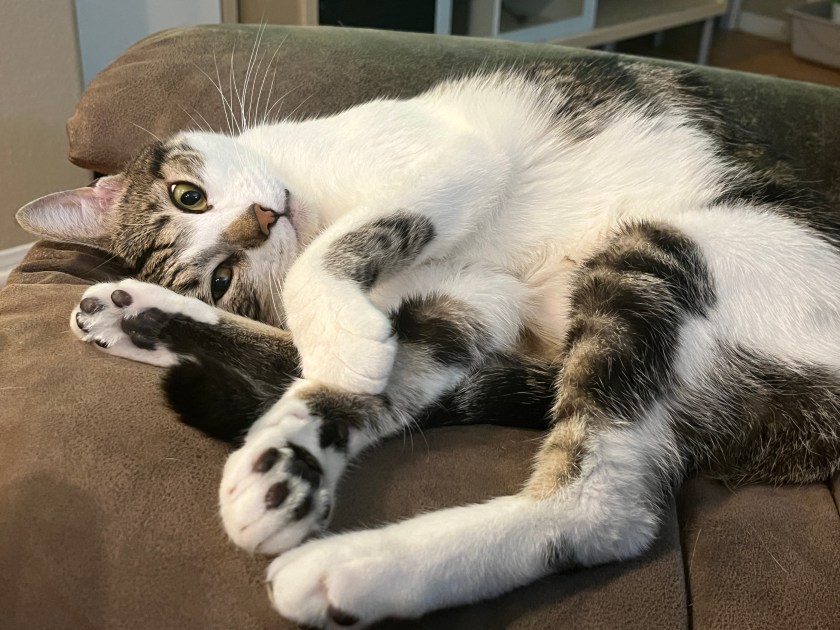
7: I am beyond grateful for my cat Puck. No matter how challenging or exhausting my day has been, he is there to greet me at the garage door, run over to the kitchen, jump on the counter, and let me hug him for a solid minute while purring into my right ear. He always gives me snuggles when I need them, and keeps me on my toes in the morning if I don’t feed him fast enough. He is the best boy ever.
Well, enough of making lists for today. I must prepare to eat 2,000 calories worth of Chicago deep dish pizza!
If a student brings you a gift, literally ANY gift, it means something special.
One of my most vibrant memories of elementary school is the day before Winter Break in which my elementary school teacher gathered the class seated criss-cross-apple-sauce on the communal rug and opened all of the gifts we had brought her for the holidays. My mom was famous for her homemade almond roca candy, and having an older brother meant my current teacher most likely had gotten a tin of that renowned roca two years prior and knew what to expect from the Zuercher family. Each gift was opened with care, and to the best of my recollection, my teacher reacted with genuine delight and appreciation for whatever happened to be gifted from each family. I’ve always assumed that my teacher absolutely adored the tin of almond roca we gave her, but I have no way of really knowing that. All I know for sure is that I definitely felt like she did.
As a classroom teacher now I always try to keep this childhood feeling in mind during the regular gift giving times. If a student brings you a gift, literally ANY gift, it means something special. That student, or the family of that student, made an effort to let you know that you mean something to them. That is a special thing, and should not be overlooked.
Did they bring you a mug with a cliche teacher quote on it that you already have three of in your surplus mug cabinet at home? Well, that student noticed that you drink coffee in the morning and wanted you to have a new mug to enjoy it in.
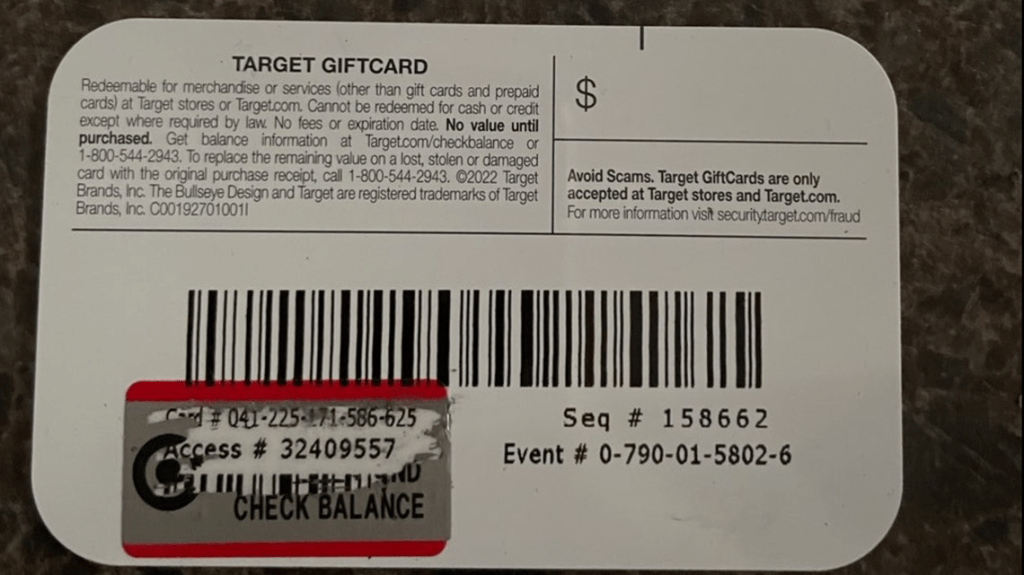
Did you receive a partially used Target gift card with $3.41 on it? This might be literally the only thing the family could afford to give, which means they probably couldn’t afford to give it to you, but they did anyway. What an amazing gesture!
Have you been given a single package of sticky notes that you can get from the front office at pretty much any time during the year? Maybe that student really loved the Quiz-Quiz-Trade activity you did with sticky notes last month to review linear functions and wanted to do it again.
Is a student presenting you with a suspicious looking non-descript baked good in a beat up plastic baggie? Acknowledge the time and effort it took them to make that, and ask them about the special family recipes they love to make during the holidays.
No matter what the gift is, it is special because of the reason it is being given. That student cares about you and is taking the time to let you know. Do your best to show genuine appreciation for any gift a student brings you, whether it is extravagant, simple, used, leaking, or possibly still alive.
While my students always enjoyed trying to use the height chart, and figured that Fabric Corey was there because I loved decorating my classroom with Anaheim Ducks merchandise, he actually served another purpose entirely.
For over a decade the first thing students saw when they walked up to my classroom was Anaheim Ducks forward Corey Perry. Not the real Corey Perry, of course, but a rectangular fabric door decoration that also doubled as a height chart. It was a gift given to me by a former student who found it amongst the various knick-knacks contained in her Wild Wingers Kids Club kit. She thought I would love it, and I did.
+
Students would walk past fabric Corey, giving him a fist bump, poking him in the face, and many times stopping to check to see if they grew an inch from one day to the next. Since Fabric Corey was rarely level with the ground, many students would shout with joy that they were over 6 feet tall, only to be crushed by the sad realization that Fabric Corey was about 10 inches too low to give an accurate measurement. Middle school can be cruel for the vertically challenged.
Fabric Corey became a mascot for the class, and even students who weren’t in my class knew me as “The Hockey Guy” because they could always see fabric Corey when they waited for their ride home outside my room or rode their bike past the front of the school. You see, even though Fabric Corey was installed on the inside of my classroom door, he was always visible to the outside because about 70% of my door is actually made out of glass.
While my students always enjoyed trying to use the height chart, and figured that Fabric Corey was there because I loved decorating my classroom with Anaheim Ducks merchandise, he actually served another purpose entirely. Since my classroom door was mostly transparent, his main purpose was to shield our classroom from an active shooter on campus.
During safety trainings and active shooter drills teachers are taught to lock all doors and windows, turn off the lights, close all window shades, and keep all students still, quiet, and out of sight. Since my classroom door is mostly glass, I had to improvise to create a shade that would meet the blackout requirements in the event of a violent intruder on campus. I used two large clip on magnets to hang Fabric Corey onto the metal frame of the door so that he would cover the entire glass portion. Often times the magnets would slip or get knocked off when students opened the door, so he would need attention every now and then. But for the most part he was an effective, fun solution to a problem.
Except that last sentence is utterly insane.
Let’s be brutally honest. If a violent person with any kind of firearm wanted to get into my classroom, there is only 6 millimeters of glass between them and 32 teenagers and one math teacher hiding for their life. Fabric Corey isn’t doing a damn thing to stop it.
I write this knowing that I live and work in one of the safest cities and school districts in pretty much the entire world. The chances of an active shooter on my campus is extremely low, and yet it’s still something I must think about and plan for as part of my job as a public middle school teacher. I attend multiple training sessions each year on active shooters, lockdown drills, and “Stop The Bleed” procedures in case of gunshot wounds. I teach my students about the realities of Fight, Flight, or Freeze, and how to barricade the door with tables and chairs in case an actual shooter is present. We discuss the reality of what happens if someone violent does enter the room.
All of this takes away from what I actually signed up for when I was earning my teaching credential.
I signed up for teaching students about logical thinking and problem solving.
I signed up for long unpaid nights and weekends grading tests and making lesson plans.
I signed up for mentoring students through some of the most challenging two years of their lives.
I signed up to coach roller hockey and teach kids the joy of Dungeons and Dragons during lunch club.
I signed up for fire drills and earthquake preparedness.
I signed up for talking kids through difficult friendship transitions.
I signed up for knowing the signs of child abuse and being a mandated reporter.
I volunteered to do all of these things willingly, knowing that the job had many pros and cons. I knew I would never be insanely rich or live a life of luxury, and that was fine. I love my work and cherish every moment a student finally understands how to solve an equation, add two fractions, or grasp the concept of an asymptote.
Not a single teacher in the United States signed up for active shooters, bomb threats, “Stopping The Bleed”,or to watch their students and colleagues get blown apart by weapons of war. We just want to teach our students, take good care of them for 7 hours a day, and send them home to their families smarter and more confident than when they got there in the morning. And we want to make it home to our families as well.
This current reality does not have to be a “fact of life” or “just the price of freedom”.
We can do so much better.
This year I retired Fabric Corey for two reasons. First, he hadn’t played for the Ducks in over 6 years and I figured he was past his time as a Ducks representative. Second, he was somewhat unreliable with his magnets moving quite a lot and shifting during the school day. So I designed a new door design with a more positive math-centric message.
Along with the aesthetic appeal (at least, I think it looks nice), it’s main purpose is to be a permanent window covering that won’t move during the school day.
I still have Fabric Corey waiting in the storage space behind my desk, ready to jump into action should he be needed.
So I started my 21st school year last week, and I wanted to share one of my favorite Thinking Tasks I started doing with my students in the past few years.
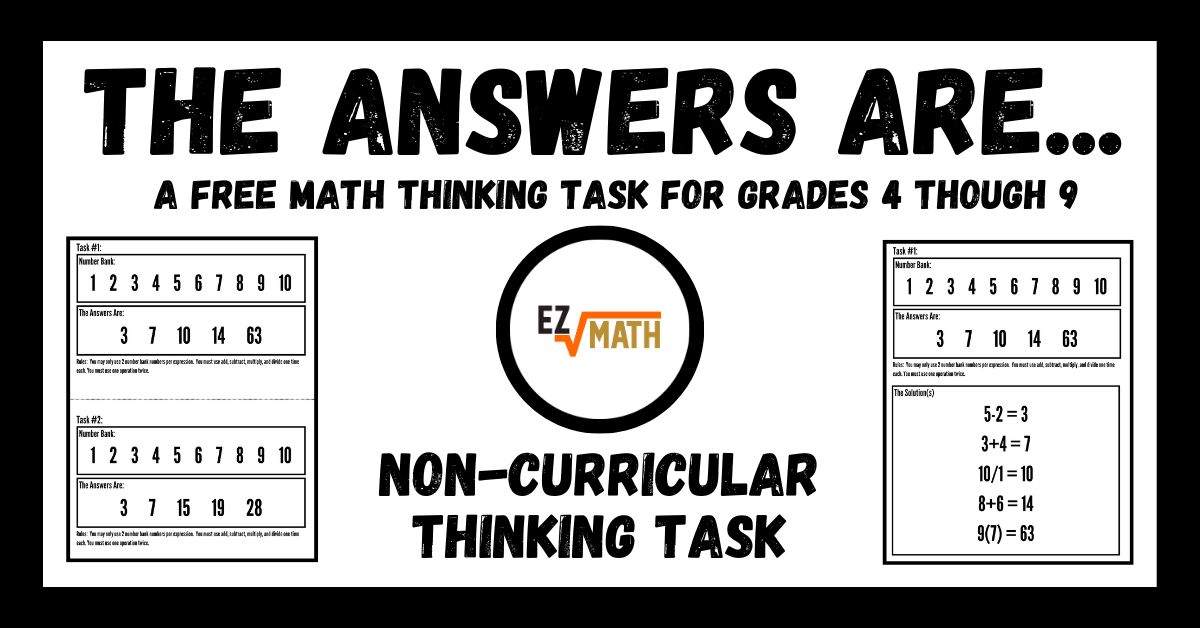
Whether you are looking for a good activity to get your mathematicians working together in the first weeks of school, or you need a quick 5-minute filler activity at the end of a class period, The Answers Are… is a great go-to math task for your students.
I first learned about this task in Peter Liljedahl’s book Building Thinking Classrooms a few years back. To be honest, when I first read the task (on page 169) I didn’t fully understand the directions, so I was reluctant to try it out. Once I finally realized what to do, and tried it with my students, it became a class favorite. Here’s how the task works:
The Directions
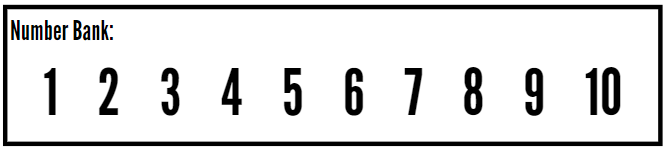
Give the students a pre-selected number bank of 10 numbers to start with. This could be any set of numbers, including integers, rationals, etc. The easiest set to begin with is the whole numbers 1-10, as seen below:
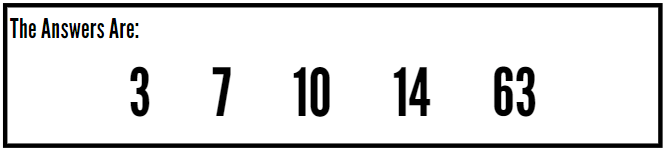
Next, give the students the answers to 5 math problems, or expressions, such as:
Now the students know what numbers they can use from the number bank, and what answers they must get from the answer bank. Here’s where the thinking comes in. The rules of the task are:
Each answer must be created from two numbers from the number bank and one mathematical operation.
Once you use a number from the number bank, it cannot be used again.
You must use each of the four basic operations once (add, subtract, multiply, divide).
You may use one operation more than once.
You must use all 10 numbers in the number bank.
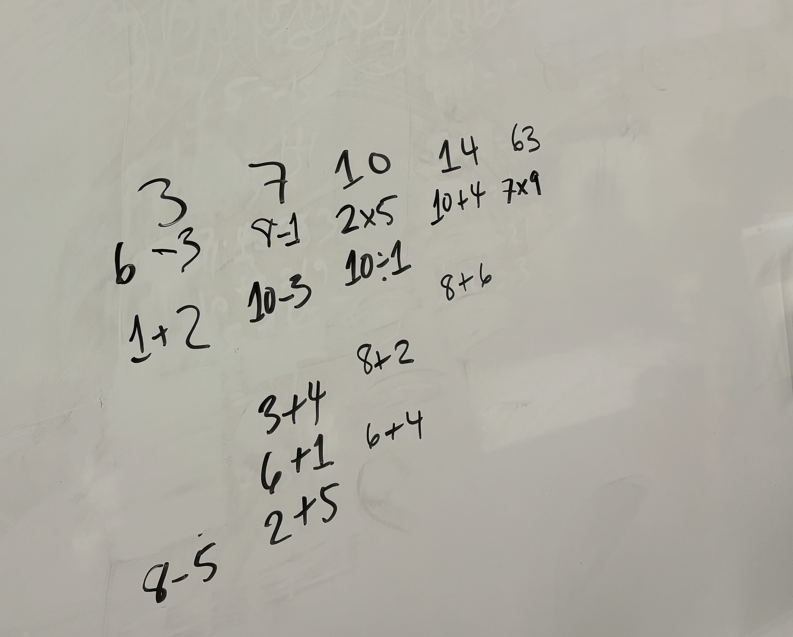
For example, to get an answer of 3, they could do 2+1, 3(1), 6/2, or even 10-7. There are a lot of options. They are all equal to 3, but aren’t necessarily what they want to use. The strategy here is that the only way to get an answer of 63 is to multiply 9 and 7, therefore they would not want to use 10-7 to get the answer of 3, since that would use up the 7. Once they use a 7 to get 63, they can’t use 7(2) to get 14, so they probably need to use some kind of addition to get the number 14, and so on. It’s a great mix of logical thinking and math fact strategy.
That’s pretty much it. Use all 10 numbers to create the 5 given answers. Can you solve the example I gave above? Click here if you want the solution!
The Setup
I have done this task multiple ways in class, depending on the needs of the day. I created a set of Task Cards for my students to use in random groups of 3 at the vertical whiteboard Thinking Stations during the first week of school while doing Non-Curricular Thinking Tasks. This is a great way to get students working together and talking about math. The directions are very simple, and if you use whole numbers like I showed above, every student has good access to the task, since the floor is quite low.
I really like creating and printing task cards, cut as half sheets of paper, so the groups can go at their own pace. You can have groups check their answer with you, or have them prove their answer is correct, then erase their board and get the next set of numbers. They can also leave up their answers to help groups that might be stuck. Peter Liljedahl calls this “Knowledge Mobility”. It has it’s pro and cons.
Students work through the possible ways to get the answers of 3, 7, 10, 14, and 63.
Sometimes I have a few minutes left in class and I just want to keep the kids thinking until the bell rings. I like to have a set ready to go that I can just write down on the board. Since I have whiteboard tables, the students can try to figure it out at their seats, or go to a Thinking Station of their choice and work on it vertically.
In a real pinch I just give them the 1 through 10 number bank and just make up 5 answers on the spot. Not ideal, but it works.
Get Started!
So what do you need in order to do The Answers Are…?
In the most basic sense, pencil and paper. You can write the number bank and answers on the class whiteboard, and students can work on it using just pencil and paper. If you have vertical whiteboards, then dry erase markers and erasers are needed.
It’s 2019, a Friday afternoon in October, and I’m driving home from school. It’s been a tough day and my brain is absolutely cooked from making 8,000 decisions during my Math 8 classes and giving a cumulative exam in Enhanced Math 1. Seems like giving a test should make for an easy day, as you don’t have to do much, but that’s not the case. Stress levels in students are high. With stress and high expectations comes the willingness to compromise morals and desire to cheat. My attention must be laser focused to make sure students are working with integrity. It’s…not fun. I know there are other ways to assess students, but the most authentic assessment of each student’s ability is to assess them independently (as far as I have found, anyway).
Then there’s the grading. Before switching to Standards Based Grading, we used a traditional points based system, assigning point values to each question, then deducting points from a question if work or formatting was incorrect. With about 100 students taking a test that is about 20 questions long, that’s examining 2,000 test items, most of which have multiple steps of work. I might give 1 or 2 well-crafted multiple choice questions, but 90% of the exam is hand written work with many steps to inspect. When I stack up all the exams, shove them in my messenger bag, and toss the bag in the car, the ride home feels so daunting, knowing I must spend the next 8-10 hours grinding.
Having already gone over the way I am grading student work now using the 4-point rubric, let me just say that it is so much better than itemizing point deductions for each question like I used to. I would drive myself crazy trying to determine if something was minus 1, minus 2, or more. I even got to the point where I was deducting one tenth of a point on certain questions, which in hindsight was absolutely insane. Like, what was I doing???
Target Specific Assessments
One of the best changes we made this past school year was how we assess our students. Before 2020 we would give one large assessment each month, which was always cumulative up to that point. That meant that at the end of February the students would get the “February Test”, which could have any topic on it they learned from August until about mid-February. We emphasized more recent material, and the old stuff was relegated to a few questions on the essential Learning Targets. The test was always worth 100 points, and we used a year-long gradebook. By the end of the school year the gradebook had about 1,200 points in it (including the monthly tests, quizzes, and homework).
The rationale was that we wanted students to maintain their skills throughout the year, instead of simply learning something for a short time and then never recalling it again because it would never be assessed again. While I agreed with this premise, the downside was that these tests were very stressful for the students, usually took up an entire block period to administer, and took an extremely long time for me to grade. Each exam would have around 20 questions on it of varying Depths of Knowledge, so grading around 170 of them each month was mentally exhausting.
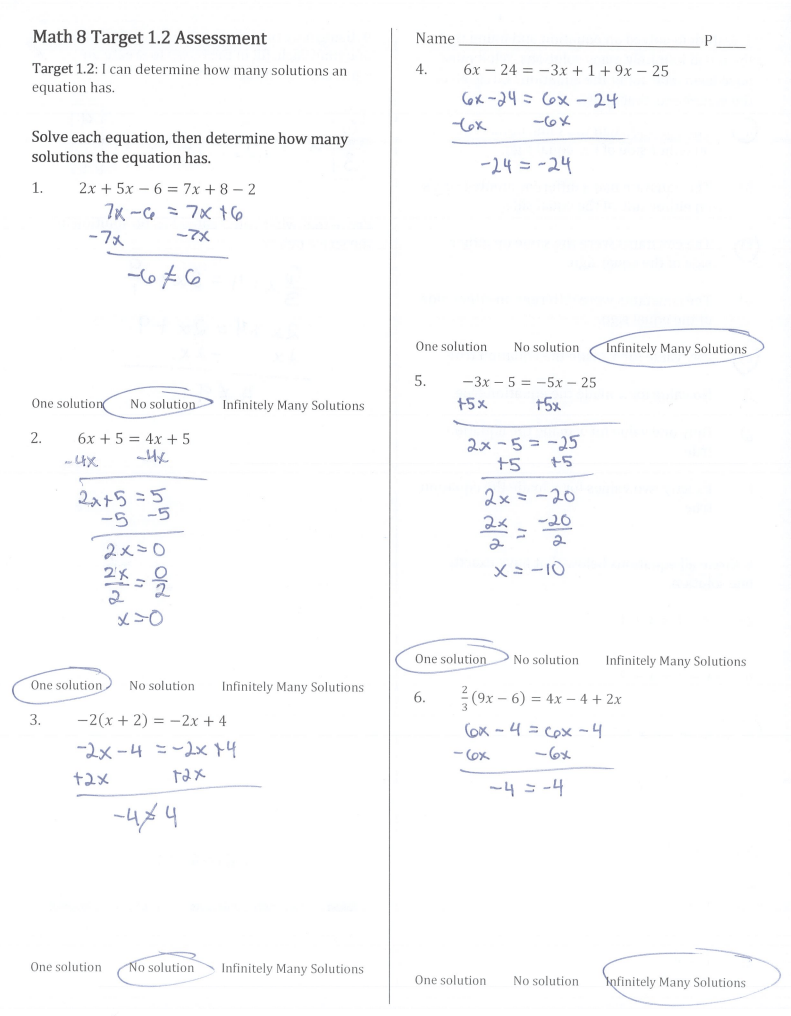
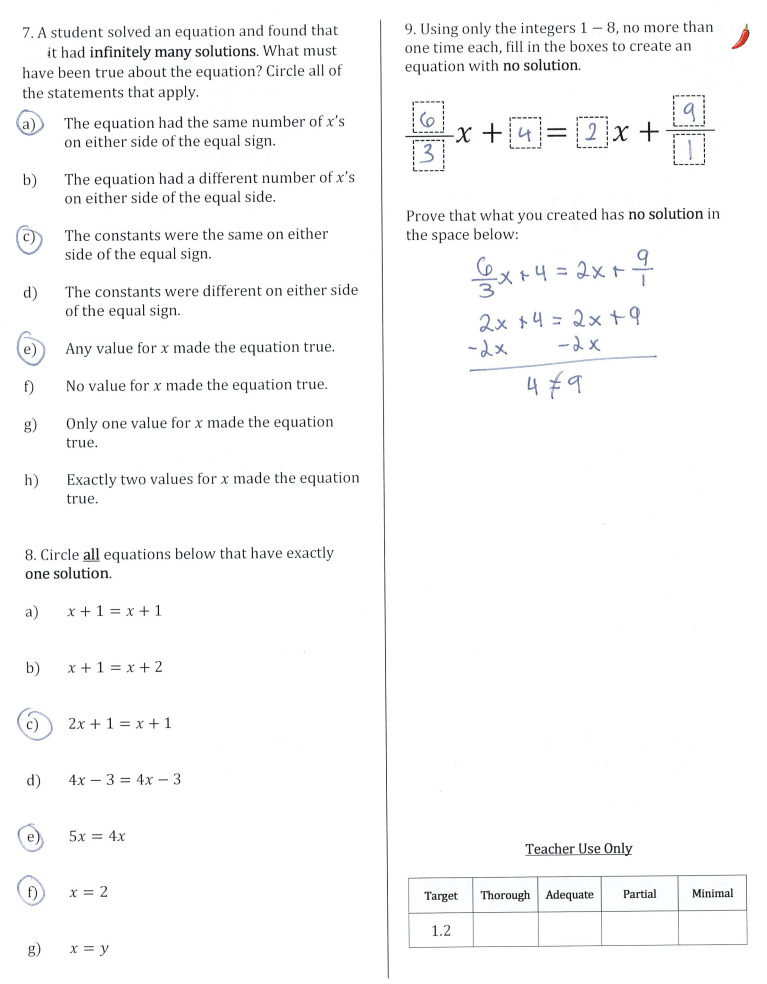
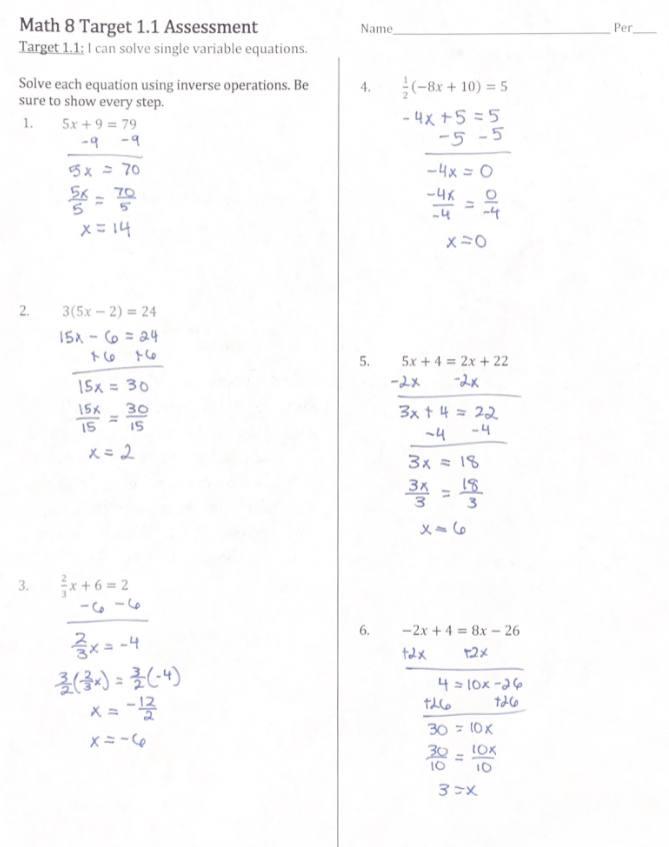
So instead we switched to more frequent Target specific assessments, focusing on only 1 to 2 Targets each. The assessments were much shorter, able to be completed in a 51-minute period by most students, and each Target could be covered by a variety of questions at different levels of rigor. We included spicy peppers to indicate to students which questions we considered more challenging, and those were the ones they should get correct to be considered having “Thorough” understanding of the Target. Here is an example of an assessment I gave last year in Math 8:
The Benefits of Target Focused Assessments
In 8th grade we gave 14 different assessments that covered 20 of the Learning Targets for the year. This meant that I graded assessments more frequently, but the assessments were much quicker to complete. Whenever I assessed Math 8 I was able to grade both class periods in under one hour, usually on the same day I gave the assessment. I could literally never do that before. Many times students would take the assessment on Friday and I could hand it back to them on Monday. During the days of grading a cumulative test it might take me a week or more to finish marking everything, therefore the feedback took longer and was less valuable.
One of the best results from the more Target focused, smaller assessments was that students were not as stressed out or overwhelmed. Since they were shorter and more focused, students were able to finish them in a reasonable time period, and students with IEP’s and 504 plans did not need to use their time accommodations as often. Additionally, with the retake policy we adopted, students knew that they always had a second chance to take a different but similar version of the exam, so if they just weren’t feeling it the day of they test, they always had the change to try again.
Giving these shorter assessments also gave me more flexibility on the day of the test. Since most students would finish with additional time, I was able to give them some more interesting tasks to do once they were finished. I now post Open Middle problems at my thinking stations, Non-Curricular Thinking Tasks, extension problems from previous Targets, or desmos activities that preview the next Target we are going to learn. Assessment day is now a “show me what you know, then go find something you are interested in” kind of day, rather than a stress-fest of feverishly working until the bell rings.
This isn’t to say that every student was instantly successful the first time, or that my assessment results were amazing across the board. In Part 3 I will look at how students did overall, how they reflected on their own results, and whether the retake system worked for all students. See you next time!
If you ask 100 classroom teachers what the least favorite part of their job is, I am willing to bet that at least 80 of them will say “grading student work”. Well, that might not be accurate. Almost all of them will say “mandated professional development”, with grading being a close second. Having taught middle school math for 2 decades I can safely estimate that I have assessed at least a million math problems that my students have completed on some kind of assessment. Don’t get me wrong, I get a tiny spark of joy each time a student gets a question correct (Yay, they learned the thing!). It’s just very time consuming, and I know that every time I grade something, there will always be a small number of students who are going to have some seriously negative emotions when I hand it back, whether they do horrible, or just get one question wrong. Too many emotions tied up in points, grades, and self-worth.
So two years ago the Math Department at my school switched to Standards Based Grading, with the hopes of giving students better feedback on their learning, an improved sense of hope and efficacy, and a focus on the learning rather than the grade. (I wrote about this back in October if you would like to read that first). We developed a whole new grading system based on a multi-point rubric for each Learning Target, offered multiple chances for students to be reassessed, and removed mandatory homework for points in the gradebook. It was a lot of work, but work worth doing. Or was it?
So instead of just going on feelings, I wanted to reflect on how last year went, and look at the data available to me to see if the changes are working as intended. It’s quite the journey, so I plan on looking at this in multiple posts, otherwise this blog will be gigantic. Let’s dive in to Part 1!
Part 1 – The Grading Rubric
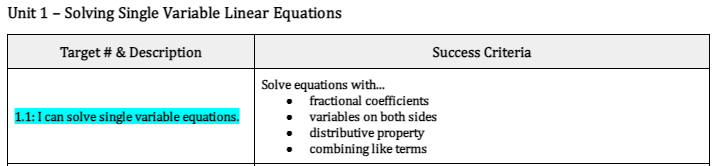
Two years ago we started off with a very basic 5-point scoring rubric for each Target to ease the transition from a traditional gradebook to an SBG one. Here’s what that looked like:
This gave a simple 20% breakdown for each letter grade, so an A was 80% – 100% and meant that more often than not a student had “Mastered” the Targets in the class. Numbers-wise this was easy for parents and students to understand. In application, things got really weird when we tried to grade an assessment. Any teacher who has assessed students for a while knows what “Mastered” and “Beginning” look like. It was the middle area where there was a lot of subjectivity. I personally had many instances where I could not tell the difference between “Proficient” and “Approaching”, as did all of my colleagues. About halfway through the year we realized that this needed to change, since we kept having long discussion about what was Mastered versus Proficient, and Proficient versus Approaching. While grade norming is essential in a PLC, you can’t spend all of your planning time doing only that.
So last year we transitioned to a 4-point rubric, which is most often advocated for when you look into SBG practices. We also developed more language to help ourselves and our students know the difference between each level of understanding. We also updated the category language, since “Mastered” felt like a weird and highly subjective descriptor. So here’s what we used last year:
I really liked this rubric more than the previous one. Since there were less levels to consider, it was easier to see from the student work where a student was at. The only place I ran into trouble was telling the difference between “Thorough (4)” and “Adequate (3)”. Sometimes it was just really hard to tell. More often than not I would assign a student a 3, then meet with them to go over their work and talk about what needed to improve to reach a 4. Since they could retake any assessment, this always felt good. It’s not like they were stuck with that score.
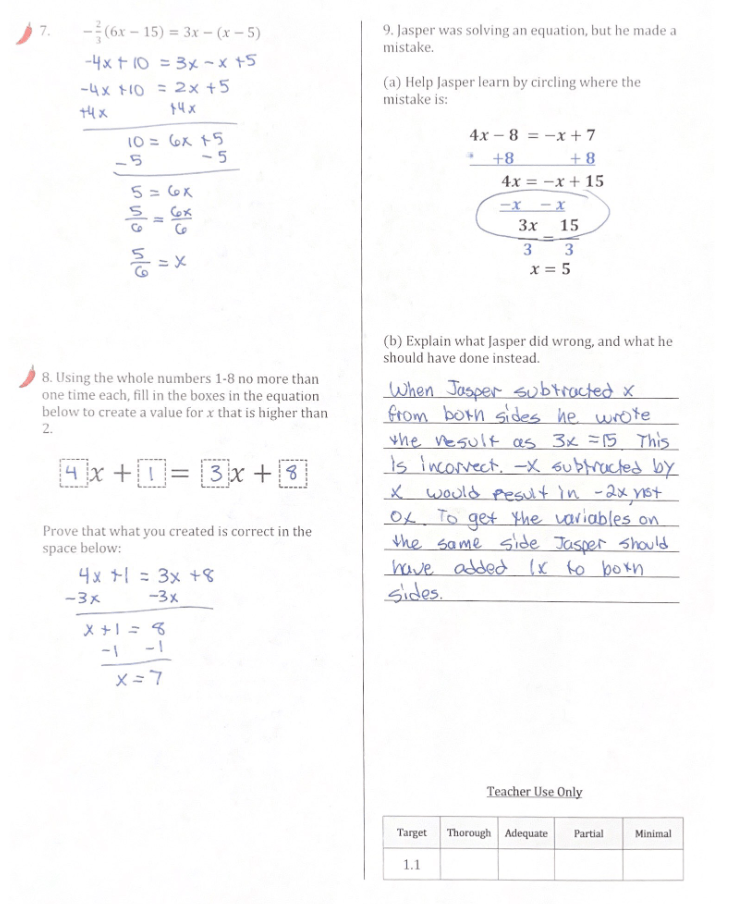
Let’s look at one of the assessments I gave last year, and how I graded it for a few students. Here is the very first assessment I gave in Math 8 for Target 1.1:
One other practice I personally developed to help me determine proficiency levels was to use a spreadsheet I created for each Target assessment. As I examined each question I would grade the response using the same 4-point rubric and enter the score. I had the spreadsheet average out the scores for the entire assessment, then use the number as a general guide as to what level the student was at. Here’s a link to a sample I have for one of my Target assessments for 8th grade.
One of the tricky things about this method of grading though is that not every question is the same level of rigor, so the average score doesn’t really tell you the proficiency level. For instance, question #8 required the students to create their own equation using an “Open Middle” structure, then prove that what they created met all of the criteria needed. This is way different than question #1, which was a basic two-step equation with only whole numbers. This is where the holistic approach comes into play.
For example, let’s look at Student #6 and Student #7. Both students got an average of 3.7 on the assessment, but one of them scored an Adequate (3) and the other a Thorough (4). Why is that? Since Student #6 got questions #5 and #6 wrong, and those were considered less rigorous (they were basic equation solves), I found them to be at the Adequate level for the entire Target, but not Thorough. Student #7 got two questions wrong as well, but there were some factors to consider. For question #7, they made a simple calculation mistake in the final step of the problem. Not a big deal. I don’t really downgrade students’ proficiency level because of a simple calculation mistake. For question #9 they were able to circle the part of the work that had the error in it, but this student was a first year English learner so they did not have the vocabulary needed to do the written explanation correctly. I could tell that they understood the overall concept. That’s an English problem, not a math concept problem. They have Thorough understanding of solving equations, so lowering their score because they have only spoken English for 6 months is not appropriate.
This is why I enjoy Standards Based Grading, but also why it can take so much time to do. When all you do is give points for correct answers and turn the points into a total score of x/100, you lose the big picture. Even though Student #6 got a high average score, they have a few misconceptions in their equation solving that I still needed them to work on. If I give them a Thorough on the Target, they are less likely to work on the misconception. This way, with some coaching and a bit of intervention they are able to re-assess later and earn a 4 on the Target, should they have the desire to.
In Part 2 I will examine the types of assessments we gave in class, and how changing to shorter, more focused assessments has benefitted both me and my students.
One of the biggest traps in teaching any subject to a group of humans is the assumption that silence equals comprehension. You teach a concept, ask if there are any questions, get a room full of silence, and assume everyone gets it. I have fallen into this trap countless times in my career, even though I am fully aware that the trap exists. Obviously, just because nobody asks a question doesn’t really mean they all understand what is going on. One third of the group most likely is thinking about something else, one third is paying attention and understands it, and the rest have some questions, but see that nobody else is saying anything, so they figure they are the only one not getting it and then all sorts of social pressures start piling up in their heads. It’s…. not ideal.
Any effective educator knows that collecting accurate formative assessment data is crucial when teaching any concept. You have to know if the kids are understanding before you move on. There’s no point in plowing through the curriculum if half the class has no clue what’s happening. Sure, you “covered the standards”, but if only a few students mastered the material, did you really cover them?
So how do you check in with all of your students, get accurate data, and do so with as little anxiety as possible?
About 15 years ago my school invested in a student response system in which each student got a handheld device that had 6 buttons on it (yes, no, A, B, C, D). The system cost over a thousand dollars, and we were able to buy 2 class sets. I used them often for about 2 years. I remember lots of batteries, a whole classroom management structure that needed to be implemented, and a system that worked most of the time, but not always.
As cell phone ownership became pretty much ubiquitous among students, several apps were developed that made the stand alone handheld devices obsolete. Things like JotForm, VeVox, and Socrative can now be used to get real time data from students using only a smart phone or Chromebook. Kahoot! came along and gamified the whole student response arena, adding points based on speed and accuracy (read this post if you’d like my thoughts on incentivizing speed in mathematics). I’ve tried most of these systems, and must admit that Kahoot! can be a lifesaver on a minimum day right before winter or spring break.
The problem I find with all of these systems is the heavy reliance on technology in the hands of every student. A device for every student brings with it problems, such as having to monitor what site the students are on, whether they have charged it, or if the Wi-Fi is connected or working properly. Relying on 36 students to all have their Chromebooks charged and ready every day is not realistic. And to be completely honest, I want my students having less screen time, not more of it.
So what is the answer? How can you collect quick formative data from every student, do so with little to no anxiety for students, reduce the reliance on each student having a device, and gather that data anonymously?
With Plickers the teacher has all of the tech and the students have a piece of cardstock.
What Is It?
Plickers is a free platform (with an optional premium account) I can use to create a presentation slide deck with up to 5 questions on it. The questions can be surveys (how are you feeling this morning?), or multiple choice with a correct answer (what is the side length of the square?). I show a slide on my overhead projector, and the students all think about their response. When ready, each student holds up a QR code that has been printed on some cardstock. The direction the student holds the card indicates the answer choice they want to give, either A, B, C, or D. Once they hold up their cards I use the Plickers app on my phone to scan the room with the camera and it instantly records all of the answers. The app will show me in real time on my phone screen who is getting the questions right by displaying either a green or red dot next to their card. If a student is giving an answer that isn’t possible (answer C for a question that only has choices A or B), the dot shows up as gray. Every time I use this it feels like magic. Results are tallied instantly and anonymously, and you can share them, or not, depending on the purpose of the question. That’s it.
I love this system because the students don’t need any kind of device, you get feedback from everyone, you know who has answered and who hasn’t, and the results are instant. It’s the fastest, most reliable whole class formative data I’ve ever found.
How I Use Plickers In My Classroom
I prefer to start a class with a Plickers slide show that asks a general survey question, such as a “Would you rather…?” or “What do you prefer?” It gets class started in a fun way, and can start a fun conversation that engages the students.
The image search feature in the slide deck builder is really easy to use, and finds school appropriate images very quickly. You can edit the photos as well, but I haven’t used that feature very much yet.
Next I will do a few review questions about the current topics we are learning. Depending on the answers, I can pivot my lesson if needed, or just spend a bit more time going over an example from the day before to make sure kids are understanding. As a fun little bonus, the screen gets showered with confetti if every student gets the question right. This rarely happens, but it’s pretty great when it does.
I also like to use a question or two in the middle or end of the lesson to see how students are understanding the new material. It’s so easy to show an example in the middle of the lesson, have students solve it on their whiteboard tables, and then get answers from the whole class. With a well crafted multiple choice question and a little forward planning you can find the misconceptions students have and deal with them in real time, rather than the next day, or even worse, find out a third of the class doesn’t get it during the actual summative assessment.
Setting up your classes on the Plickers web site is pretty easy. I create a class for each period, and leeave the student names as “Student 1, Student 2, Student 3, etc”. Since each card has a small number printed on each corner of the QR code, the students know which number they are each time they use it. This way I don’t have to assign a specific card to each student. I like this approach, since I just want whole class anonymous feedback. If I needed to know how each student answered, and wanted to keep the data, I would put actual student names in the system (first name, last initial), and assign a specific card to each person. I don’t plan on doing this though, since I want Plickers to be quick, enjoyable, and anonymous. The more information I want, the more I have to manage in my classroom. I find it way easier to give each table group a set of 4 random cards rather than have each student get their specific numbered card every time I want to use the system.
Issues I Have Encountered
While I like a lot about Plickers, it’s not perfect. Since the students have physical cards, they tend to get damaged easily. So far I have seen students tear them, roll them into tubes, and use the corners as toothpicks (gross, I know). One class set of cards printed on heavy cardstock might last a whole school year. I could try laminating them, but I’m not sure how well the camera will register the QR codes with the additional glare. I plan on trying it out with one laminated card next year to see how it goes.
The camera system can be pretty sensitive as well. If the student covers up any part of the code with their fingers then it won’t register the answer properly. Also, if the card is tilted at more than a 10 degree angle, it won’t show up. The most annoying thing though is when students get their card registered, sometimes they bring the card down, but still have it visible. The camera system will register the card a second time and change the students’ answer because it is now giving a different response. This can be mitigated by training the students to put the card QR code face down after they see that their response has been counted on the screen.
As with any tool you use in the classroom you must teach the students how to use it properly. Once I realized those problems were happening, we were able to fix them pretty quickly.
Conclusion
Overall I think this is a great low cost system that teachers of all grade levels can use in their classroom daily. It’s easy to set up, simple to use, and gives great formative data quickly so that you can focus on making sure every student in your class is understanding the lesson. If you haven’t tried this system yet, I recommend checking it out.
Disclaimer: I am not affiliated with Plickers in any way. This is not a paid endorsement. I just really like this tool and I think it can help a lot of teachers help a lot of students.
I barely graduated high school. And by barely, I mean “pretty sure the school counselors did some creative accounting on my transcript to keep the graduation rate high” barely. When I tell my current students this fact they are flabbergasted. I dropped this little life nugget to my Enhanced Math 1 students the other day and a third of them just sat there agog. Each day in class they are presented with a college graduate with a 20 year teaching career who can explain any math topic from 9th grade on down. What they don’t see is the awkward 90’s teenager who struggled through each day fighting depression, anxiety, imposter syndrome, and an overall belief that the world would be better off without him.
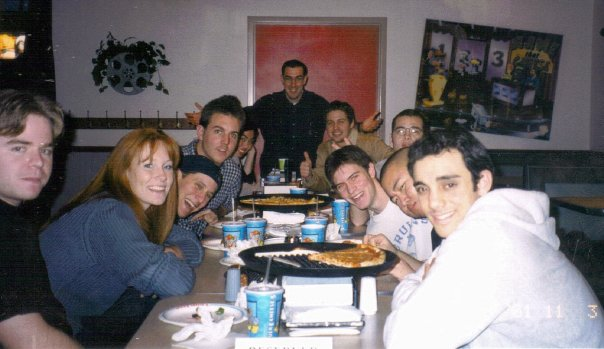
A few things literally saved my life in high school; playing roller hockey with my brother in the cul-de-sac, my love of computer games, and the big group of theatre nerds I found in sophomore year.
I finally started finding myself during my junior year. My brother moved to San Diego for college and I became more active in the school theatre. I can’t say I was much of a fan of acting, but I really liked to sing, and enjoyed doing the school musicals the most. I never had any big roles, but I thrived in the company, doing bit parts here and there. I worked tech, did box office, learned some construction skills, and was part of something created by a community. It felt like where I was supposed to be.
Eating some pizza, rocking that sweet backwards ball cap.
When you have a friend group that you feel comfortable with and trust, you tend to branch out and take more social risks. Around junior year I was introduced to tabletop roleplaying games. What a shock that a bunch of thespians would enjoy role-playing games! My earliest memories are of playing a Glitter Boy in the game Rifts, a crazy RPG that had a little bit of everything. I had no idea what I was doing, didn’t know any of the rules, but I had a giant gun that went Boom. It was amazing.
Where do I park this thing?
Playing these games with my friends, working on shows, and playing hockey got me through high school.
During my Community College years my friend Dave invited me to play in a weekly game of 3rd Edition Dungeons & Dragons. He was living in a house with three roommates and one of them, Dan, ran a game. I lived for those weekend games. I got better at school, learned how to work hard at my warehouse job lifting boxes of jigsaw puzzles, and made up crazy stories with my friends involving wizards, Drow, Illithid, and Dave’s crazy rogue.
At some point our weekly game ended. I honestly don’t remember why.
I graduated from Chapman University, earned my teaching credential, got my first big boy job, and life got way more serious. It would be about 15 years until I played D&D again.
Kevin was a 7th grade boy with a giant smile, a big laugh, and an even bigger heart. He was assigned to my Advisement class in 2006 and was also in my Intro to Pre-Algebra class. His mom had requested he have a male Advisement teacher and some strong male teacher figures, since his father had died the year before when Kevin was in 6th grade. I had played roller hockey with his father on occasion, so I recognized the last name when I looked at my rosters before school began. Knowing what he had gone through, I made it a mission of mine to be the best role model I could be for him.
Surfing at San Onofre.
During our two years together I coached him in roller hockey and helped with his struggles and challenges with ADHD. I watched him play drums in the school band, and learned of his love of music, drawing, snowboarding, and CARS! Kevin loved cars! All the cars.
He made great progress in middle school, and I felt good knowing that I had done my best to send him off to high school with the skills and confidence he needed.
As he entered high school, his mom asked if I could continue tutoring and mentoring him, which I gladly did. He continued playing roller hockey for the high school, as well as wrestled and played lacrosse. He qualified for the CIF wrestling tournament freshman year and I went to his first match in which he got pinned in under 30 seconds and left with a broken nose.
School was very hard for Kevin, which I really understood. We had some of the same struggles, so I felt like I understood him pretty well. By junior year things were not going well for him academically, so his mom decided he would attend a military academy. They provided way more structure and routine, and it was a good place for him to be. I did my best to mentor him from afar, but life got in the way and we didn’t communicate as much.
Kevin graduated high school and eventually moved to Colorado to pursue work in the automotive field. He always wanted to work on cars, and I was happy to see that he was pursuing his passion. We lost touch for a while. Then in 2015 I got a message from him saying he was back in SoCal and was looking to start playing hockey again. I jumped at the chance to get him on my adult league roller hockey team and we finally got the opportunity to play competitive hockey together.
Once a week we would lace up the skates, play on the same line and always try to get each other to score, then talk for a while in the parking lot about life. He would talk about his girlfriend, wanting to go to automotive school, and his motorcycle. I tried to teach him about budgeting, long-term investing, and why he should stop getting so many dang tattoos.
On Sunday May 17th, 2015, Kevin Michael Corey was killed while riding his motorcycle, about a month before his 21st birthday.
I was told the news on Monday morning during the ten minute snack break at school by a colleague who saw the news on Facebook.
I’ve never known a deeper pain in all of my life. An immense wave of depression, anxiety, and sorrow instantly overwhelmed me, and persisted for months. Kevin was not my child, but he was my kid. I knew him better than any student I had ever known, and his passing left a deep void in my heart.
We held a memorial for Kevin at the center of the roller hockey rink. I gave the eulogy. I hugged his family, friends, and former students.
And then I was just…empty.
I don’t remember the rest of that school year. I struggled to go to work each day. I tried to be fake happy with my students, but I wasn’t fooling anyone. I was a zombie around campus, and I couldn’t wait for summer to start so I didn’t have to be an adult for a while.
When summer did begin, things got worse. I was alone and grieving. I had no motivation to do anything and spent weeks just watching TV, playing computer games, and sleeping. It was the darkest point in my life. Until it wasn’t.
One day in July of 2015 during a mindless computer game binge I decided to play some YouTube videos in a background browser window. The autoplay feature was on and I was watching videos about board games (another passion of mine) on the Geek & Sundry channel. After a while a new video began playing that was about Dungeons & Dragons. The man in the video had a nice voice and was talking about this new show they were going to try where a bunch of nerdy voice actors would sit around and play D&D. This caught my attention. I used to love playing D&D! What is this show?
The video was 3 hours long, and I devoured the whole thing in one sitting. It was the first bit of enjoyment I felt in months. I checked the channel and found a few other episodes had been uploaded, and I watched them all in a day. It was the first time in months where I went over an hour not replaying Kevin’s death in my mind. It was such a relief.
The show was called Critical Role, and during each episode they talked about streaming their show every Thursday night on Twitch. I had never heard of that, so I quickly navigated to the site and learned it was a streaming platform for video gamers. I found the concept strange, as I would much rather play a video game than watch someone else do it. But they had other shows, and Critical Role was one of them.
And so I tuned in the next Thursday night at 7pm Pacific and watched a live stream of a bunch of friends playing Dungeons & Dragons in real-time. The episode was 4.5 hours long and it flew by. I was fully immersed in the world of Exandria created by Matthew Mercer, and was provided a brief respite from my grief. They ended the episode with a small catch phrase of “Is It Thursday Yet?”, a small nod to the fact that all of the players in the game would constantly ask if it was Thursday yet, because they loved playing D&D with each other so much.
This phrase quickly became my mantra. Every day of the week was a struggle to get through, but no matter how bad I felt I just reminded myself that another episode of Critical Role was just a few days away. Just make it to Thursday.
This went on for most of the summer, and through the next school year.
Just make it to Thursday.
I made it to Thursday.
Just make it to Thursday.
Is it Thursday yet?
At some point I realized that when I thought about Kevin I didn’t feel sadness or despair anymore, but joy in having known him. Literally every memory I have of him is a happy one, and every time I picture him in my mind he is smiling. It took almost a year to get to that point, but I finally did.
Thanks to a group of nerdy-ass voice actors who gave me a reason to keep going, find joy in my friends, and take time every day to play and imagine and wonder.
When Covid-19 forced us to close down the schools and teach from home I had a lot of free time on my hands. Separated from the people I cared about, I looked for ways to connect. Playing board games around a table was not a possibility, so I searched for ways to connect online. I quickly found a D&D group run by a great DM named Tim through the Roll20 website and began playing over voice chat every Saturday. Playing by voice only was difficult, since I couldn’t read the body language and facial expressions of my fellow party members. There was a lot of cross talk, interrupted speech, and misunderstandings at first. I adapted, however, and quickly started to look forward to my weekly games with my new friends from Seattle, Florida, and South America. Critical Role was on hiatus, so “Is It Thursday Yet?” became “Is It Saturday Yet?”.
In my time between games I began re-watching all of campaign 1 of Critical Role, as every episode was on YouTube, and it was a great thing to have on in the background. I created new digital math lessons with Scanlan, Percy, and Pike having adventures in the background. A small bit of comfort to help me pass the time.
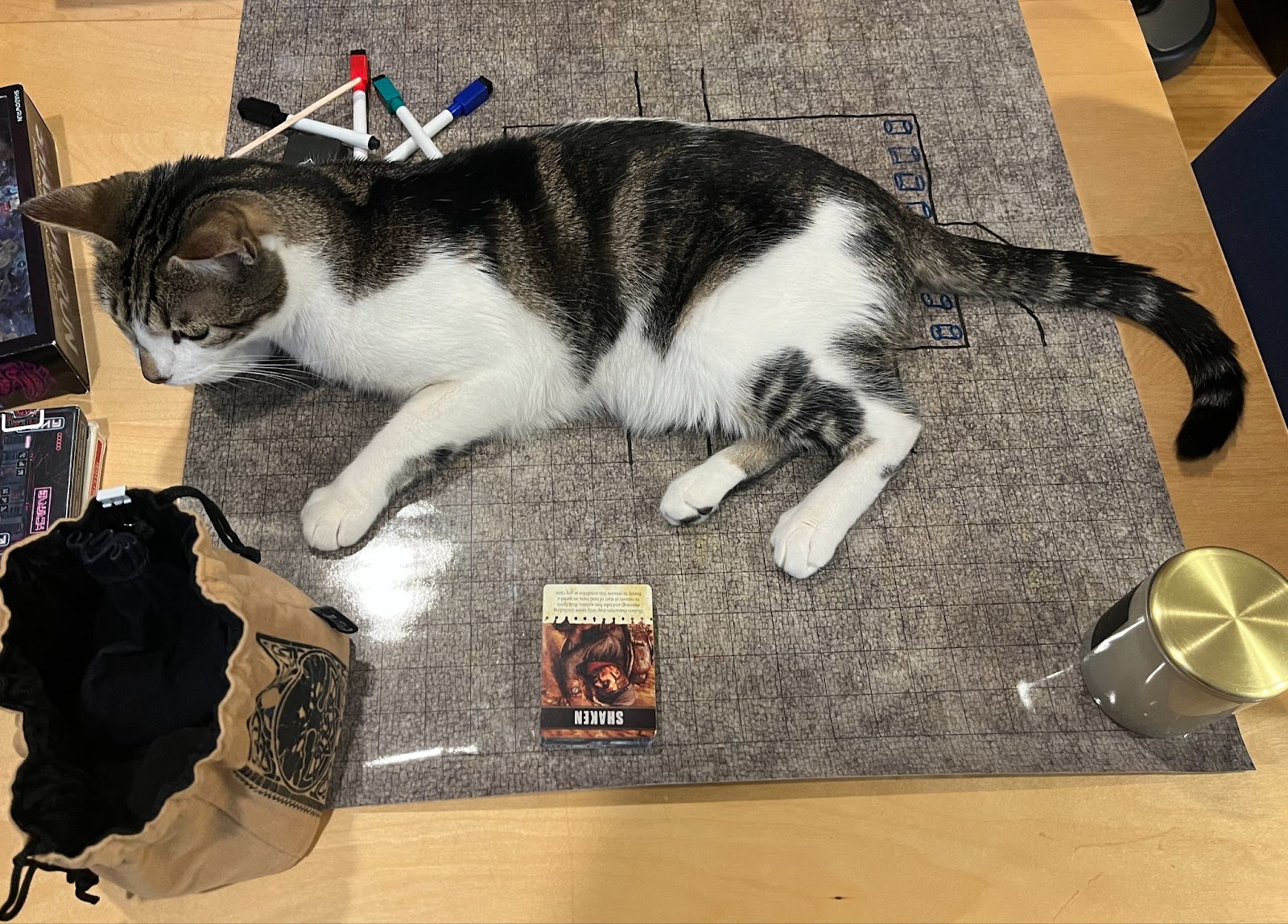
The Covid crisis subsided, I got back into the classroom, and I started longing for my high school days of D&D. 8 hours of gaming with good friends and terrible snacks. As luck would have it, I received a text message in early 2022 from my friend Paul about joining his Shadowrun RPG group now that everyone was vaccinated and things were a bit safer. I jumped at the chance to be at the table again, and soon I was learning a whole new gaming system with my old high school friends Justin & Paul, and my new friends Keith and Greg every Friday night. Even Puck gets into the action, whether we want him to or not.
Puck loves dice.
Is It Friday Yet?
I now run the Dungeons & Dragons club at school. Last year we had about 20 students show up to the club regularly, and they quickly formed playing groups. I noticed that four students kept coming to club, but didn’t join any groups to play. They wanted to learn, but didn’t really know how to begin. So I decided to run a game for them, the first time I ever took on the role of “Dungeon Master”. It was really scary. It was really fun. Now I know why Matthew Mercer always looks like he is having the time of his life every time he guides his friends through another adventure.
This year I have about 25 kids regularly come to club, and I’m running a game with 3 new students and one holdover from last year (the other three promoted to high school). Every Wednesday when the lunch bell rings I have students seemingly apparate at my door, trying to get into the room and tell stories with their friends for as much time as possible.
I love seeing the joy and surprise on their faces when the dice roll great, or horribly, and we describe together what happens to their make-believe heroes. One of my players is so invested in the game that he frequently seeks me out during break or lunch time on other days of the week to ask questions about spells his Wizard can do and what stat he should level up next. He bought a player’s handbook and brings it to school every day.
Dungeons & Dragons is not magic, and doesn’t cure depression. Rifts isn’t going to solve all of your problems, nor is Shadowrun the answer to life’s deep questions. These games are merely a mechanism for getting people into a room together to make-believe and tell stories. They provide a safe place and the structure to be your weird, quirky self, and allow you the space to bond with your friends over something that only you few will ever feel is real. I still vividly recall my friend Justin rolling a natural 20 in the most impossible scenario 25 years ago and all of us screaming wildly at 1 AM. It’s all imaginary, but it’s so very real. Those memories are something I will always share with my friends, and are some of the most cherished times of my life.
I know that I will never be friends with the cast of Critical Role. I will never sit at a table gaming with them into the wee hours of the night. Even so, I still feel a debt of gratitude to them for helping me through the darkest time in my life. Their decision to share their beloved home game of Dungeons & Dragons with the world provided me comfort and relief at a time when I needed it the most.
I still miss Kevin every day. Some days it’s a fleeting thought. A flash of his smile and the sound of his laugh. Other times I’m sad for the life I never got to see come to fruition. I imagine him working on cars all day, then meeting me at the rink for some pickup hockey and talking about life. He would show me his newest tattoo, and I’d shake my head disapprovingly, mostly in jest.
I rarely make deep connections with students in the same way anymore, mostly as a defense mechanism to guard against feeling the same sorrow ever again. It’s not logical, but it’s what I do. The best I can do now is open my classroom every Wednesday at lunch and provide some of the most vulnerable and marginalized students at school a safe place to be their weird selves. In a small way my room is their Critical Role, and I’m happy to provide them that safe place of comfort and joy. I hope Kevin would be proud.
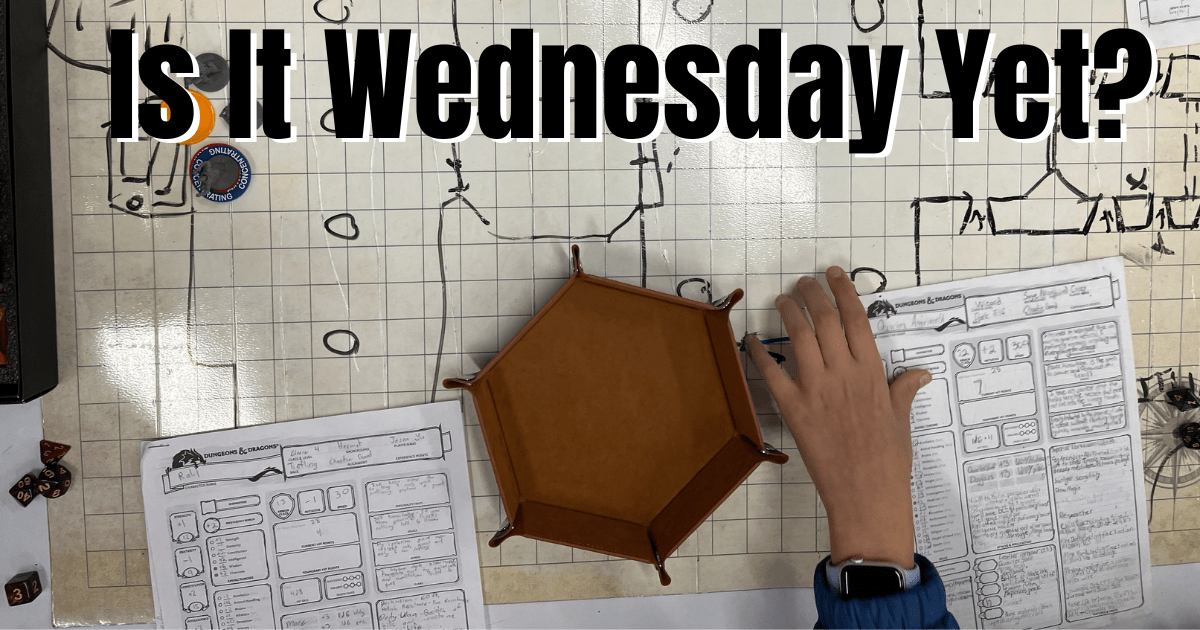
Is It Wednesday Yet?
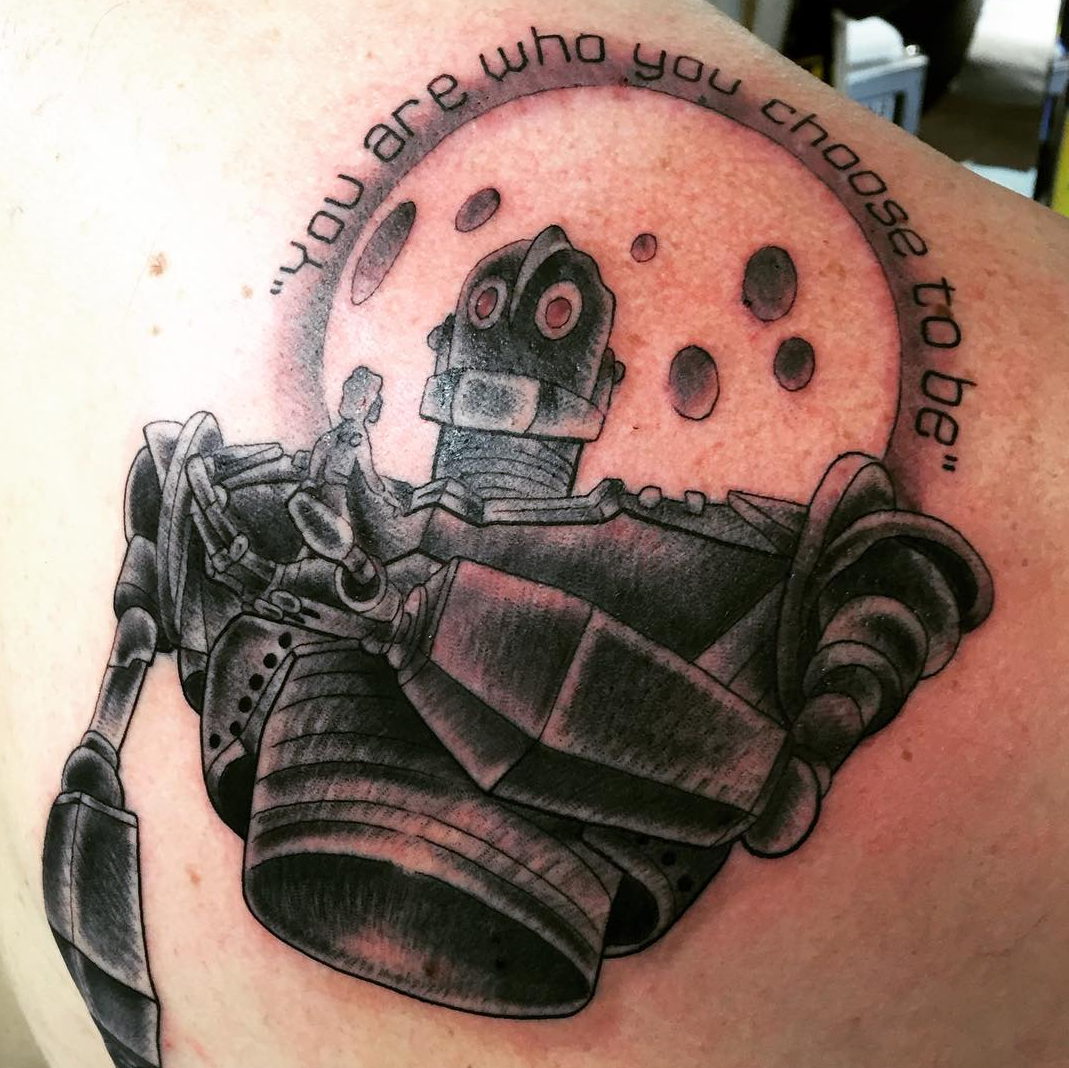
P.S. – I got the first and only tattoo of my life a year after Kevin died. It is a memorial to him and the joy he brought to me. I think he would like it.
After a year of listening, here are my favorite podcasts about teaching.
Anyone who knows me can tell you that I love a good podcast. I listen to them during my morning routine getting ready for work, while I’m exercising, and before I go to sleep. It’s gotten to the point where if I need to walk into another room in my house to get something, I turn on a podcast through my phone speakers during the 5-10 seconds I am traveling to the other room. I’m not sure how much I get out of the few seconds, but it’s a habit of mine now.
Most of the shows I listen to are about politics, financial literacy, science related topics, or actual play RPG shows like Worlds Beyond Number. This past year however I delved into the world of podcasts focused on the teaching profession, mainly because I needed more help and guidance to implement the Building Thinking Classrooms model of instruction into my class. As any podcast fan is probably aware, once you find one good pod, many more tend to find their way into your feed.
After a year of listening, here are my favorite podcasts about teaching.
This podcast’s goal is to help listeners, and the hosts, implement Building Thinking Classrooms the best way possible in their own classrooms. Many of the episodes delve into each chapter of the book, much as I have started to do in my own BTC section of my website, helping break down the most important takeaways and strategies that we could be using. They also interview various experts and classroom teachers to see how it is going for them, and what adjustments they have made along the way. Episode 5 is a highlight, as the hosts interview the author Peter Liljedahl. If you are attempting to teach using this model, I highly recommend listening to every episode.
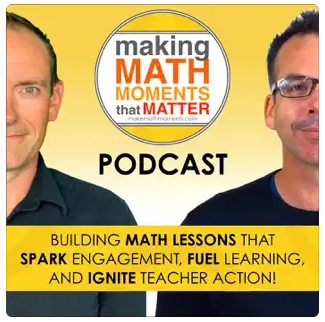
I’m a math teacher, and I need all the help that I can get. Hosts Kyle Pearce & Jon Orr are passionate educators who truly love teaching math, and want all of their students to succeed and feel the same way that they do about the big world of numbers. Since 2018 they have been interviewing innovators in the math teaching field, as well as experts in brain research and how kids learn math. This was the first teaching podcast that I ever found, and I love when my feed pops up with a new episode because I know for sure that I will learn something new that I can apply with my students almost instantly. If you are a math teacher, you need to listen to this podcast.
Last year the math team at my school switched to using Standards Based Grading over the traditional points/percentage based system we had always used in the past. It was not a very smooth transition, for myself or my students. Over the summer I looked for help in understanding how to better implement the system, and more knowledge about why it was more beneficial so that I could be better prepared for all of the questions I would get from students and parents alike. This podcast has really helped me understand why what I am doing is better for students, and how to implement it more effectively. I really resonated with the first few episodes where the hosts Sharona Krinsky and Robert Bosley talked about their own struggles and failures when putting this into place in the high school and college setting. A must listen for any teacher using Standards Based Grading, or is interested in doing so.
So, teaching during the pandemic was really hard. Many teachers decided to leave the profession during that time. Not gonna lie, I thought about it as well. Frazz & Redacted host a show where former teachers talk about why they quit their job, or reasons that make current teachers want to. While the hosts Frazz and Ms. Redacted have TikTok fame, I don’t use that platform, so I only stumbled upon them from an ad from a different podcast. While I never quit teaching (or at least haven’t done so yet) I think my favorite thing about this podcast is the catharsis I feel when listening to other teachers who simply had enough and decided to walk away. If you have taught for more than 5 years I bet you have had that feeling at least once. Probably the best thing I get out of listening is hearing about how poorly teachers are treated in other parts of the country, which really helps me appreciate how amazing my school and school district actually is. A huge dose of perspective when I’m having a bad day.
So that’s my list for 2023. What did I miss? Which teaching podcasts do you find value in that I could start listening to? Please let me know in the comments section below, and let’s find more great resources in 2024.









 +
+










 EZMath Blog